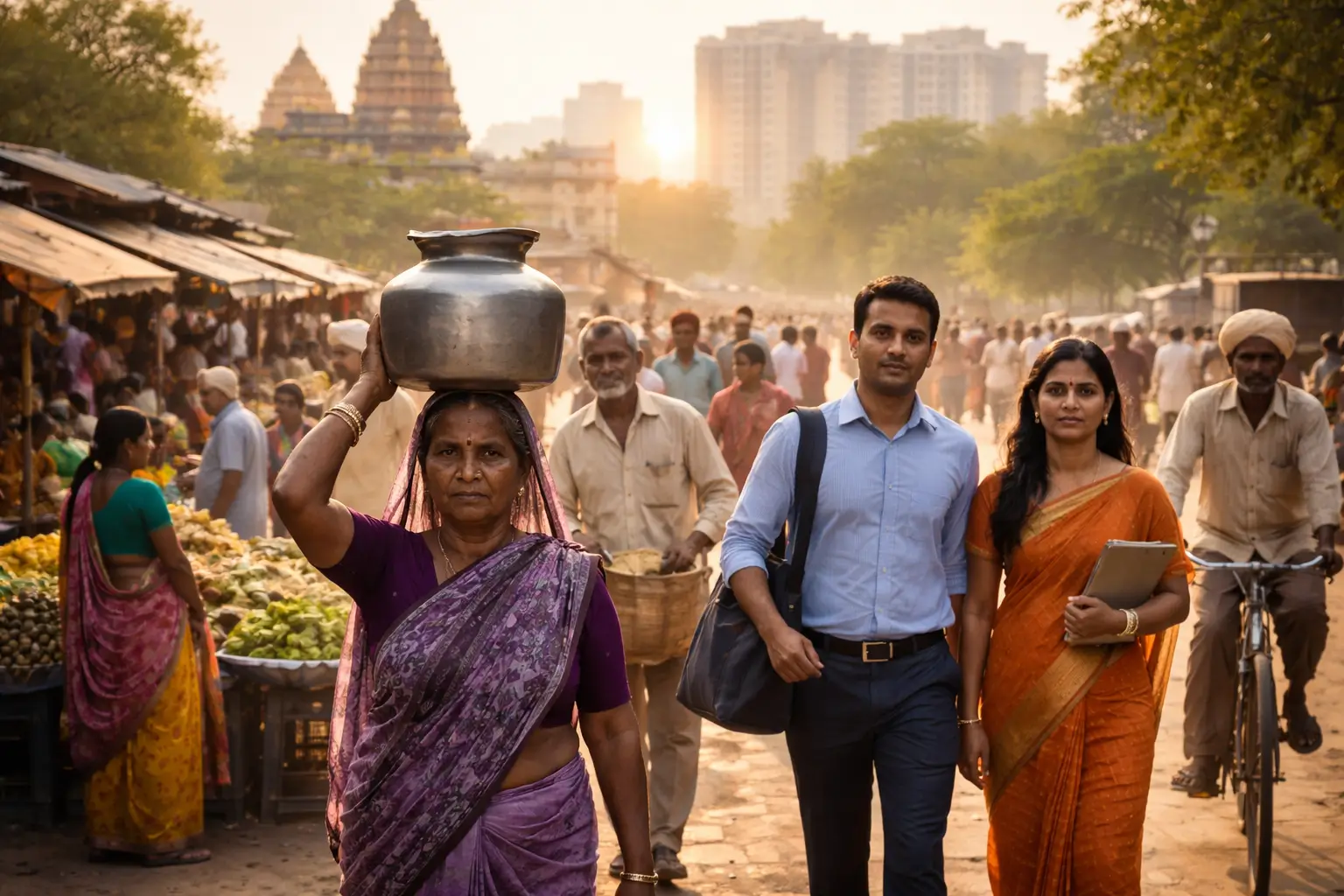
The caste system in India continues to matter because it still shapes access to opportunity, social identity, and power—despite constitutional equality and decades of reform. For many people, caste influences education, employment, marriage, politics, and everyday social interactions. Understanding why it persists requires looking at how it originated, how it adapted to modern institutions, and how it operates today beyond formal law.
What the caste system in India actually is today
In contemporary India, caste is not a single rigid hierarchy enforced uniformly across the country. It functions as a social classification system that:
- Assigns individuals to groups by birth
- Shapes social networks and marriage choices
- Influences access to land, education, and employment
- Intersects with religion, region, and class
Legally, caste-based discrimination is prohibited. Socially, caste continues to operate through informal norms, community enforcement, and inherited advantage or disadvantage.
Origin of caste system in India: why it became embedded
The origin of caste system in India lies in a long historical process rather than a single text or moment.
Early social classification
- Ancient Indian society organized work and roles through occupational groupings.
- Over time, these roles became hereditary and socially ranked.
- Religious texts later reflected and reinforced these divisions rather than creating them from scratch.
From fluid roles to rigid identities
What began as relatively flexible social roles gradually hardened due to:
- Inheritance of occupation and status
- Control over land and resources by dominant groups
- Social exclusion of communities labeled as “polluting”
This transformation made caste a system of social control, not just division of labor.
Why the caste system in India survived legal abolition
India’s Constitution abolished “untouchability” and outlawed caste discrimination. Yet the system remains socially influential because law alone cannot dismantle deeply embedded social structures.
Social enforcement over legal rules
Caste norms persist through:
- Family expectations and community pressure
- Informal sanctions such as exclusion or violence
- Social rewards for conformity, especially in marriage
These forces often operate outside the reach of formal law.
Unequal starting points
Centuries of caste hierarchy created unequal access to:
- Education
- Property and land ownership
- Political representation
Even when legal equality exists, these historical imbalances continue to affect outcomes.
How caste still shapes daily life
For many Indians, caste is not an abstract concept but a lived reality.
Education and employment
- Access to quality schooling often varies by caste-linked geography.
- Professional networks frequently form within caste groups.
- Hiring bias, though illegal, still occurs informally.
Marriage and family life
- Most marriages remain caste-endogamous.
- Inter-caste marriages can lead to social ostracism or violence.
- Family honor is often tied to maintaining caste boundaries.
Housing and social interaction
- Residential segregation by caste exists in both rural and urban areas.
- Social mixing across caste lines may remain limited.
- Everyday practices—who eats with whom, who enters which spaces—can still be caste-coded.
Economic change did not erase caste
Economic growth and urbanization were expected to weaken caste. Instead, caste adapted.
Caste as social capital
In cities, caste often functions as:
- A networking tool for jobs and business
- A trust-based system for migration and housing
- A support structure in the absence of state welfare
Rather than disappearing, caste shifted from ritual hierarchy to economic advantage.
Persistence across classes
Caste affects both:
- Marginalized communities facing exclusion
- Privileged groups maintaining inherited advantages
Wealth reduces vulnerability but does not eliminate caste identity.
Caste and politics: why it remains influential
Caste matters politically because it shapes voting behavior, leadership, and policy priorities.
Representation and mobilization
- Political parties mobilize voters along caste lines.
- Caste-based organizations negotiate power and resources.
- Representation has increased for some groups but remains uneven.
Policy responses
Affirmative action policies exist to correct historical injustice. These policies:
- Acknowledge caste as a lived social reality
- Generate debate about fairness and merit
- Reinforce caste categories even as they aim to reduce inequality
This creates a paradox where caste is challenged and reaffirmed simultaneously.
Why caste is not just a rural or “old” problem
A common misconception is that caste survives only in villages or among older generations.
Urban and professional spaces
- Caste-based preferences influence hiring and promotion.
- Elite institutions are not immune to informal exclusion.
- Digital platforms sometimes replicate caste filtering in new forms.
Cultural transmission
Caste persists because it is taught and normalized:
- Through family upbringing
- Through marriage expectations
- Through social silence rather than open endorsement
Avoiding discussion often allows caste norms to continue unchallenged.
Why the caste system in India still matters globally
Caste is no longer confined within national borders.
- Migration has carried caste identities abroad.
- Diaspora communities often reproduce caste networks.
- International institutions increasingly recognize caste-based discrimination.
This global dimension reinforces why caste remains socially relevant rather than historically obsolete.
What actually weakens caste influence
Evidence shows caste influence declines not through denial but through structural change.
Factors that reduce caste dependence
- Universal access to quality education
- Economic security independent of community networks
- Social mobility through mixed housing and schooling
- Enforcement of anti-discrimination laws
Where these conditions exist, caste matters less—not because it disappears, but because it loses power.
Why understanding caste still matters
The caste system in India matters today because it explains:
- Persistent inequality despite legal equality
- Social tensions around identity and reform
- Why economic growth alone does not ensure social justice
Ignoring caste does not make it disappear. Understanding how it functions in modern life is essential to understanding Indian society itself.