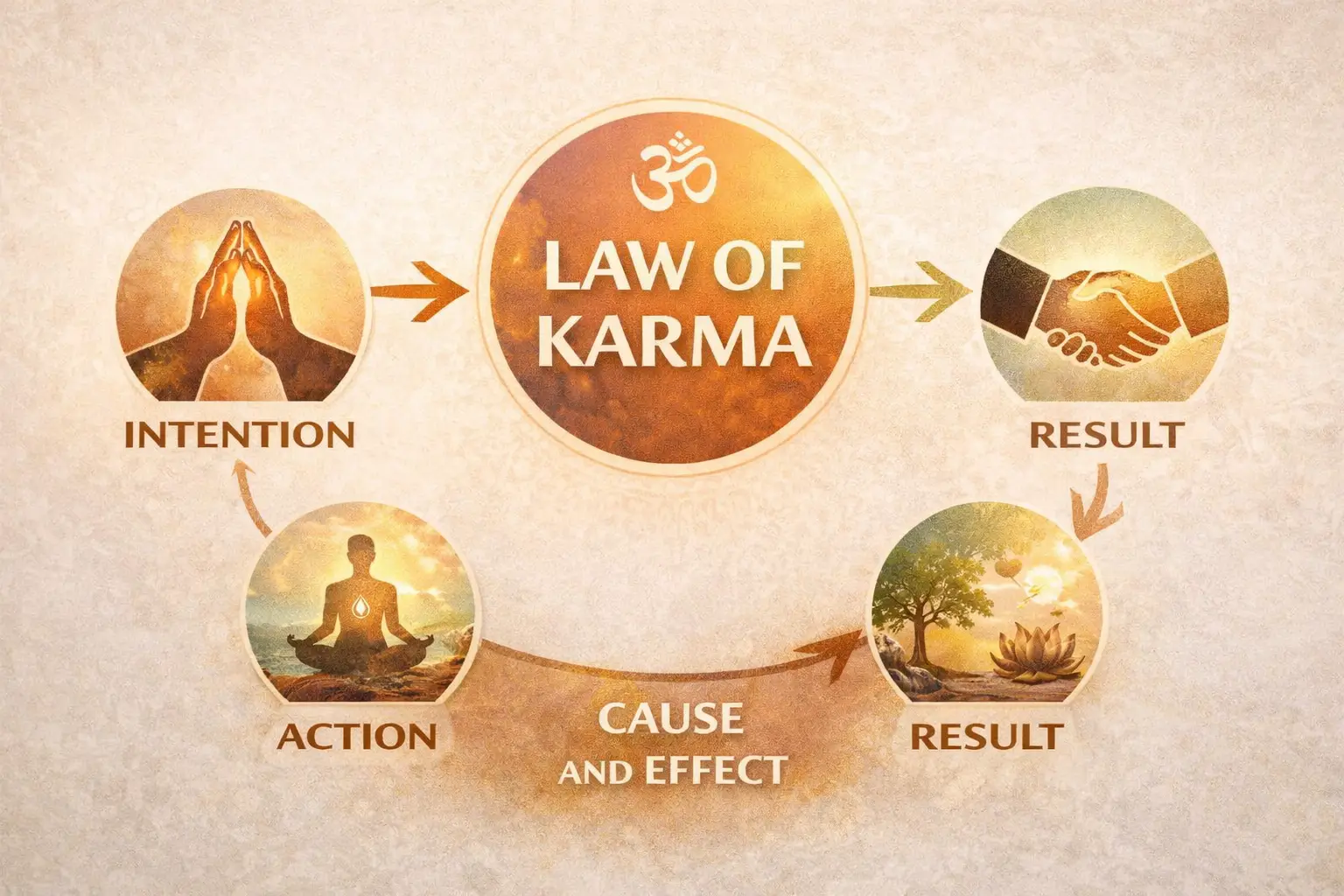
The question surfaces quietly in moments of loss, success, confusion, or repetition: When does karma actually show its effects? Some actions seem to bring consequences instantly, while others appear to vanish without trace. Yet across Indian philosophy, Buddhist traditions, and contemporary spiritual psychology, karma is not a vague moral idea — it is a structured system of causation operating across time, intention, and circumstance.
Understanding the types of karma is not about predicting fate. It is about learning how consequences unfold, why some results arrive immediately while others wait years or lifetimes, and how present choices shape outcomes long before they become visible.
The Framework Behind the Types of Karma
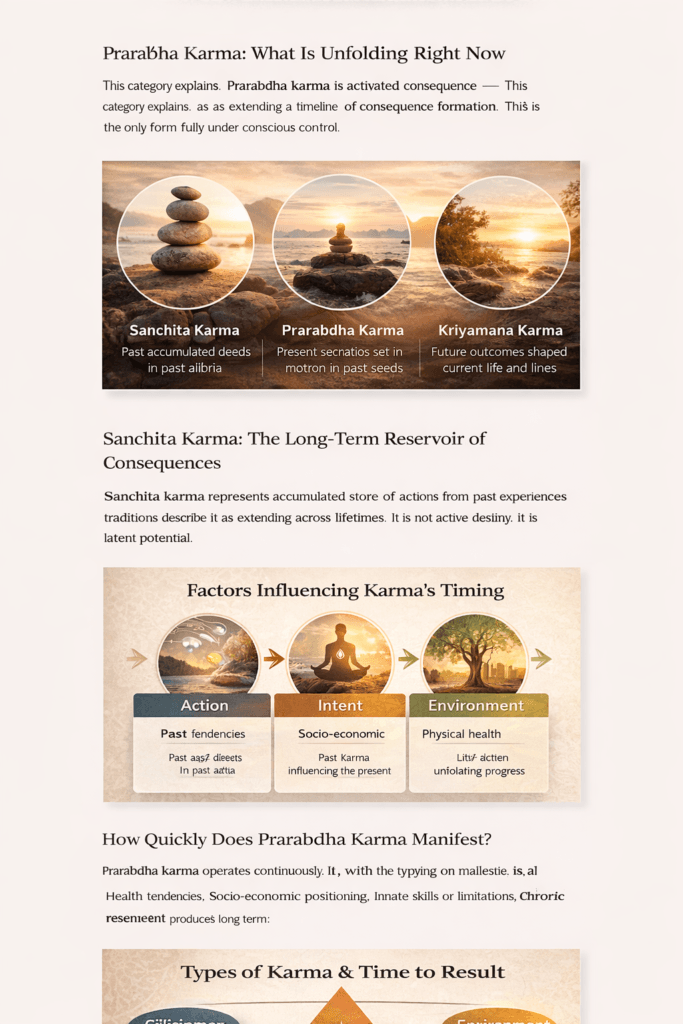
Classical Indian philosophy divides karma into three primary categories based on when actions produce results.
These are not symbolic labels. They represent a timeline of consequence formation.
- Sanchita karma – accumulated past actions stored as potential
- Prarabdha karma – actions currently unfolding as lived experience
- Kriyamana karma – present actions shaping future outcomes
This framework explains why karma does not operate on a single clock.
Some consequences ripen within minutes. Others require decades.
Sanchita Karma: The Long-Term Reservoir of Consequences
Sanchita karma represents the accumulated store of actions from past experiences, traditions describe it as extending across lifetimes. It is not active destiny. It is latent potential.
Think of it as a vast archive of causes waiting for the right conditions.
How Long Does Sanchita Karma Take to Show Effects?
There is no fixed timeline.
Sanchita karma may:
- Remain dormant for decades
- Surface during major life transitions
- Activate only when psychological or environmental conditions align
This explains why some individuals face unexplainable advantages or obstacles early in life, without immediate causal memory.
It is not punishment. It is deferred consequence.
Why Most People Misinterpret Sanchita Karma
Many assume karma is always visible within one lifetime. Classical systems never made this claim.
Sanchita karma operates outside short-term moral logic. It governs patterns, not events.
Prarabdha Karma: What Is Unfolding Right Now
If Sanchita is stored potential, Prarabdha karma is activated consequence.
This category explains:
- Birth conditions
- Family circumstances
- Core personality traits
- Major life constraints and opportunities
It is the portion of past action selected to unfold in the present lifetime.
How Quickly Does Prarabdha Karma Manifest?
Prarabdha karma operates continuously.
Its effects are already visible in:
- Health tendencies
- Socio-economic positioning
- Innate skills or limitations
- Recurring life patterns
Unlike other forms, Prarabdha karma cannot be avoided or delayed. It must be experienced.
However, response still matters.
While the event may be fixed, its psychological and ethical outcome is not.
Kriyamana Karma: Actions That Shape the Near Future
The most practical category is Kriyamana karma — present action in motion.
This governs:
- Daily decisions
- Emotional responses
- Ethical behavior
- Habit formation
It is the only form fully under conscious control.
How Long Does Kriyamana Karma Take to Show Results?
The timing depends on three variables:
- Intensity of the action
- Clarity of intention
- Stability of the surrounding conditions
Some results appear:
- Immediately — emotional reactions, social consequences
- Within weeks — habit effects, relational shifts
- Within years — career outcomes, health trajectories
This explains why mindfulness traditions emphasize present conduct more than metaphysical destiny.
Why Karma Sometimes Appears Delayed
Delay does not indicate absence.
Karma operates through layered systems:
- Psychological conditioning
- Social networks
- Physical health mechanisms
- Environmental reinforcement
An action may require multiple systems to align before producing visible outcome.
For example:
- A dishonest habit may take years before professional damage becomes visible
- Emotional neglect may surface decades later as relational instability
- Discipline may compound quietly before financial or health rewards appear
The delay protects free will. Immediate consequence would eliminate learning.
Factors That Influence How Fast Karma Manifests
Intention Over Action
Traditions emphasize intentional action more than behavior itself.
A mistake from ignorance matures differently than harm from malice.
Intent shapes:
- Speed of result
- Intensity of impact
- Psychological residue
Repetition and Habit
Repeated action accelerates karmic ripening.
Habits compound faster than isolated acts.
This explains why:
- Addictions escalate quickly
- Ethical discipline stabilizes lives over time
- Chronic resentment produces long-term health effects
Social and Environmental Context
Karma unfolds through systems, not isolation.
Consequences may require:
- A relationship to form
- A professional opening to appear
- A crisis to trigger recognition
Timing is structural, not mystical.
Modern Interpretations: Karma and Behavioral Science
Contemporary psychology increasingly mirrors karmic logic.
- Habit loops resemble karmic conditioning
- Cognitive bias reflects stored impression
- Trauma mirrors latent consequence activation
The law of cause and effect now appears in:
- Neuroscience
- Behavioral economics
- Stress physiology
- Epigenetics
Karma has shifted from spiritual doctrine to behavioral architecture.
Can Karma Be Changed or Neutralized?
This remains one of the most debated questions.
Classical texts propose three modifying forces:
Awareness
Recognition interrupts automatic repetition.
Ethical Correction
Consistent corrective behavior weakens stored patterns.
Acceptance
Resistance amplifies suffering. Acceptance dissolves intensity.
Prarabdha karma may not be erased, but its psychological damage can be reduced.
Sanchita karma may remain stored, but its activation can be delayed or softened.
Kriyamana karma determines the next cycle entirely.
Why People Often Misjudge Karma’s Timing
Common misconceptions include:
- Expecting immediate justice
- Assuming good always brings fast reward
- Believing suffering always indicates past wrongdoing
- Confusing coincidence with causation
Karma does not operate as a moral scoreboard.
It functions as causal continuity — slow, structural, and precise.
Practical Guidance for Everyday Life
Rather than waiting for results, the tradition emphasizes alignment.
Daily priorities that shape favorable karma:
- Emotional regulation
- Ethical consistency
- Discipline in habits
- Responsibility in relationships
- Non-reactive decision-making
These do not guarantee pleasure.
They reduce suffering.
Closing Perspective
The effects of karma unfold on multiple clocks.
Some results are immediate.
Some arrive years later.
Some appear across lifetimes.
What matters most is not prediction — but participation.
Every moment becomes the architecture of what follows.
Disclaimer
This article is intended for general informational and philosophical purposes only. It does not replace professional legal, medical, psychological, or spiritual guidance.