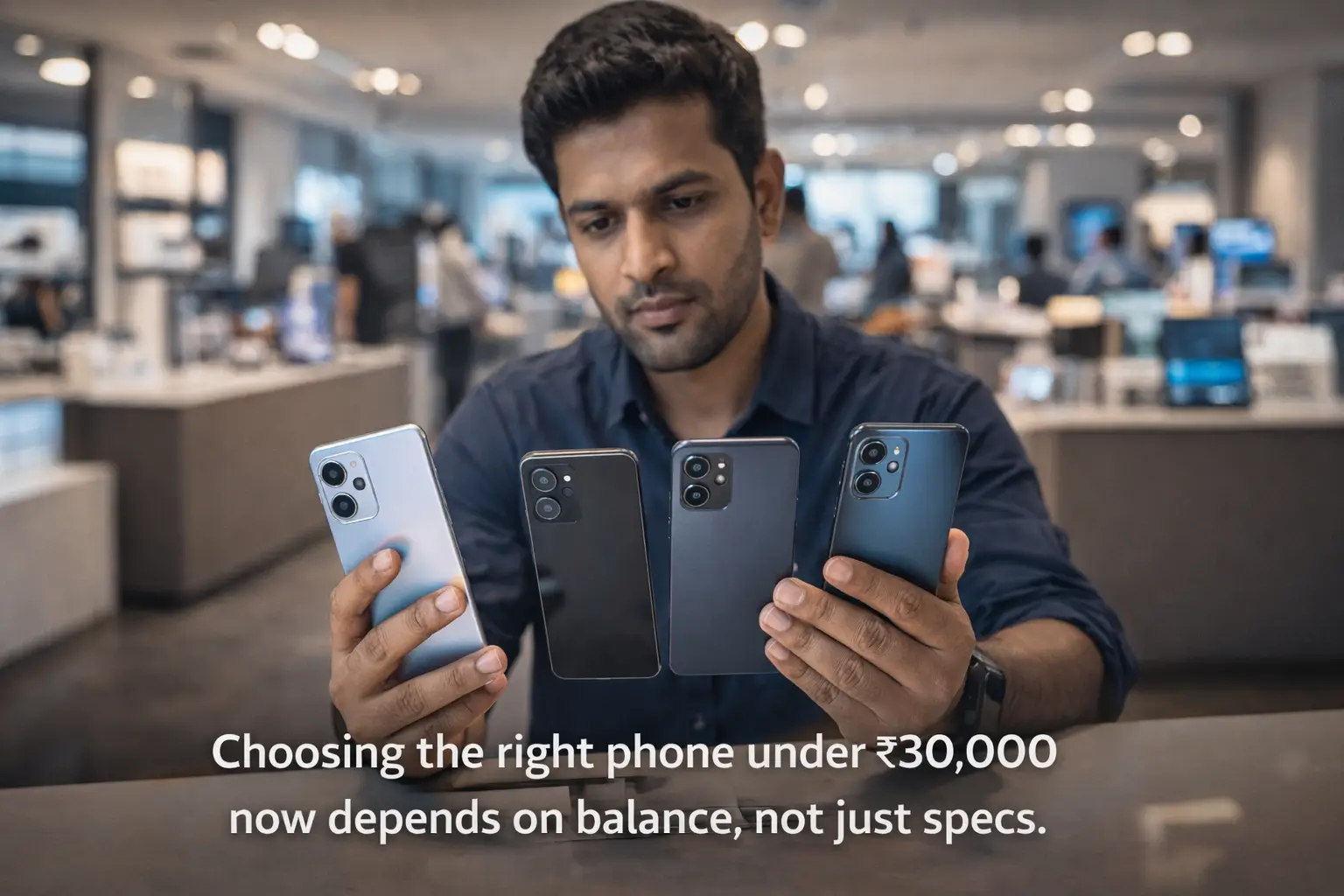
Buying a smartphone under ₹30,000 in 2026 is no longer about compromise. This price segment now hosts devices with near-flagship processors, advanced camera systems, OLED displays, long-term software promises, and credible build quality. The problem is no longer availability — it is decision clarity.
With more than twenty serious contenders in the Indian market alone, buyers face overlapping specifications, inflated marketing claims, and inconsistent long-term reliability. A wrong choice at this level is not trivial: it often means living with thermal throttling, poor update support, battery degradation, or resale loss within a year.
This guide explains how to identify the best phone under 30000 for your specific usage in 2026 — not by ranking models, but by helping you evaluate performance reality, camera truth, display quality, software reliability, and long-term ownership value.
Why ₹30,000 Has Become the Most Competitive Smartphone Segment
Until recently, the ₹20,000–₹30,000 category was a “premium mid-range” zone. In 2026, it has become the core performance segment for mainstream users.
Several market shifts explain this:
- Flagship processors from two years ago now power mid-range models
- AMOLED and LTPO displays are no longer premium-only
- 5G chipset maturity has reduced modem inefficiencies
- OEMs now promise longer software and security lifecycles
The result: phones under ₹30,000 can now deliver:
- Sustained gaming performance
- Reliable multi-camera systems
- Flagship-grade displays
- Two to four years of stable usage
The trade-offs now lie in optimization, consistency, and longevity, not raw specifications.
The First Decision That Matters: Performance or Balance
The biggest mistake buyers make in this segment is chasing benchmarks without understanding sustained performance behavior.
Modern mid-range processors fall into three broad classes:
Upper-Mid Performance Chipsets
Examples: Snapdragon 8s Gen series, Dimensity 8300-class
These offer:
- Near-flagship CPU performance
- Strong GPU for gaming
- Better camera ISP pipelines
Trade-offs:
- Higher thermal output
- Faster battery drain under load
- Heavier reliance on cooling design
Balanced Performance Chipsets
Examples: Snapdragon 7+ Gen, Dimensity 8200-class
These focus on:
- Thermal stability
- Predictable performance
- Better efficiency
Often:
- Better real-world longevity
- Fewer throttling issues
- Slightly weaker peak benchmarks
Efficiency-First Chipsets
Examples: newer 6-series or efficiency-tuned Dimensity
Best for:
- Battery-focused users
- Casual gaming
- Clean UI performance
Not ideal for:
- Heavy gaming
- Advanced photography pipelines
Editorial insight: In 2026, sustained performance matters more than peak benchmarks. Phones that throttle after 10 minutes deliver worse real-world experience than slightly slower but stable devices.
Camera Systems Under ₹30,000: Where Marketing Ends and Reality Begins
Camera quality in this segment has improved — but it remains the most misunderstood specification.
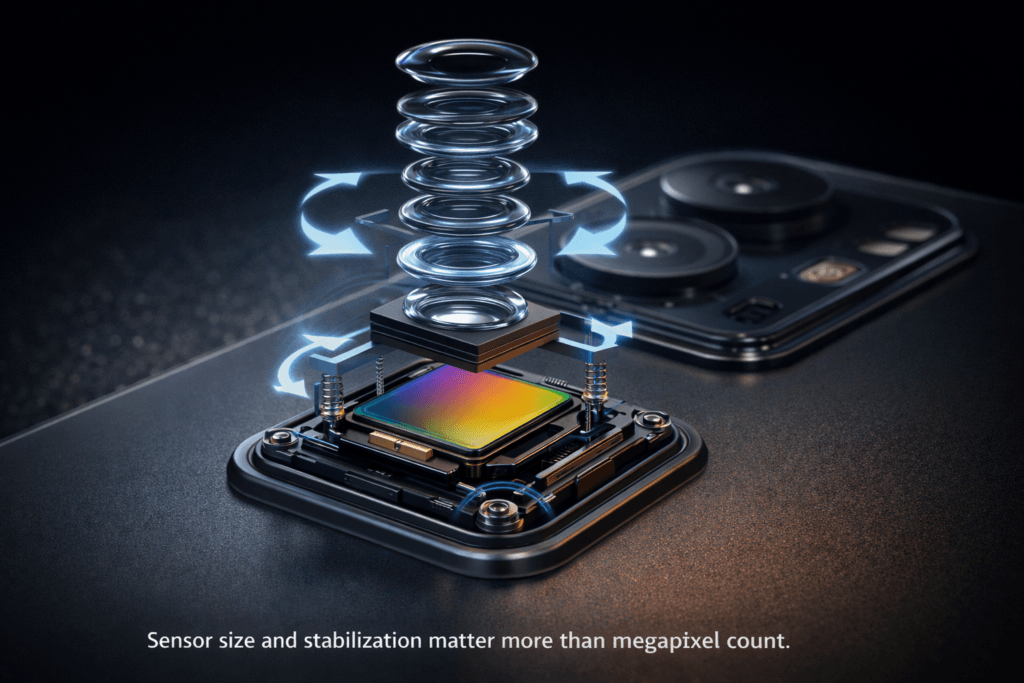
Sensor Quality Now Matters More Than Megapixels
The key indicators:
- Sensor size (1/1.3″, 1/1.5″ outperform 1/2″ sensors)
- Pixel binning quality
- ISP pipeline from the chipset
A 50MP sensor with a large sensor and good ISP will outperform a 200MP marketing sensor every time.
Optical Stabilization Is the Real Divider
In 2026, the presence of OIS (Optical Image Stabilization) is still the clearest marker of a serious camera phone under ₹30,000.
Phones without OIS typically suffer in:
- Night photography
- Video stabilization
- Indoor motion shots
Ultrawide and Telephoto Reality
Under ₹30,000:
- Ultrawide cameras are often average
- Telephoto lenses are rare and usually digital crops
Editorial rule: Buy for the main camera first. Secondary lenses in this segment are often inconsistent.
Displays: What Actually Improves Your Daily Experience
Nearly every phone under ₹30,000 now advertises AMOLED and 120Hz. The differences lie elsewhere.
Panel Quality Indicators That Matter
Look for:
- LTPO or adaptive refresh rate
- Peak sustained brightness (not marketing peak)
- PWM dimming control
- Calibration profile (sRGB / DCI-P3 accuracy)
Resolution vs Efficiency Trade-off
- 1.5K panels offer better sharpness
- FHD+ panels offer better battery efficiency
For most users:
- Good FHD+ with high brightness is superior to mediocre 1.5K
Battery and Charging: The Ownership Cost Nobody Calculates
In 2026, fast charging is everywhere — but battery longevity is now the real concern.
Silicon-Carbon Batteries Are Emerging
Some newer models now use silicon-carbon cells, offering:
- Higher density
- Slower degradation
- Better cold performance
These batteries retain capacity better after 500–800 cycles.
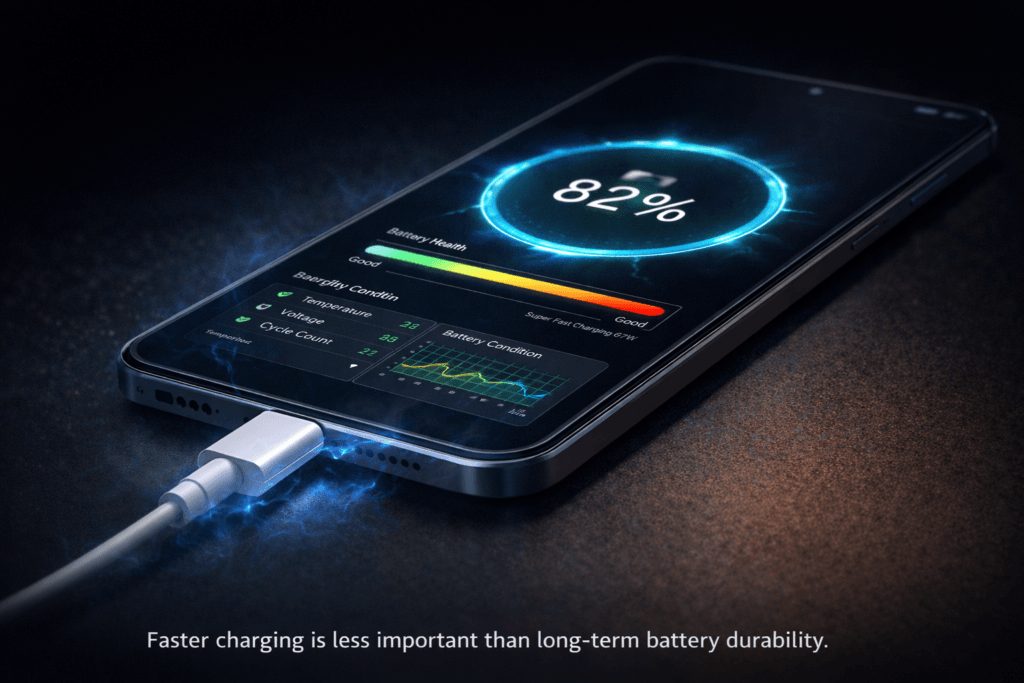
Charging Speed vs Heat Stress
- 100W+ charging increases thermal stress
- Moderate 67W–80W often offers best longevity balance
Editorial insight: A phone that charges slightly slower but degrades less is usually the better three-year device.
Software Experience: The Hidden Determinant of Long-Term Satisfaction
Hardware parity means software now defines ownership quality.
Update Policy Matters More Than UI Skins
Key indicators:
- Number of Android version updates promised
- Security patch frequency
- Track record of OEM compliance
In this segment:
- Samsung and Google lead in long-term policy
- OnePlus and Motorola vary by model
- Chinese OEMs differ sharply by region
Stability Over Features
Feature-heavy skins often introduce:
- Background drain
- Camera inconsistency
- Delayed updates
Clean or lightly optimized UIs age far better.
Build Quality and Thermal Design: Why Two Similar Phones Behave Differently
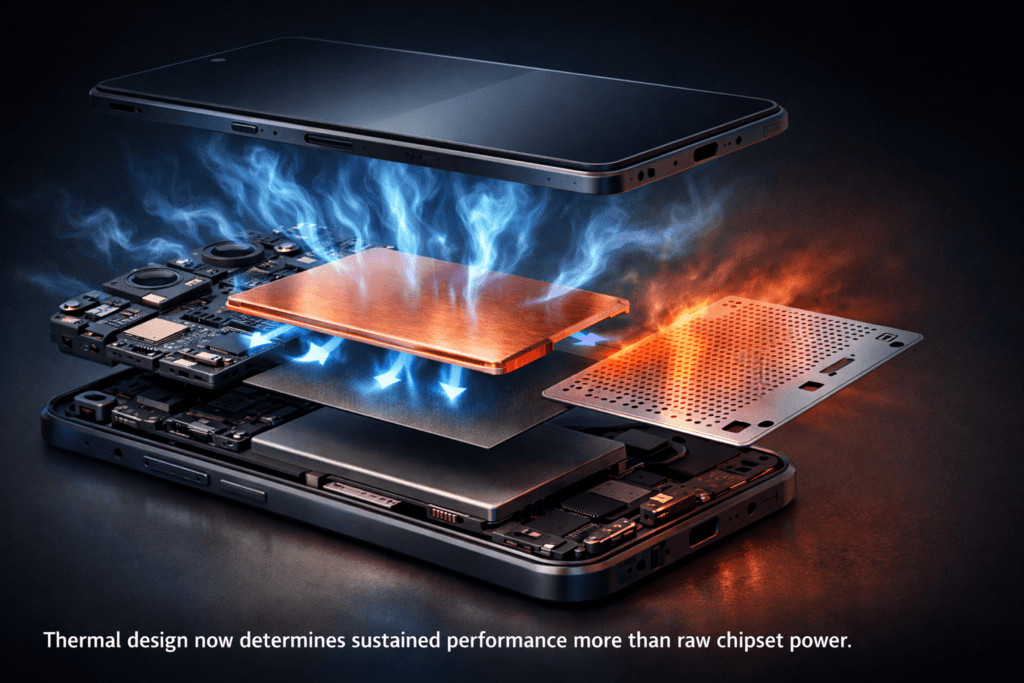
Thermal management is now decisive.
Look for:
- Vapour chamber cooling size
- Graphite layer density
- Frame material (metal frames dissipate heat better)
Phones with identical chipsets can differ by 20–30% sustained performance depending on cooling design.
5G, Connectivity, and Network Compatibility in India
By 2026, nearly all phones under ₹30,000 support:
- Dual 5G SIM
- Standalone and Non-Standalone bands
- Carrier aggregation
Important checks:
- n28 + n78 band support for India
- VoNR readiness
- Wi-Fi 6 or 6E support
Storage, RAM, and Real-World Multitasking
The practical baseline in 2026:
- 12GB RAM is now ideal for longevity
- 256GB storage recommended for three-year use
- UFS 3.1 or UFS 4.0 preferred
Avoid:
- 8GB RAM models with heavy skins
- 128GB storage if you record video regularly
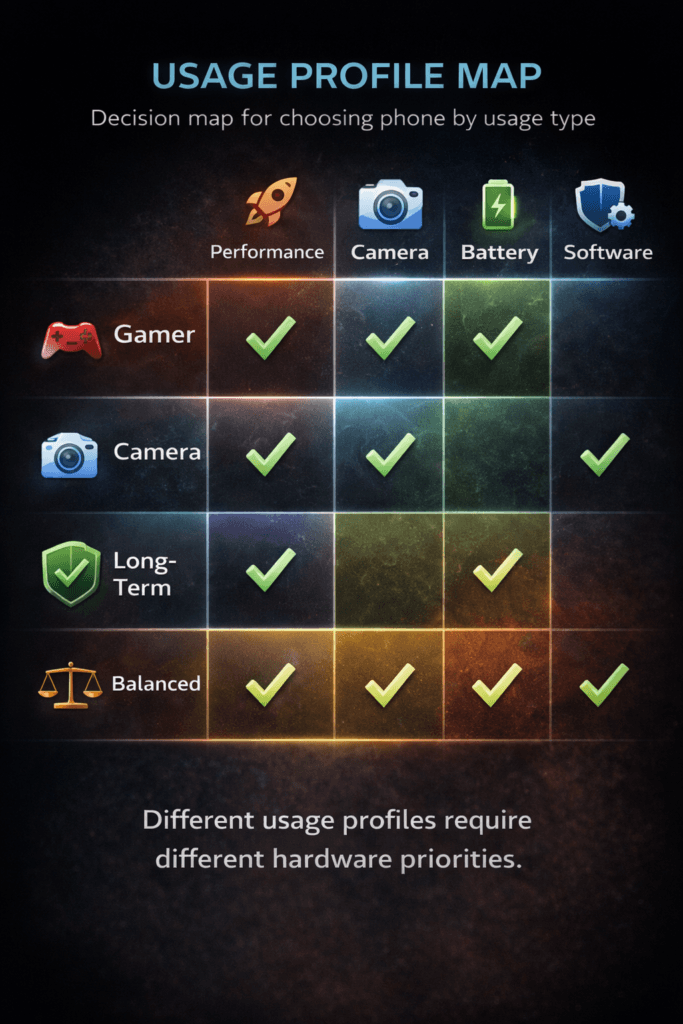
How to Choose Based on Usage Profile
Heavy Gamers
Prioritize:
- Sustained GPU performance
- Vapour chamber cooling
- Flat display for touch accuracy
Accept:
- Slight camera compromise
- Higher weight
Camera-Focused Users
Prioritize:
- OIS main camera
- Reliable ISP chipset
- Natural color science
Accept:
- Slightly weaker gaming performance
Long-Term Users (3+ years)
Prioritize:
- Update policy
- Battery chemistry
- Thermal stability
Avoid:
- First-generation chipsets
- Aggressive charging systems
General Balanced Users
Prioritize:
- Stable chipset
- Clean UI
- Balanced camera
This profile usually delivers the best ownership satisfaction.
Current Market Patterns in Early 2026
Several trends define this segment now:
- Older flagship chips outperform newer mid-range chips
- Camera processing matters more than sensor hardware
- Software policy influences resale value
- Thermal throttling is the primary performance limiter
Phones that balance chipset + cooling + software + battery consistently outperform spec-heavy but poorly optimized models.
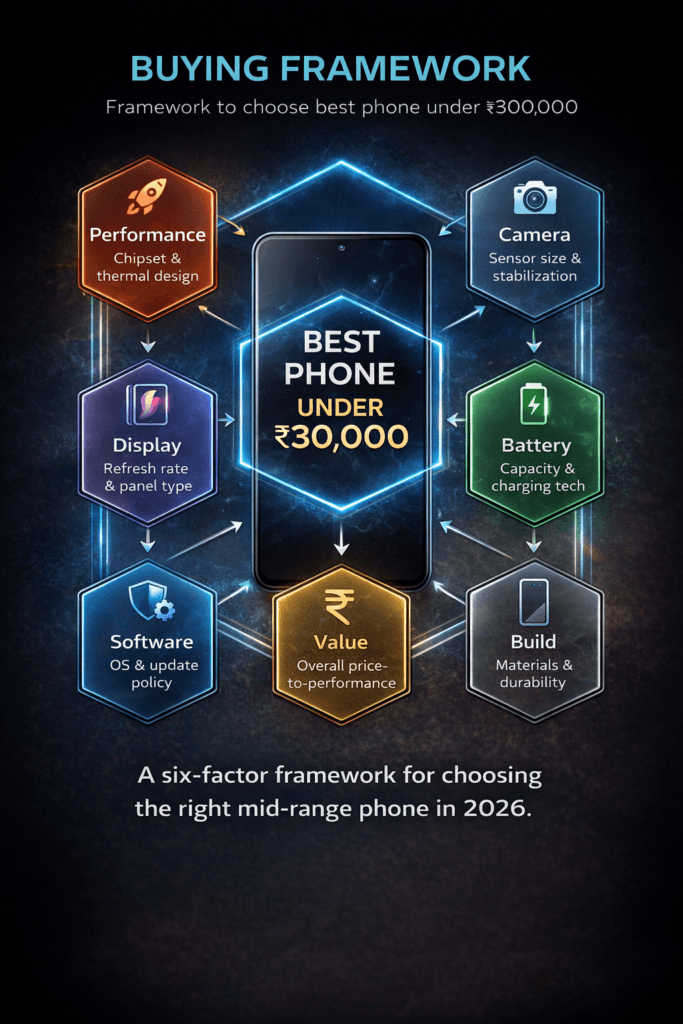
Final Buying Framework
Before finalizing any phone under ₹30,000, evaluate:
Performance
- Sustained benchmarks, not peak
- Thermal throttling behavior
Camera
- Sensor size and OIS
- Night and video performance
Display
- Brightness and calibration
- Adaptive refresh behavior
Battery
- Cell type and charging heat
- Real-world endurance
Software
- Update roadmap
- Stability reputation
Build
- Cooling system
- Frame rigidity
A phone that scores well across all six usually becomes the true best phone under 30000 for long-term ownership.
Here are compelling mobile phone models under ₹30,000 (India, early 2026) — each with key specs, approximate price, and images (where available). These options balance performance, camera quality, battery life, and long-term usability based on the latest market data.
Top All-Rounder Picks Under ₹30,000
Motorola Edge 60 Fusion — ₹21,919 (approx)
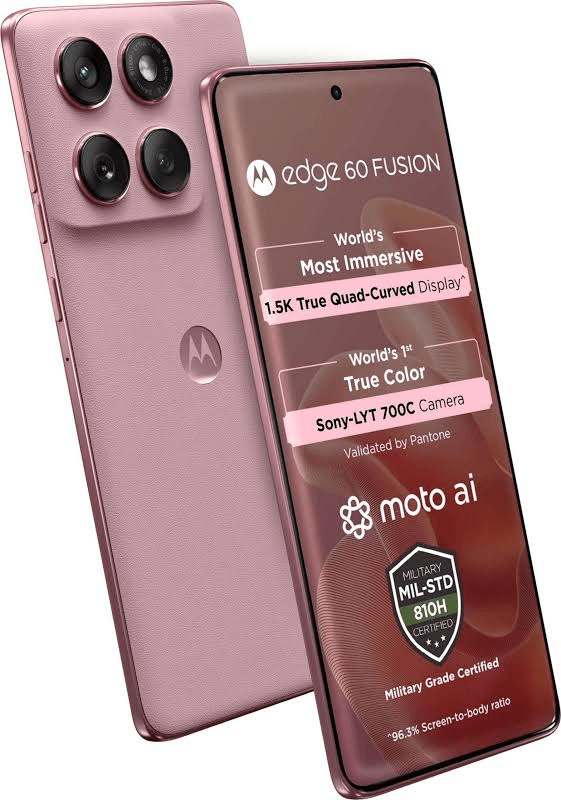
- Display: 6.67″ pOLED, 120 Hz — smooth visuals
- Processor: Mid-range 5G chip (efficient for daily multitasking)
- Cameras: Triple camera setup with good main shooter
- Battery: ~5000 mAh with fast charging
- Why consider: Excellent value with a balanced feature set and strong Motorola software support.
Redmi Note 15 5G — ₹22,999 (approx)
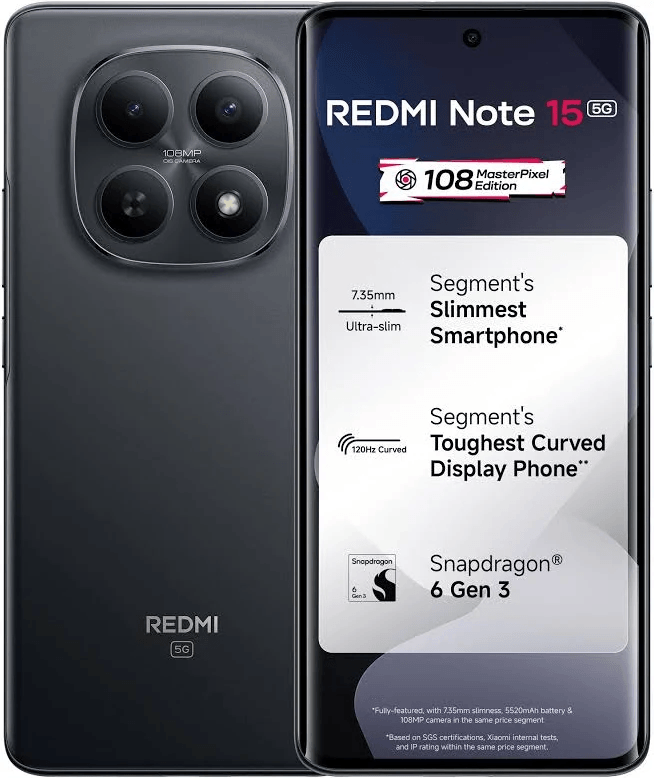
- Display: Large AMOLED panel
- Processor: 5G-capable chipset suitable for general use
- Battery: ~5000 mAh
- Camera: Capable main sensor for everyday shots
- A solid balanced everyday phone with good display quality for media and social use.
Realme 15T 5G — ₹22,999 (approx)
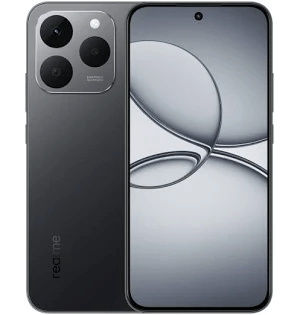
- Display: Vibrant 6.6″ display
- Processor: 5G-enabled, efficient for apps and casual games
- Battery: Long-lasting with fast charging
- Why consider: Great value for mixed usage — good battery and smooth UI experience.
Strong Performance & Feature-Focused Models
OnePlus Nord CE5 5G — ₹24,499 (approx)
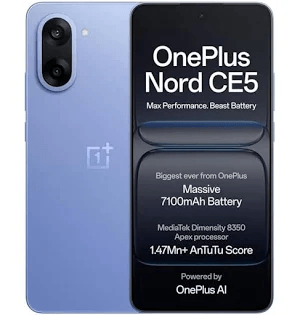
- Display: 6.77″ AMOLED, 120 Hz — fluid visuals
- Processor: Dimensity-series 5G chip for balanced performance
- Battery: ~5000 mAh, fast charging support
- Why consider: Good display performance and software experience typical of Nord series devices.
Tecno Pova Slim 5G — ₹20,999 (approx)

- Display: Slim design with large screen
- Processor: 5G capable, efficient
- Battery: Strong runtime for long days
- Why consider: Clean hardware profile with solid battery life and dependable performance for daily tasks.
Premium Software & Camera Balance
Google Pixel 8A — ₹23,199 (approx)

- Display: Crisp OLED panel
- Processor: Tensor-series chip optimized for camera and AI tasks
- Cameras: Excellent still photography, clean imaging processing
- Software: Best-in-class Android experience with timely updates
- Why consider: If camera quality and clean Android updates are priorities, this model stands out.
Quick Comparison (Indicative)
| Model | Display | Processor | Battery | Camera Strength | Best For |
|---|---|---|---|---|---|
| Motorola Edge 60 Fusion | 6.67″ pOLED, 120 Hz | Balanced 5G | ~5000 mAh | Good all-round | Everyday balanced user |
| Redmi Note 15 5G | AMOLED | 5G mid-tier | ~5000 mAh | Solid main camera | General media & socials |
| Realme 15T 5G | Large display | Energetic 5G | Strong battery | Good | Mixed usage |
| OnePlus Nord CE5 5G | 6.77″ AMOLED | 5G chip | ~5000 mAh | Balanced | Display + UI focus |
| Tecno Pova Slim 5G | Large screen | 5G performance | Long battery | Decent | Value battery priority |
| Google Pixel 8A | OLED | Tensor-class | ~4300 mAh | Outstanding stills | Camera & software |
Price Context for India (Early 2026)
- Many of these models are listed around ₹21,000–₹29,999 in mainstream Indian retail pricing as of early 2026.
- Some devices may see offers, exchange discounts, or festive sale price drops, especially on e-commerce platforms.
Disclaimer
This article is for informational purposes only. Specifications, update policies, and availability may change by region and manufacturer. Readers should verify current details with official sources before making a purchase decision.