A suspicious email is not always just spam. A slow website may not simply be experiencing heavy traffic. Even a familiar login page can sometimes be the doorway an attacker needs.
That is why understanding the types of cyber attacks matters. Cybercriminals do not use one universal method. They combine deception, stolen credentials, malicious software, vulnerable applications and compromised devices to reach their goals.
Recent threat research shows how broad this landscape has become. ENISA’s 2025 Threat Landscape analyzed 4,875 incidents from July 2024 through June 2025 and identified phishing as the leading initial intrusion vector in its dataset, while ransomware remained one of the most impactful threats.
Here are the major attack types you should understand—and the practical defenses that can reduce your exposure.
What Is a Cyber Attack?
A cyber attack is a deliberate attempt to gain unauthorized access to systems, networks, applications or data, or to disrupt their normal operation.
Attackers may want to steal information, demand money, spy on an organization, damage infrastructure, manipulate data or simply make a service unavailable.
The important point is that cyber attacks are not limited to sophisticated hacking operations.
Sometimes the first step is remarkably simple: convincing someone to click the wrong link.
12 Major Types of Cyber Attacks
| Attack type | Typical target | Main objective | Key defense |
|---|---|---|---|
| Phishing | People and organizations | Steal credentials/data | Awareness + MFA |
| Malware | Devices and networks | Damage, espionage or access | Endpoint protection |
| Ransomware | Businesses and institutions | Extortion | Tested backups + MFA |
| DDoS | Websites and services | Disruption | DDoS protection |
| Password attacks | User accounts | Account takeover | Strong unique passwords |
| MITM | Network communications | Interception | Encryption + secure networks |
| SQL injection | Web applications | Database access/manipulation | Secure coding |
| XSS | Web applications/users | Script execution | Input/output controls |
| Zero-day exploits | Vulnerable systems | Unauthorized access | Patching + layered defense |
| Supply-chain attacks | Vendors/software ecosystems | Indirect compromise | Vendor risk management |
| Insider threats | Organizations | Data theft/damage | Least privilege + monitoring |
| Social engineering | People | Manipulation | Verification + training |
1. Phishing Attacks
Phishing is one of the most common forms of cyber attack. It uses deceptive emails, messages, websites or other communications to persuade someone to reveal information or perform an unsafe action.
An attacker may impersonate a bank, employer, delivery company, colleague or online service.
Modern phishing can be highly convincing. ENISA reported phishing—including related techniques such as vishing and malicious advertising—as the leading initial intrusion method in its 2025 threat landscape.
Example: An employee receives an urgent message supposedly from the finance department requesting an invoice payment. The email looks legitimate, but the payment account belongs to the attacker.
Defense: Verify unexpected requests through another communication channel, avoid suspicious links and enable multifactor authentication.
2. Malware Attacks
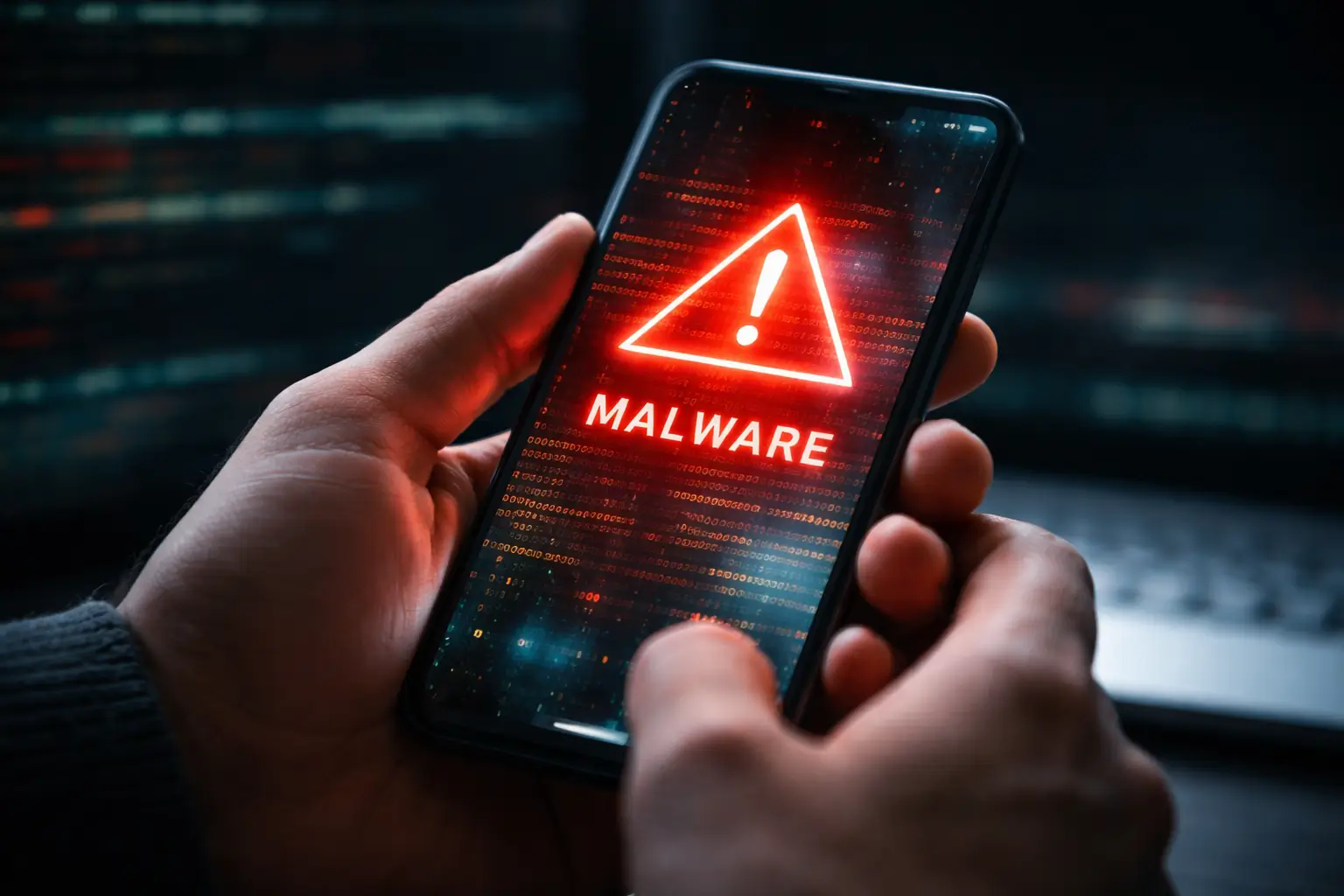
Malware means malicious software designed to perform unauthorized or harmful actions.
It includes several categories:
- Viruses
- Worms
- Trojans
- Spyware
- Remote-access malware
- Ransomware
Malware can steal information, monitor activity, damage files or establish unauthorized access.
The danger is often hidden behind something ordinary, such as a downloaded document, application or browser extension.
Best defense: Keep operating systems and applications updated, use reputable endpoint security, restrict unnecessary software installation and avoid untrusted downloads.
3. Ransomware Attacks
Ransomware is designed to deny access to data or systems, often by encrypting files and demanding payment.
Modern ransomware can go further. Attackers may steal sensitive information before encrypting systems and then threaten to publish the stolen data.
NIST’s June 2026 ransomware profile specifically addresses ransomware as an attack that can combine encryption with data theft and extortion.
CISA recommends measures including offline backups, incident-response planning, MFA, patching and controlling exposed remote services.
Mini case study: Imagine a small company whose shared file server becomes inaccessible Monday morning. If its only backup is connected to the same network, ransomware may reach that backup too. An isolated, tested backup can dramatically change the recovery equation.
4. Distributed Denial-of-Service Attacks
A DDoS attack attempts to overwhelm a website, application or network with traffic so legitimate users cannot access it.
Unlike a normal traffic spike, malicious traffic is intentionally generated to consume resources.
ENISA’s 2025 threat landscape found DDoS to be the dominant incident type in its dataset, accounting for 77% of reported incidents, although many were low-impact hacktivist campaigns.
Defense: Use DDoS mitigation services, traffic filtering, rate limiting, resilient infrastructure and monitoring.
5. Password and Credential Attacks
Attackers do not always need to break into a system technically. Sometimes they simply obtain a valid username and password.
Common credential attacks include:
- Brute-force attacks
- Password spraying
- Credential stuffing
- Phishing-based credential theft
Password reuse makes credential stuffing especially dangerous because one leaked password may unlock several accounts.
Better approach: Use a password manager, create unique passwords and enable MFA wherever possible. CISA specifically recommends strong passwords, password managers and multifactor authentication as core protective measures.
6. Man-in-the-Middle Attacks
A man-in-the-middle (MITM) attack occurs when an attacker intercepts communication between two parties.
The attacker may attempt to observe, steal or manipulate information traveling between the parties.
Unsecured networks can increase exposure, especially when users ignore certificate warnings or connect through untrusted infrastructure.
Defense: Use HTTPS, secure Wi-Fi, trusted networks and strong encryption. Avoid entering sensitive information when a connection appears suspicious.
7. SQL Injection
SQL injection targets applications that interact with databases.
If an application improperly handles user input, attackers may manipulate database queries in ways the developer never intended.
The potential impact can include unauthorized data access, modification or deletion.
SQL injection is part of the broader application-security landscape tracked by OWASP. Its current Top 10:2025 also places Injection at number five, alongside risks such as broken access control and software supply-chain failures.
Defense: Use parameterized queries, input validation, secure development practices and least-privilege database accounts.
8. Cross-Site Scripting
Cross-site scripting (XSS) occurs when attackers cause malicious scripts to execute in a user’s browser through a vulnerable web application.
The consequences depend on the vulnerability and context but can include session abuse, unauthorized actions or manipulation of web content.
The core lesson for developers is simple: never assume user-controlled input is trustworthy.
Output encoding, appropriate content-security controls, input handling and secure frameworks can reduce XSS risk.
9. Zero-Day Exploits
A zero-day exploit takes advantage of a vulnerability before a reliable fix or patch is broadly available.
That creates a difficult defensive problem: traditional patching may not yet be possible.
This is why cybersecurity cannot rely on a single control.
Organizations also need network segmentation, endpoint monitoring, least privilege, behavioral detection and rapid incident response.
Key insight: Zero-day protection is less about finding one perfect security product and more about limiting what happens when an unknown vulnerability is eventually exploited.
10. Supply-Chain Attacks
A supply-chain attack targets an organization indirectly through a trusted vendor, software package, service provider or dependency.
Instead of attacking the final victim directly, attackers compromise something the victim already trusts.
This threat has become increasingly important because modern organizations depend on interconnected cloud platforms, software libraries and third-party providers.
ENISA has highlighted the abuse of cyber dependencies as a growing concern because one compromised dependency can amplify the impact across interconnected organizations.
Defense: Maintain vendor inventories, evaluate third-party security controls, restrict privileges, monitor software dependencies and establish clear incident-reporting requirements.
11. Insider Threats
Not every security incident begins outside an organization.
An insider threat can involve a malicious employee, contractor or partner—or an authorized person accidentally causing harm.
Examples include:
- Downloading confidential files to a personal device
- Sharing credentials
- Sending sensitive information to the wrong recipient
- Deliberately stealing company data
The best defense is not simply trusting employees more. It is designing systems so that one compromised account has limited power.
Least privilege, access reviews, logging, segmentation and data-loss prevention can help.
12. Social Engineering Attacks
Social engineering attacks exploit human behavior rather than relying exclusively on technical vulnerabilities.
Phishing is one form, but social engineering can also involve:
- Pretexting
- Vishing
- Smishing
- Impersonation
- Baiting
- Business email compromise
The FBI’s 2025 IC3 report recorded 191,561 phishing/spoofing complaints, illustrating how significant deceptive communication remains in reported cybercrime.
AI is also making deception more convincing. Attackers can produce polished messages, imitate communication styles and combine text, voice or visual impersonation.
That makes verification procedures more important than simply looking for spelling mistakes.
How Do Cyber Attacks Usually Start?
Most attacks follow a chain rather than appearing out of nowhere.
A simplified sequence looks like this:
- Reconnaissance — attackers identify people, systems or weaknesses.
- Initial access — phishing, stolen credentials or vulnerability exploitation may provide entry.
- Execution — malicious code or unauthorized commands run.
- Persistence — attackers attempt to maintain access.
- Privilege escalation — they seek greater permissions.
- Lateral movement — compromised systems become stepping stones.
- Impact — attackers steal data, encrypt files, disrupt services or conduct espionage.
This explains why stopping an attack at the first stage is valuable.
A suspicious login blocked by MFA is much easier to handle than an attacker who has already reached critical servers.
How to Protect Against Different Types of Cyber Attacks
There is no single tool that prevents every cyber attack.
A stronger strategy uses multiple layers.
For individuals
- Use unique, long passwords.
- Store passwords in a reputable password manager.
- Enable MFA.
- Keep software automatically updated.
- Treat unexpected links and attachments cautiously.
- Verify urgent financial requests independently.
- Back up important files.
- Avoid sensitive activity on untrusted networks.
CISA similarly emphasizes phishing awareness, strong passwords, MFA and software updates as fundamental protective behaviors.
For businesses
Organizations should go further:
- Maintain an accurate asset inventory.
- Apply security patches quickly.
- Implement phishing-resistant MFA where appropriate.
- Segment critical networks.
- Use endpoint detection and response.
- Monitor authentication activity.
- Maintain offline or otherwise protected backups.
- Test incident-response procedures.
- Review third-party suppliers.
- Apply least-privilege access.
- Centralize security logging.
NIST Cybersecurity Framework 2.0 organizes cybersecurity risk management around Govern, Identify, Protect, Detect, Respond and Recover.
Common Cybersecurity Mistakes to Avoid
Mistake 1: Thinking antivirus is enough
Modern attacks can involve identity theft, social engineering and legitimate credentials. Malware detection alone cannot address every attack path.
Mistake 2: Reusing passwords
One compromised password can become several compromised accounts.
Mistake 3: Ignoring backups
A backup that has never been tested is not a reliable recovery strategy.
Mistake 4: Treating employees as the weakest link
People can make mistakes, but good security design assumes mistakes will happen and limits their consequences.
Mistake 5: Patching only when something breaks
Unpatched software can leave known vulnerabilities exposed for attackers to exploit.
Cyber Attack Myths vs Facts
| Myth | Fact |
|---|---|
| Cyber attacks only target large companies | Individuals and small businesses are also targeted |
| Strong passwords solve everything | Credentials are only one part of the attack surface |
| Phishing is easy to spot | Modern phishing can be highly convincing |
| Backups make ransomware harmless | Backups must be protected and tested |
| Zero-days cannot be defended against | Layered controls can reduce impact even without a patch |
| Cybersecurity is only an IT problem | Security risk affects operations, finance and leadership |
The Most Important Takeaway
The biggest mistake is thinking that cyber attacks are isolated events with completely different solutions.
They are connected.
A phishing message can steal credentials. Those credentials can enable unauthorized access. That access can lead to malware deployment, lateral movement and eventually ransomware or data theft.
The strongest defense therefore combines people, processes and technology.
Cybersecurity is not about predicting the exact attack that will happen tomorrow. It is about building enough resilience that when an attacker finds one weakness, that weakness does not automatically become a complete compromise.
FAQ
What are the most common types of cyber attacks?
The most common types include phishing, malware, ransomware, DDoS attacks, password attacks, social engineering, web application attacks, man-in-the-middle attacks, zero-day exploits and supply-chain attacks.
What is the most common cyber attack?
There is no universal ranking because results depend on the dataset and definition. However, phishing and other social-engineering techniques are consistently major attack vectors. ENISA identified phishing as the leading initial intrusion vector in its 2025 threat landscape.
What is the difference between malware and ransomware?
Malware is a broad category of malicious software. Ransomware is one type of malware that typically blocks access to data or systems and demands payment, although modern ransomware campaigns can also involve data theft and extortion.
How can I protect myself from cyber attacks?
Use unique strong passwords, MFA, current software, reputable security tools and reliable backups. Also verify unexpected requests for money, passwords or sensitive information before acting.
What is a zero-day cyber attack?
A zero-day attack exploits a previously unknown or unpatched software vulnerability. Because a reliable fix may not yet be available, organizations need layered controls such as monitoring, segmentation and least-privilege access.
Can small businesses be targeted by cyber attacks?
Yes. Small businesses can be attractive targets because they may have valuable data but fewer cybersecurity resources. Basic controls such as MFA, patch management, backups, access controls and employee security training can significantly improve resilience.
Conclusion
The most important lesson from the types of cyber attacks covered here is that attackers rarely depend on one technique alone. A phishing message can lead to stolen credentials; stolen credentials can provide access; that access can eventually enable malware, data theft or ransomware.
For individuals, the strongest starting point is simple: use unique passwords, enable MFA, update your devices, recognize suspicious requests and maintain backups.
For businesses, protection needs to be broader. Asset visibility, least privilege, secure application development, monitoring, segmentation, tested recovery procedures and third-party risk management all matter.
NIST’s Cybersecurity Framework 2.0 captures the larger principle well: cybersecurity should be treated as a continuous cycle of governance, identification, protection, detection, response and recovery, rather than a one-time technical project.
The goal is not to assume you will never be attacked. The goal is to make the attack harder to start, easier to detect and far less damaging when it happens.
Disclaimer
Disclaimer: This article is provided for general cybersecurity education and awareness. Cyber threats, vulnerabilities and defensive recommendations can change rapidly, and no security measure can guarantee complete protection from every attack. Organizations should assess their own risk environment and consult qualified cybersecurity professionals when handling significant security incidents, regulatory requirements or critical infrastructure. For an active cyber incident, follow your organization’s incident-response procedures and contact the appropriate security, legal or government authorities.