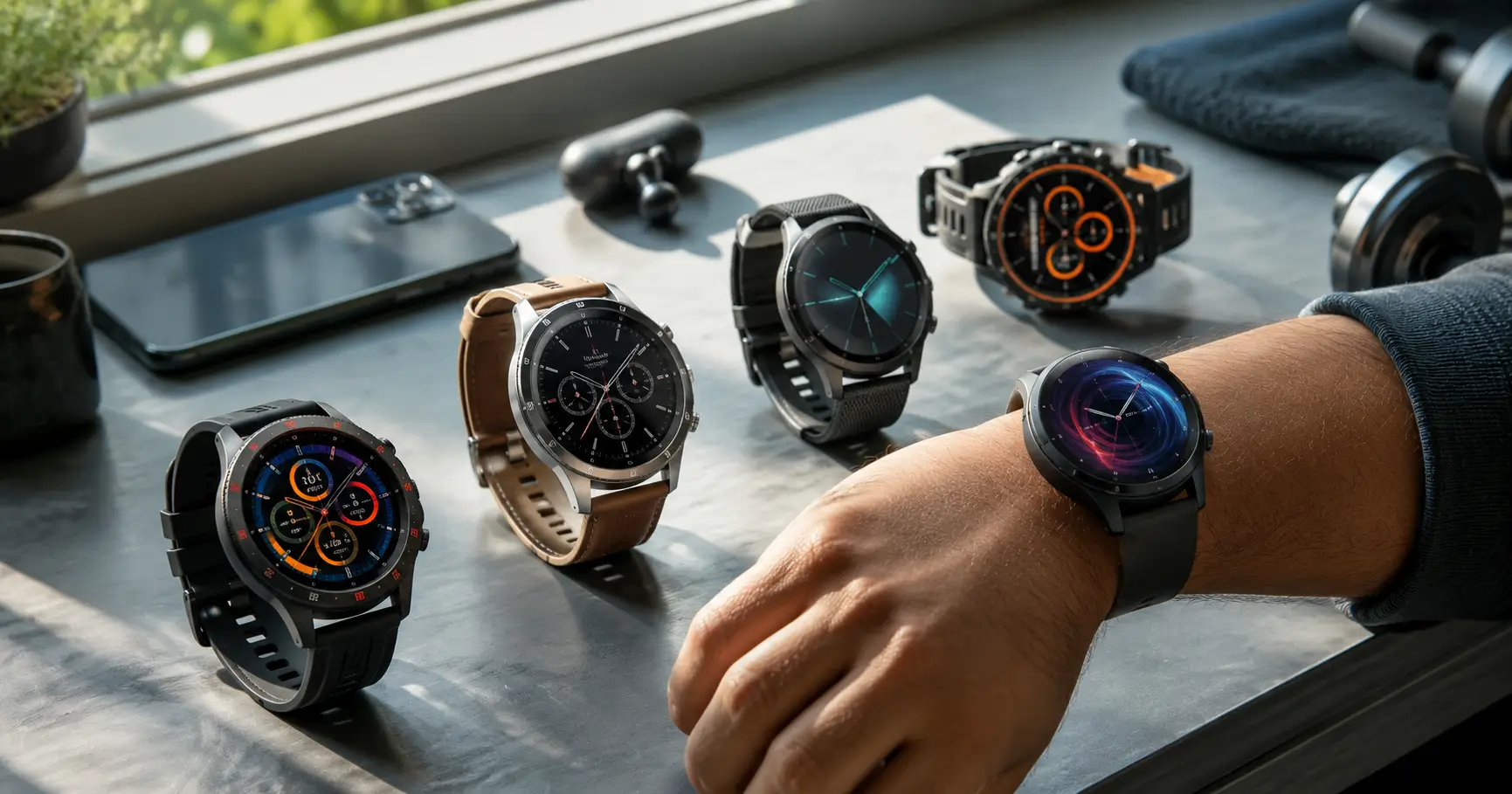
A smartwatch can track your workouts, show notifications, monitor sleep and even guide you through parts of your daily routine. But there is one problem with many models: they look more like tiny computers than watches.
That is why the demand for the best round smartwatch remains strong. A circular case feels familiar, works with traditional watch styles and can look equally comfortable with office clothes or gym wear.
But choosing one is not as simple as picking the prettiest dial.
Battery life, software, GPS accuracy, health sensors, display quality, smartphone compatibility and long-term support can make a much bigger difference than a flashy specification sheet.
So what should you actually look for?
What makes a round smartwatch worth buying?
A round smartwatch is simply a wearable with a circular or predominantly circular watch case and display rather than the rectangular design used by many mainstream smartwatches.
The shape is largely a design choice, but it affects how the watch feels on your wrist and how information is presented.
A good round smartwatch should balance five things:
- Comfort
- Display quality
- Smart features
- Health and fitness tracking
- Battery endurance
The most expensive model is not automatically the best.
For example, someone who mainly wants notifications and step tracking may gain little from paying for advanced training features. A runner, meanwhile, may care much more about GPS performance and workout analytics than calling from the wrist.
Best round smartwatch options to consider in 2026
The market now spans inexpensive lifestyle watches through premium fitness and Wear OS models.
Current Indian listings show circular watches from brands including Samsung, Garmin, CMF, boAt and others, with substantial differences in price and capabilities.
Here is the type of shortlist worth considering:
| Type | Best suited for | What to prioritize |
|---|---|---|
| Samsung Galaxy Watch | Android users | Wear OS, apps, health features |
| Amazfit Balance 2 | Fitness + battery | Training, GPS, endurance |
| Garmin round watches | Serious fitness | GPS, training and sports metrics |
| CMF Watch Pro 2 | Budget buyers | Design and essential smart features |
| Galaxy Watch Classic | Traditional-watch fans | Premium design and rotating bezel |
| Budget round-dial watches | Casual users | Price, display and battery |
| Premium outdoor watches | Adventure users | Durability, GPS and endurance |
The important point is that there is no universal winner.
Samsung Galaxy Watch: best for Android users
Samsung’s Galaxy Watch family is one of the strongest choices if you already use an Android smartphone, particularly a Galaxy phone.
Recent Galaxy Watch models combine a traditional circular watch aesthetic with health tracking, workouts, notifications and Google’s Wear OS ecosystem.
Samsung’s current lineup includes Galaxy Watch, Galaxy Watch Classic and Ultra models.
The Classic range is especially interesting for buyers who dislike the “tech gadget” appearance.
Samsung’s Galaxy Watch8 Classic brings back the rotating bezel, which provides physical navigation and reinforces its traditional-watch character.
Best for: Android users who want smartwatch features without sacrificing classic styling.
Amazfit Balance 2: best for battery-focused buyers
Amazfit takes a different approach.
The Balance 2 is positioned as a multisport smartwatch, with a 1.5-inch AMOLED display, sapphire glass, more than 170 workout modes, dual-band GPS and a claimed typical-use battery life of up to 21 days.
That combination makes it particularly attractive to people who hate charging their watch every night.
Its 10 ATM water-resistance rating and sports-focused features also make it more versatile than a basic lifestyle smartwatch.
Best for: Fitness enthusiasts who prioritize battery life and training features.
Garmin: best for serious fitness tracking
Garmin occupies a different part of the smartwatch market.
Its round watches tend to appeal to runners, cyclists, hikers and outdoor enthusiasts who care more about training data than having the largest collection of smartwatch apps.
The key advantage is the fitness ecosystem.
If your smartwatch is primarily a training instrument, Garmin deserves serious consideration.
Best for: Athletes and outdoor users.
CMF Watch Pro 2: best budget-oriented option
Budget buyers do not necessarily need to accept a rectangular design.
CMF’s Watch Pro 2 helped bring the round smartwatch aesthetic into a lower price segment, making the circular design accessible to people who do not want to spend flagship-level money.
The important distinction is that inexpensive smartwatches should be evaluated primarily on what they actually do well, rather than on the number of features printed on the packaging.
Best for: Buyers who want a stylish round watch without a premium price.
Galaxy Watch Classic: best traditional-watch experience
Some people buy a smartwatch because they want technology.
Others buy one because they want technology inside something that still feels like a watch.
That is where the Galaxy Watch Classic becomes interesting.
The rotating bezel provides tactile interaction, while the circular design and premium construction make it easier to pair with formal clothing.
Samsung describes the rotating bezel as both a design signature and a practical navigation method.
Best for: Office users and traditional-watch enthusiasts.
Premium outdoor smartwatches: best for adventure
If your weekends involve trekking, long-distance running, cycling or water activities, appearance should move down your priority list.
Look for:
- Strong water resistance
- Durable glass
- Reliable GPS
- Long battery life
- Physical buttons
- Outdoor navigation
- Multi-day endurance
Samsung’s Galaxy Watch Ultra, for example, combines titanium construction, sapphire crystal glass, dual-frequency GPS and 10 ATM water resistance.
That illustrates an important buying principle: buy the hardware for the environment where you will actually use it.
How to choose the best round smartwatch for you
Before buying, follow this five-step process.
1. Start with your smartphone
This is one of the easiest mistakes to avoid.
A watch may have excellent hardware but still be a poor choice if its software ecosystem does not fit your phone.
Check:
- Android compatibility
- iPhone compatibility
- Required companion apps
- Calling support
- App ecosystem
- Health-feature availability
Do this before comparing display sizes or colors.
2. Decide whether you need GPS
If you exercise outdoors, built-in GPS can be extremely useful.
It allows the watch to record routes and outdoor activity without depending entirely on your phone.
For casual walking, however, GPS may not justify a large price increase.
3. Treat battery life as a real-world feature
Manufacturers often quote maximum or typical battery figures under specific conditions.
Your actual result can be lower when you use:
- Always-on display
- GPS
- Frequent notifications
- Bluetooth calls
- Continuous health monitoring
- Bright display settings
A watch advertised for multiple days can therefore behave very differently from one user to another.
4. Look beyond heart-rate claims
Health sensors are useful, but smartwatch measurements should not automatically be treated as medical diagnoses.
Research on wrist-worn activity trackers shows that accuracy varies considerably by metric and device. A systematic review found that energy-expenditure estimates were particularly inconsistent, while accuracy for other measures varied across devices and studies.
So instead of asking, “How many health sensors does it have?” ask:
How reliable and useful are the measurements for the activities I actually perform?
5. Consider comfort before buying a large watch
A large round case can look impressive in photographs but feel bulky after eight hours.
Check:
- Case diameter
- Case thickness
- Weight
- Strap material
- Lug design
- Wrist circumference
A slightly smaller watch that you wear every day is usually more useful than a feature-packed model that spends most of its time in a drawer.
Why battery life can matter more than another smart feature
Imagine two watches.
Watch A has dozens of advanced features but needs frequent charging.
Watch B has fewer features but lasts more than a week.
For many users, Watch B may produce more useful data simply because it stays on the wrist.
This matters particularly for sleep tracking.
Consistency is a feature.
Research on wearable activity trackers suggests these devices can encourage physical activity, although results depend on the device, user and intervention. A large umbrella review found evidence that activity trackers can improve physical activity levels.
That does not mean a smartwatch automatically makes someone healthier.
It means the device can become a useful feedback tool when someone actually uses the information.
Round smartwatch vs square smartwatch
The debate is mostly about priorities.
| Feature | Round smartwatch | Square smartwatch |
|---|---|---|
| Traditional appearance | Excellent | Moderate |
| Watch-like styling | Excellent | Moderate |
| Text-heavy interfaces | Good | Excellent |
| Fitness dashboards | Good | Very good |
| Formal clothing | Excellent | Good |
| Familiar watch design | Excellent | Moderate |
A round watch generally wins on aesthetics.
A square display can sometimes make dense information easier to read.
Neither shape is universally superior.
Common mistakes to avoid
Buying based only on appearance
A beautiful watch with poor software is still a poor smartwatch.
Believing maximum battery claims blindly
Always-on displays and GPS can significantly change real-world endurance.
Ignoring ecosystem compatibility
A watch designed around one ecosystem may offer a much better experience with the matching phone.
Choosing the biggest possible case
Bigger is not always better.
Treating smartwatch health readings as medical diagnoses
Consumer wearables are useful for tracking trends, but they should not replace professional medical assessment.
Myths vs facts
Myth: A more expensive smartwatch is always more accurate.
Fact: Price does not guarantee equal accuracy across every sensor or metric. Independent research has found meaningful variation between wearable devices and measurements.
Myth: More health sensors automatically mean better health tracking.
Fact: Sensor quantity matters less than measurement quality, software interpretation and how consistently you use the data.
Myth: A smartwatch can replace exercise.
Fact: A watch can encourage movement, provide feedback and track activity. It cannot substitute for physical activity itself.
WHO recommends adults aged 18–64 get at least 150 minutes of moderate-intensity physical activity per week, or an equivalent amount of vigorous activity.
The smartest way to buy a round smartwatch
Instead of starting with the question, “Which smartwatch is number one?”, start with:
“What do I need this watch to do every day?”
If your priority is Android integration, look closely at Samsung.
If battery life and multisport tracking dominate your needs, Amazfit deserves attention.
If structured training is the priority, investigate Garmin.
If your budget is limited, look at affordable circular models from brands such as CMF and other established manufacturers.
And if traditional aesthetics matter most, a Classic-style smartwatch can be the sweet spot.
The best choice is therefore not necessarily the watch with the longest specification list.
It is the one that fits your phone, wrist, lifestyle and daily habits well enough that you actually keep wearing it.
FAQ
What is the best round smartwatch in 2026?
The best option depends on your priorities. Samsung is particularly strong for Android users, Amazfit is attractive for battery-focused fitness users, and Garmin is well suited to serious training and outdoor activities.
Are round smartwatches better than square smartwatches?
Neither shape is universally better. Round smartwatches generally offer a more traditional watch appearance, while square displays can be better suited to text-heavy interfaces and dense information.
Which round smartwatch has the best battery life?
Battery life varies considerably by model and usage. Amazfit’s Balance 2, for example, is officially rated for up to 21 days of typical use, although GPS, display settings and other features can reduce real-world endurance.
Is a round smartwatch good for fitness tracking?
Yes. Many round smartwatches offer heart-rate monitoring, activity tracking, workout modes and GPS. However, measurement accuracy varies by device and metric, so specifications alone should not determine your purchase.
Can a smartwatch replace a fitness tracker?
A smartwatch can perform many of the same tracking functions while adding notifications, apps, calls and other smart features. Dedicated fitness devices may still be preferable for users who want a simpler, more specialized experience.
Are smartwatch health readings medically accurate?
Smartwatch measurements should generally be treated as wellness and tracking information rather than a substitute for medical diagnosis. Accuracy differs between devices and measurements, and professional advice should be sought for medical concerns.
Conclusion
A great round smartwatch should do more than look good on your wrist.
It should fit naturally into your phone ecosystem, fitness routine, working day and charging habits. For some buyers, that means a feature-rich Samsung Galaxy Watch. For others, the long battery life and training capabilities of Amazfit may matter more. Serious athletes may prefer Garmin, while budget-conscious buyers have increasingly attractive circular options.
The biggest lesson is simple: don’t buy the smartwatch with the longest specification list—buy the one whose strengths match the way you actually live.
If you are comparing models, start with compatibility, battery life, GPS, display quality, comfort and the health features you genuinely need. Then compare price.
That approach will lead you much closer to the best round smartwatch for you, rather than simply the most expensive smartwatch on the shelf.
Disclaimer
Disclaimer: This article is intended for general informational and consumer-technology guidance only. Product features, prices, compatibility, software support and availability can change over time and may vary by region. Health and fitness measurements provided by consumer smartwatches are not a substitute for professional medical diagnosis, treatment or advice. Always verify the manufacturer’s latest specifications and compatibility information before purchasing.