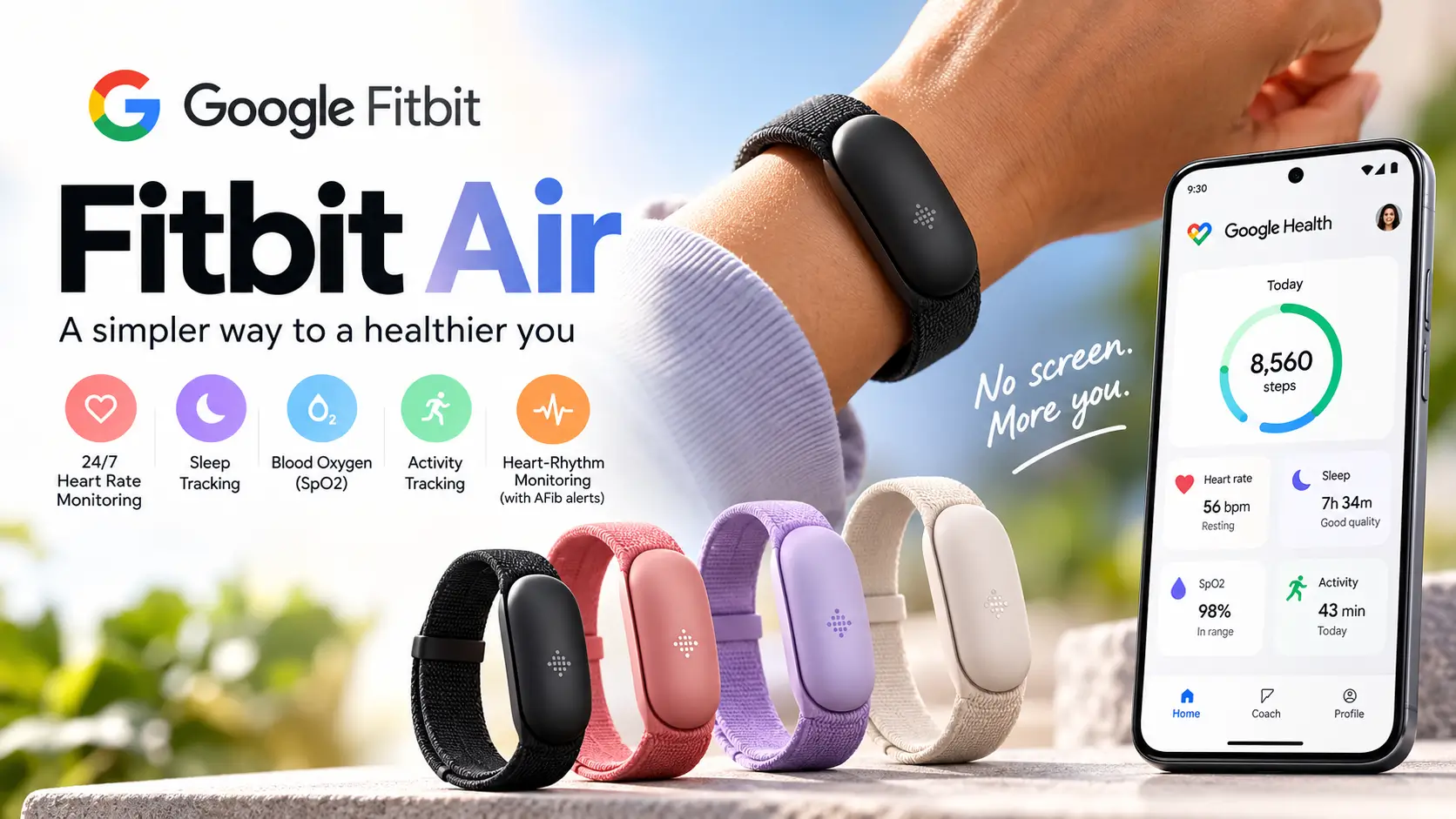
Google has introduced the Fitbit Air in India at ₹13,999, bringing a different approach to personal fitness tracking. Unlike conventional fitness bands and smartwatches, this wearable does not have a screen. Instead, it continuously collects health and activity information and sends the data to Google’s Health app on a connected smartphone.
The Fitbit Air was first announced globally on May 7, 2026. Google confirmed its Indian launch on September 30, with retail sales scheduled to begin on October 2, 2026.
The device focuses on heart-rate monitoring, sleep tracking, blood oxygen measurements, heart-rhythm monitoring and activity detection. It also offers up to seven days of battery life and interchangeable band designs.
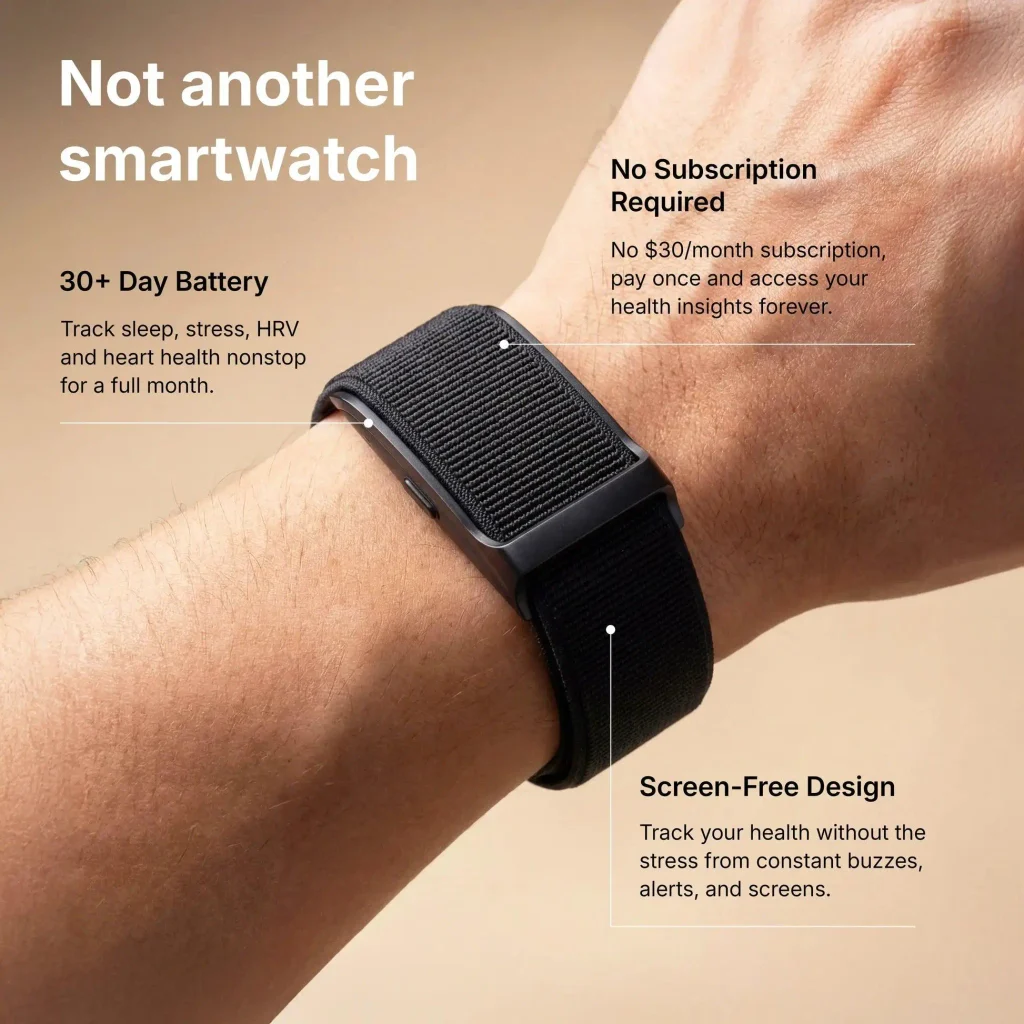
At ₹13,999, Fitbit Air enters India’s wearable market as a screenless alternative to conventional smartwatches. But its lack of a display and reliance on Google’s health ecosystem make it important to understand exactly what buyers are getting.
Fitbit Air Price in India and Availability
Google has announced the Fitbit Air at a price of ₹13,999 in India.
The device will be available from October 2, 2026, through the Google Store and retail partners.
Fitbit Air India pricing and launch details
| Detail | Information |
|---|---|
| Product name | Google Fitbit Air |
| Price in India | ₹13,999 |
| India announcement | September 30, 2026 |
| Sale begins | October 2, 2026 |
| Colours | Obsidian, Berry, Lavender, Fog |
| Design | Screenless fitness tracker |
| Companion app | Google Health |
| Free trial | 3 months of Google Health Premium |
Google is also including a three-month Google Health Premium trial with the device. This provides access to Google Health Coach and associated premium features during the introductory period.
Buyers should check the subscription terms before the trial ends, particularly if they intend to continue using premium coaching features.
What Is Fitbit Air?
Fitbit Air is a compact, screenless wearable designed for continuous health and fitness monitoring.
Unlike a traditional smartwatch, it does not display notifications, messages, time or health statistics directly on the wrist.
Instead, the device collects information through its built-in sensors and synchronises it with the Google Health app.
The idea is to make health tracking less dependent on frequent screen interactions.
For example, someone can wear Fitbit Air while working, exercising or sleeping without regularly checking a watch display. They can review collected information later through their smartphone.
Its small pebble-shaped tracking unit can also be removed from the band and transferred between compatible band styles.
This makes Fitbit Air different from conventional wristbands that combine a tracking module and display in one device.
Fitbit Air Features and Health Tracking
The main purpose of Fitbit Air is to monitor several health and activity indicators throughout the day.
Its sensor system supports multiple measurements.
1. Continuous Heart-Rate Monitoring
Fitbit Air supports 24-hour heart-rate monitoring.
Heart rate refers to the number of times the heart beats per minute. Tracking changes over time can help users understand how their heart rate responds to exercise, rest and sleep.
The information is available through the Google Health app.
However, wearable heart-rate measurements should be understood as wellness information rather than a replacement for clinical heart monitoring.
2. Heart-Rhythm Monitoring and AFib Alerts
One of the notable features is heart-rhythm monitoring with atrial fibrillation (AFib) alerts, where supported.
Atrial fibrillation is a type of irregular heart rhythm that can increase the risk of stroke and other complications.
The ability to monitor heart-rhythm patterns can provide useful information, but it does not mean Fitbit Air can diagnose every heart-rhythm problem.
Google also notes that AFib-related features have eligibility and regional availability limitations.
Users should not rely on a wearable device to rule out a heart condition or delay medical evaluation when symptoms occur.
3. Blood Oxygen (SpO2) Tracking
Fitbit Air also supports blood oxygen saturation tracking.
SpO2 represents the estimated percentage of oxygen carried by haemoglobin in the blood.
This measurement can contribute to a broader understanding of health and sleep patterns.
However, consumer wearable measurements are not equivalent to a medical-grade diagnostic assessment. Readings can be affected by device positioning, movement, circulation and other factors.
4. Resting Heart Rate
Resting heart rate refers to the number of heartbeats per minute when the body is at rest.
Monitoring changes over time may help users understand their general fitness and recovery patterns.
For example, resting heart rate can vary with physical activity, sleep, stress, illness and other lifestyle factors.
The value of this feature comes from observing trends rather than interpreting a single reading in isolation.
5. Heart-Rate Variability (HRV)
Heart-rate variability measures the variation in time intervals between consecutive heartbeats.
It is different from average heart rate.
HRV is sometimes used as an indicator of physiological recovery and the body’s response to stress. However, its interpretation depends on several factors, including age, fitness, sleep and individual physiology.
Fitbit Air collects HRV information as part of its broader health-monitoring system.
6. Sleep Tracking
Sleep tracking is another important feature of Fitbit Air.
The device records sleep-related information, including:
- Sleep duration.
- Sleep stages.
- Overnight heart-rate information.
- Sleep-related trends.
Because Fitbit Air does not have a screen, it can be worn overnight without the need to interact with a display.
Users can review their sleep information through the Google Health app.
Sleep-tracking estimates should not be treated as a clinical sleep study or as a way to diagnose sleep disorders.
Fitness and Activity Tracking
Fitbit Air is not limited to passive health monitoring.
It also supports activity tracking and automatic detection of common workouts.
Users can start a workout through the Google Health app or allow the device to recognise supported activities automatically.
Once an activity is completed, its summary can be reviewed through the application.
Google Health Coach also supports guided workout recommendations and additional workout logging features.
For example, users can photograph cardio equipment or a gym workout routine written on a whiteboard to help record exercise information through the coaching experience.
Some of these advanced coaching features require Google Health Premium.
This integration is an important part of Fitbit Air’s overall purpose: the wearable collects information, while the application helps organise and interpret it.
Fitbit Air Battery Life and Charging
Battery life is one of the main practical advantages of Fitbit Air’s screenless design.
Google claims that the device offers up to seven days of battery life on a single charge.
It also supports fast charging, with approximately five minutes of charging providing up to one day of use.
| Battery feature | Google-stated information |
|---|---|
| Maximum battery life | Up to 7 days |
| Fast charging | 5 minutes for up to 1 day of use |
| Charging approach | Dedicated charging accessory |
Actual battery life can vary depending on enabled features, usage patterns, environmental conditions and battery age.
Google’s maximum battery-life estimate is based on testing with pre-production hardware and software, rather than a guarantee that every user will obtain seven days.
For people who want to monitor sleep as well as daytime activities, longer battery life can reduce the frequency of charging interruptions.
Fitbit Air Design and Band Options
Fitbit Air uses a small tracking unit that sits inside a compatible wristband.
Its screenless construction keeps the device focused on collecting data rather than displaying information.
Google offers different band styles for different uses.
Performance Loop
The Performance Loop is the standard band included with Fitbit Air.
It uses recycled materials and has a micro-adjustable design intended to provide a flexible and breathable fit.
Active Band
The Active Band uses sweatproof and wetproof silicone.
It is designed for exercise and other activities where a more practical, easy-to-clean material may be useful.
Elevated Modern Band
The Elevated Modern Band has a more decorative appearance and is designed for users who want the wearable to look more like a conventional accessory.
Some alternative bands are sold separately, and availability may vary by country.
Google Health App and Fitbit Air Integration
Fitbit Air works with Google’s Health app, which serves as the main place to view collected information.
The application brings together several categories of personal health and fitness information, including activity, sleep and health metrics.
Google Health Coach adds an AI-assisted layer that can provide personalised guidance using available health and activity information.
The overall experience is designed around two separate functions:
- Fitbit Air collects health and activity information.
- Google Health organises the information and provides additional insights.
The distinction matters because Fitbit Air does not have its own display.
Users need a compatible smartphone to review their measurements and access the full application experience.
Smartphone compatibility
Google lists compatibility with most smartphones running:
- Android 11 or later.
- iOS 16.4 or later.
A Google Account, the Google Health app and an internet connection are also required for relevant services.
Fitbit Air vs Traditional Smartwatches
The biggest difference between Fitbit Air and a conventional smartwatch is the screen.
A smartwatch typically combines health tracking with notifications, applications, a clock, controls and other interactive features.
Fitbit Air focuses more narrowly on health and activity monitoring.
| Feature | Fitbit Air | Traditional smartwatch |
|---|---|---|
| Display | No screen | Usually has a screen |
| Heart-rate monitoring | Yes | Common on many models |
| Sleep tracking | Yes | Available on many models |
| Activity tracking | Yes | Available |
| Notifications on wrist | No | Usually supported |
| Time display | No | Yes |
| App interaction | Through phone | Often directly on watch |
| Battery approach | Up to 7 days claimed | Varies by model |
| Main purpose | Passive health tracking | Health tracking and smart features |
This is not a comparison of every smartwatch model. Features, battery life and sensor capabilities differ considerably across brands and price categories.
The important distinction is the intended experience.
Fitbit Air is designed for people who do not necessarily want another screen on their wrist.
Fitbit Air vs WHOOP-Style Screenless Wearables
Fitbit Air also enters a product category associated with screenless fitness and recovery trackers.
These devices typically collect information continuously and rely on a smartphone application to present trends and recommendations.
The general similarities include:
- Minimalist wearable design.
- Sleep and activity monitoring.
- Continuous physiological data collection.
- Smartphone-based health dashboards.
- Emphasis on longer-term trends rather than constant notifications.
However, Fitbit Air has its own Google Health integration, pricing structure and sensor features.
A meaningful buying comparison should examine the subscription requirements, supported measurements, comfort, battery life, data access and overall ownership cost rather than simply comparing the absence of a screen.
Does Fitbit Air Require a Subscription?
This is an important question for potential buyers.
Google includes a three-month Google Health Premium trial with Fitbit Air in India.
However, some advanced features associated with Google Health Coach require a Google Health Premium subscription.
The basic distinction is:
- The wearable collects supported health and activity information.
- The Google Health app provides the platform for reviewing information.
- Premium services provide access to additional coaching and selected advanced experiences.
Buyers should check which features remain available without a paid subscription and review the applicable Indian subscription terms before purchasing.
Do not assume that every feature demonstrated in Google’s promotional material is permanently free.
Is Fitbit Air Worth Buying in India?
At ₹13,999, Fitbit Air is aimed at consumers who want a dedicated health-tracking wearable without the conventional smartwatch interface.
Whether it makes sense depends on what the buyer expects from a fitness device.
Who may find Fitbit Air useful?
It may be worth considering for people who:
- Prefer a screenless wearable.
- Want continuous health and sleep tracking.
- Do not need wrist-based notifications.
- Prefer reviewing health information on a smartphone.
- Want a compact tracker for daytime and overnight use.
- Are comfortable using Google’s health ecosystem.
Who may prefer a smartwatch instead?
A conventional smartwatch may be more suitable for people who:
- Want to check the time on their wrist.
- Frequently read messages and notifications.
- Want music controls and other applications.
- Prefer interacting directly with their wearable.
- Want more extensive smartwatch functionality.
What Indian buyers should check before purchasing
Before ordering Fitbit Air, consider the following:
- Subscription requirements: Understand what happens when the three-month Premium trial expires.
- Smartphone compatibility: Check whether your Android or iPhone supports the required software.
- Health feature availability: Confirm which monitoring features are supported in India.
- Band availability: Check the price and availability of replacement bands.
- Battery expectations: Treat seven days as a maximum claimed estimate, not a guaranteed result.
- Health-data privacy: Review Google’s privacy information and decide which data you want to share or retain.
Final Thoughts
Fitbit Air brings a different approach to wearable technology in India. Rather than combining health monitoring with a miniature smartwatch display, Google has designed a screenless tracker that collects information in the background and presents it through the Google Health app.
Its 24/7 heart-rate monitoring, sleep tracking, HRV, SpO2 measurements, AFib-related features and claimed seven-day battery life form the core of its offering.
The ₹13,999 price makes the subscription model and the absence of a screen important parts of the purchasing decision.
For consumers who want notifications, apps and direct interaction, a conventional smartwatch may better match their expectations. For those interested in passive health tracking without another display, Fitbit Air offers a different product experience.
Ultimately, its usefulness depends not only on the sensors but also on the quality of the companion app, the availability of features in India and the value users receive beyond the introductory subscription period.
Frequently asked questions
1. What is the price of Fitbit Air in India?
Google has announced Fitbit Air at ₹13,999 in India. Retail sales begin on October 2, 2026.
2. Does Fitbit Air have a display?
No. Fitbit Air is a screenless fitness tracker. Users need the Google Health app on a compatible smartphone to review their health and activity information.
3. How many days does Fitbit Air battery last?
Google claims up to seven days of battery life. Five minutes of charging is advertised to provide up to one day of use. Actual battery life depends on usage and enabled features.
4. Does Fitbit Air monitor blood oxygen?
Yes. Fitbit Air supports SpO2 tracking, along with heart rate, resting heart rate, HRV and sleep monitoring.
5. Does Fitbit Air detect irregular heart rhythms?
It supports heart-rhythm monitoring with AFib alerts, subject to eligibility and regional availability. It is not a substitute for clinical diagnosis.
6. Does Fitbit Air work with iPhones?
Yes. Google lists compatibility with most iPhones running iOS 16.4 or later. A Google Account and Google Health app are required.
7. Is Google Health Premium required for Fitbit Air?
Not for every basic function. However, certain advanced coaching and workout features require Google Health Premium. Google includes a three-month trial with the device.
8. When will Fitbit Air go on sale in India?
Google has announced October 2, 2026, as the Indian retail availability date.
Health information disclaimer: Fitbit Air provides consumer wellness and fitness measurements. Its heart-rate, SpO2, sleep and other tracking features are not intended to diagnose, treat or prevent medical conditions. Do not use wearable readings as a substitute for medical testing or professional advice. Consult a qualified healthcare professional if you have concerns about your health.