Why You Need to Understand Divorce Laws in India
Many couples and individuals approach the idea of divorce with fear, confusion, and uncertainty. In India’s diverse legal system, marital dissolution isn’t a one-size-fits-all matter. Whether you’re a husband, wife, or part of an inter-faith / civil marriage, knowing the law can protect your rights and help you make informed decisions.
This article breaks down the legal landscape across personal laws, the procedures, your rights, and what to expect in real-world scenarios. We’ll cover both “easy/amicable” and “challenging/disputed” routes, along with practical advice and FAQs.
Legal Framework: Which Law Applies to You?
India doesn’t have a single uniform divorce law. Instead, relief depends on religion or how you were married:
| Personal Law / Act | Who It Applies To / When It’s Used |
|---|---|
| Hindu Marriage Act, 1955 | Hindus, Buddhists, Jains, Sikhs. |
| Dissolution of Muslim Marriages Act, 1939 | Muslim women married under Muslim law. |
| Indian Divorce Act, 1869 | Christian couples seeking divorce. |
| Parsi Marriage and Divorce Act, 1936 | For Parsi community marriages. |
| Special Marriage Act, 1954 | Civil marriages registered under this act (inter-religion or no-religion couples). |
Key takeaway: Know under which law you are married—your rights, procedure, and entitlements follow accordingly.
Types of Divorce: Mutual Consent vs Contested (Unilateral)
Understanding the type of divorce you may pursue is crucial because it impacts time, cost, and complexity.
Mutual Consent Divorce
- This happens when both spouses agree to end the marriage. They jointly file a divorce petition.
- Under Hindu law, for example, couples must meet certain requirements (such as living separately for a specified period) to apply for mutual divorce.
- This route is usually much quicker, smoother, and less adversarial.
Contested or Unilateral Divorce
- Here, one spouse files for divorce without the consent of the other, citing legal grounds.
- The process typically involves the courts—and can include hearings, evidence, and a longer timeline.
- This approach may be necessary in cases involving cruelty, abandonment, or other serious grounds.
Grounds for Divorce: What the Law Considers
If filing for a contested divorce, there are specific legal grounds under which a petition can be accepted.
Under Hindu Law
Some of the common grounds under the Hindu Marriage Act include:
- Adultery (voluntary sexual intercourse by a spouse with someone other than the other spouse)
- Cruelty (physical or mental)
- Desertion for a continuous period (often specified in law / precedents)
- Conversion to another religion by one spouse
- Mental disorder, contagious / venereal disease for a defined period, renunciation of the world, or the spouse presumed dead (after seven years of disappearance).
There are also grounds specifically available to a wife under certain conditions.
Under Muslim Law (for Women)
Under the Dissolution of Muslim Marriages Act, a woman can seek dissolution of marriage under certain circumstances, including:
- Husband’s whereabouts unknown for four years.
- Husband’s failure to provide maintenance for two years.
- Husband imprisoned for seven or more years.
- Husband’s failure to perform marital obligations for a defined period.
Under Christian Law
Under the Indian Divorce Act, a divorce petition may be filed on grounds such as mental illness or unsound mind, conversion, or other causes as defined in the act.
The Divorce Process: Step-by-Step (General Overview)
While exact requirements vary with law and jurisdiction, here’s a general idea of what the process involves:
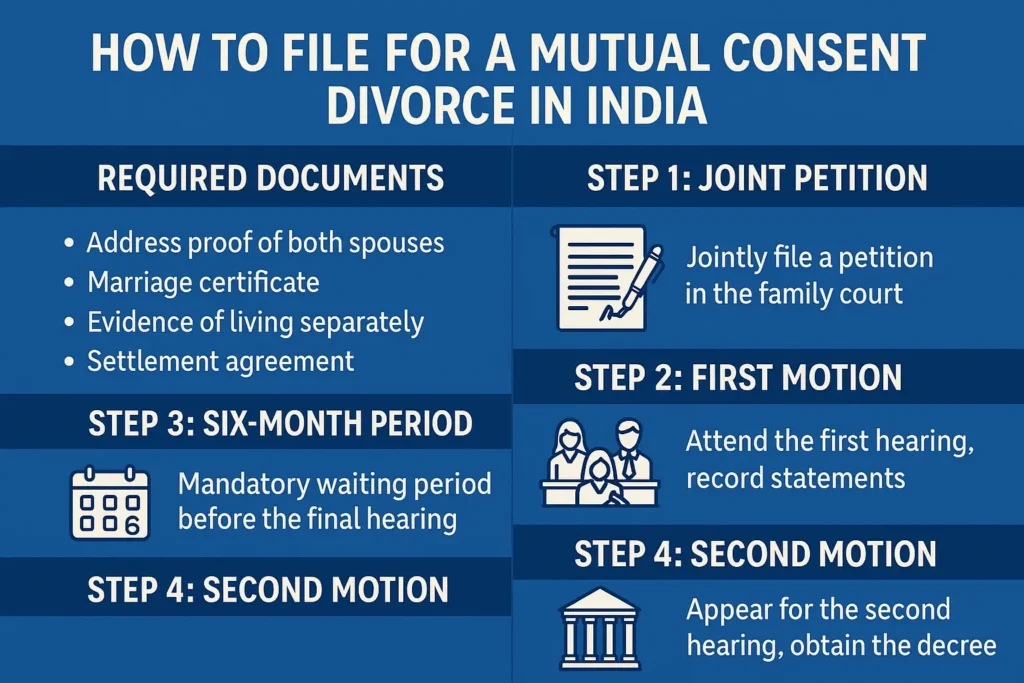
- Drafting and Filing a Petition
- For mutual consent, both spouses and their lawyers (or one lawyer on behalf of both) file jointly.
- For contested cases, the filing spouse drafts a petition citing legal grounds and supporting documentation.
- Service of Summons / Notification
- Once filed, the court issues notices/summons to the other spouse, offering opportunity to respond.
- Response and Trial (If Contested)
- If contested, court proceedings may include examination of evidence, witnesses, affidavits, mediation attempts, etc.
- For mutual consent divorces, there may still be hearings where statements are recorded under oath.
- Cooling-off or Waiting Period (Where Applicable)
- Under Hindu law, for mutual consent divorces, there may be rules requiring separation before the petition is accepted.
- Interim Orders
- During proceedings, courts may issue interim orders regarding maintenance, custody, or asset protection.
- Final Decree / Judgment
- If court is satisfied (or parties are in agreement), a divorce decree is passed. This legally dissolves marriage rights/obligations.
- Post-decree, issues like alimony, child custody, and property may be resolved if not addressed earlier.
Rights and Responsibilities Post-Divorce: What Both Parties Should Know
Alimony / Maintenance & Support: Courts can grant maintenance or support depending on grounds, the spouse’s income, and other factors.
Child Custody & Visitation: Child welfare is taken into account under various laws—courts decide custody and visitation rights when applicable.
Division of Property & Assets: Under secular or personal laws, property and assets division may depend on agreements or court decisions. Several guides note property treatment in divorce proceedings.
Legal Protection for Women (Muslim Law): Under Muslim Women (Protection of Rights on Divorce) Act, 1986, maintenance and rights during “iddat” period and beyond have provisions for protection of divorced women.
Possibility of Remarriage / Legal Cleanup: Once legally divorced with valid decree, individuals are generally free to remarry subject to personal law provisions.
Real-World Example Scenario: Navigating a Divorce
Case “A” – Mutual Consent, Smooth Resolution
Ravi & Neha (Hindu couple) decide after 5 years they can no longer live together amicably. They both agree. They consult a lawyer, draft a mutual‐consent petition under Section 13B of the Hindu Marriage Act. A court hearing is held, statements under oath are recorded, and after procedural compliance, a divorce decree is granted in ~6 months. They also file jointly regarding child custody and maintenance, which is mutually agreed and approved by court.
Case “B” – Contested Divorce with Grounds
Same couple, but suppose Ravi accuses Neha of cruelty and Neha denies it and contests. Ravi files for divorce citing cruelty under the Hindu law provisions. The case goes to court: summons are issued, evidence and affidavits are submitted by both sides, and after several hearings, the court reviews the facts. Duration may extend over years depending on complexity. If Ravi proves grounds, court may grant divorce with appropriate orders.
Case “C” – Muslim Marriage, Woman Seeking Divorce
Fatima (married under Muslim law) finds her husband absent for 4 years. Under the Dissolution of Muslim Marriages Act, she can file for judicial dissolution citing his absence. After court proceedings and validations, decree may be granted.
Key Tips for Anyone Considering Divorce in India
Know your applicable law correctly — mistakes here can delay the entire process or even nullify your case.
Attempt mediation first — even if it doesn’t work, courts often expect efforts at reconciliation.
Document everything — emails, messages, financial records, medical reports (if applicable) can be crucial evidence.
Be mindful of time limits and mandatory requirements — for example living-separate duration, proof of separation etc. (as required under laws for mutual consent)
Legal representation helps — navigating complicated contested divorces without proper counsel can be risky.
Think long-term welfare of children — courts prioritize child welfare above all when settling custody or visitation.
FAQ — Frequently Asked Questions
Q. Can I divorce if my spouse and I belong to different religions?
A. Yes, if the marriage was registered under the Special Marriage Act, 1954. That law provides for civil marriage and divorce irrespective of religion.
Q. Can either spouse file for divorce for “irretrievable breakdown” of marriage under Hindu law?
A. Although not explicitly stated in all sections of the Hindu Marriage Act, Indian courts have recognized the concept of “irretrievable breakdown” as a ground for divorce in certain cases.
Q. How long does mutual consent divorce take?
A. It generally takes less time compared with contested divorce, as both parties agree and procedures are smoother. However, exact duration depends on court workload and compliance with statutory requirements.
Q. What if my spouse refuses to sign the mutual divorce papers?
A. Then mutual consent route isn’t possible. You may have to file a contested divorce petition citing valid grounds under the applicable law.
Q. Will I get alimony or maintenance after divorce?
A. It depends on circumstances including the law that applies, your income, and court’s discretion. Maintenance and support are common legal considerations in divorce cases.
Conclusion: Divorce with Clarity & Dignity
Divorce in India can be a complex legal journey—but it doesn’t have to be overwhelming. With the right understanding of which laws apply, clarity on mutual vs contested routes, and proper legal support, both men and women can navigate this phase with dignity, resilience, and confidence.
If you’re considering divorce, take your time, consult legal experts, and make choices informed by both emotional and legal clarity. The law is designed not just to end marriages—but to ensure fair treatment, protection, and a just outcome for everyone involved.