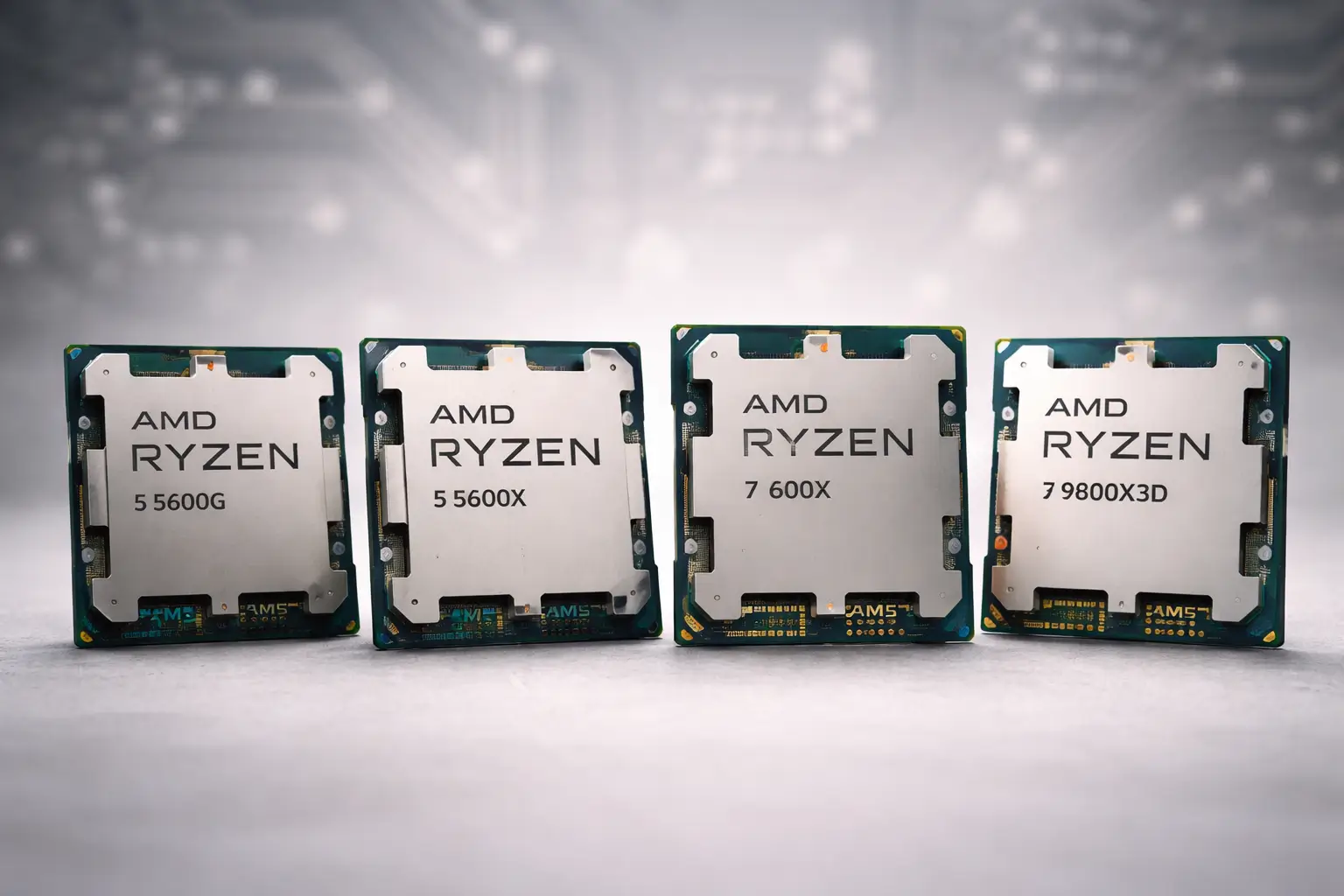
This article answers that directly by comparing the Ryzen 5 5600G with newer mainstream and high-end Ryzen chips, including the Ryzen 5 5600X, Ryzen 5 7600X, and Ryzen 7 9800X3D, focusing only on differences that affect real buying and upgrade decisions.
Where the Ryzen 5 5600G Stands Today
The Ryzen 5 5600G is a 6-core, 12-thread processor based on AMD’s Zen 3 architecture with integrated Radeon graphics. Its defining characteristic has always been balance: acceptable CPU performance combined with one of the strongest integrated GPUs of its generation.
What has changed since its launch is not the chip itself, but the ecosystem around it. Newer Ryzen CPUs have moved forward in three key ways:
- CPU architecture and instructions per clock
- Platform and memory support
- Performance specialization (gaming vs productivity)
Understanding those shifts is essential to evaluating the 5600G’s relevance today.
Architectural Progress: Zen 3 vs Newer Zen Generations
Ryzen 5 5600G: Zen 3 (Monolithic Design)
The Ryzen 5 5600G uses a monolithic Zen 3 design optimized for integrated graphics. Compared to chiplet-based Zen 3 CPUs, it trades some cache and raw CPU performance for better GPU integration and lower latency.
Key architectural traits:
- Zen 3 cores
- Lower L3 cache than non-G Zen 3 CPUs
- Strong CPU–GPU communication
- PCIe 3.0 support
Ryzen 5 7600X: Zen 4 Leap
The Ryzen 5 7600X represents a generational shift:
- Zen 4 cores with higher IPC
- Much higher clock speeds
- DDR5-only memory support
- PCIe 5.0 platform
In pure CPU workloads, the 7600X is significantly faster per core and per thread than the 5600G. However, its integrated graphics are minimal and not intended for gaming.
Ryzen 7 9800X3D: Specialized Zen with 3D Cache
The Ryzen 7 9800X3D is not a general upgrade comparison but shows how AMD’s priorities have shifted:
- Large 3D V-Cache stacked on Zen cores
- Exceptional gaming performance
- Designed for discrete GPUs only
This highlights a major change: newer Ryzen chips increasingly assume a dedicated graphics card.
CPU Performance: Real-World Differences That Matter
Single-Core and Multi-Core Gains
Compared to the Ryzen 5 5600G:
- Ryzen 5 5600X delivers noticeably higher CPU performance due to more cache and higher clocks
- Ryzen 5 7600X offers a substantial jump in both single-core and multi-core workloads
- Ryzen 7 9800X3D is in a different class entirely, especially for gaming
For everyday tasks such as browsing, office work, and light content creation, the 5600G still feels responsive. The difference becomes clear in:
- Heavy multitasking
- Video rendering
- Code compilation
- CPU-intensive gaming paired with a GPU
Productivity vs Efficiency
The 5600G remains power-efficient and thermally manageable. Newer chips deliver more performance but often require:
- Better cooling
- Higher power budgets
- Newer, more expensive motherboards
Integrated Graphics: The Area Where the 5600G Still Competes
Radeon Graphics on Ryzen 5 5600G
The integrated Radeon GPU on the 5600G is still one of the strongest iGPUs AMD has shipped in a desktop CPU.
Practical implications:
- Playable esports titles at 1080p (with settings adjusted)
- Light creative workloads without a GPU
- Functional entry-level gaming builds
New Ryzen CPUs and iGPU Trade-Offs
- Ryzen 5 5600X: no integrated graphics
- Ryzen 5 7600X: basic RDNA-based iGPU, display-focused
- Ryzen 7 9800X3D: no integrated graphics
AMD’s newer strategy assumes discrete GPUs, making the 5600G unique for users who want an all-in-one processor.
Gaming Performance: Context Matters More Than Raw Numbers
Without a Discrete GPU
If no graphics card is used:
- Ryzen 5 5600G clearly outperforms newer Ryzen CPUs
- It remains the better option for budget and compact systems
With a Discrete GPU
Once paired with a dedicated GPU:
- Ryzen 5 5600X pulls ahead due to higher cache and clocks
- Ryzen 5 7600X offers significantly higher frame rates in CPU-bound games
- Ryzen 7 9800X3D dominates high-refresh and competitive gaming
This is one of the most important distinctions users overlook when comparing generations.
Platform and Upgrade Path Differences
AM4 Platform (Ryzen 5 5600G and 5600X)
Advantages:
- Mature, affordable motherboards
- DDR4 memory compatibility
- Wide BIOS support
- Lower total system cost
Limitations:
- No PCIe 5.0
- End of platform upgrades
AM5 Platform (Ryzen 5 7600X and Beyond)
Advantages:
- Long-term platform support
- DDR5 performance scaling
- PCIe 5.0 readiness
Trade-offs:
- Higher motherboard cost
- DDR5 pricing
- Not ideal for budget builds
For many users, platform cost—not CPU price—is the deciding factor.
Pricing Shifts and Value Positioning
The Ryzen 5 5600G has transitioned from a mainstream launch CPU to a value-focused option.
Current value considerations:
- Lower total system cost than newer Ryzen CPUs
- No need for a GPU in entry builds
- Strong availability in prebuilt and OEM systems
By contrast:
- Ryzen 5 7600X offers better long-term performance but at a higher platform cost
- Ryzen 7 9800X3D targets a completely different buyer profile
Use-Case Breakdown: Which CPU Fits Which User
Ryzen 5 5600G Still Makes Sense If You:
- Want integrated graphics without a GPU
- Are building a budget or compact PC
- Use AM4 components already
- Prioritize efficiency and cost control
New Ryzen CPUs Make Sense If You:
- Plan to use a dedicated GPU
- Want higher gaming frame rates
- Need strong productivity performance
- Are building a system for long-term upgrades
Key Changes Summarized Clearly
What has changed since the Ryzen 5 5600G launched:
- AMD shifted focus away from strong desktop iGPUs
- CPU performance gains are now tied to newer platforms
- Gaming leadership moved to cache-heavy designs
- Budget all-in-one CPUs became less common
What has not changed:
- The 5600G remains competent for everyday use
- Integrated graphics still matter for many users
- Platform cost continues to influence buying decisions