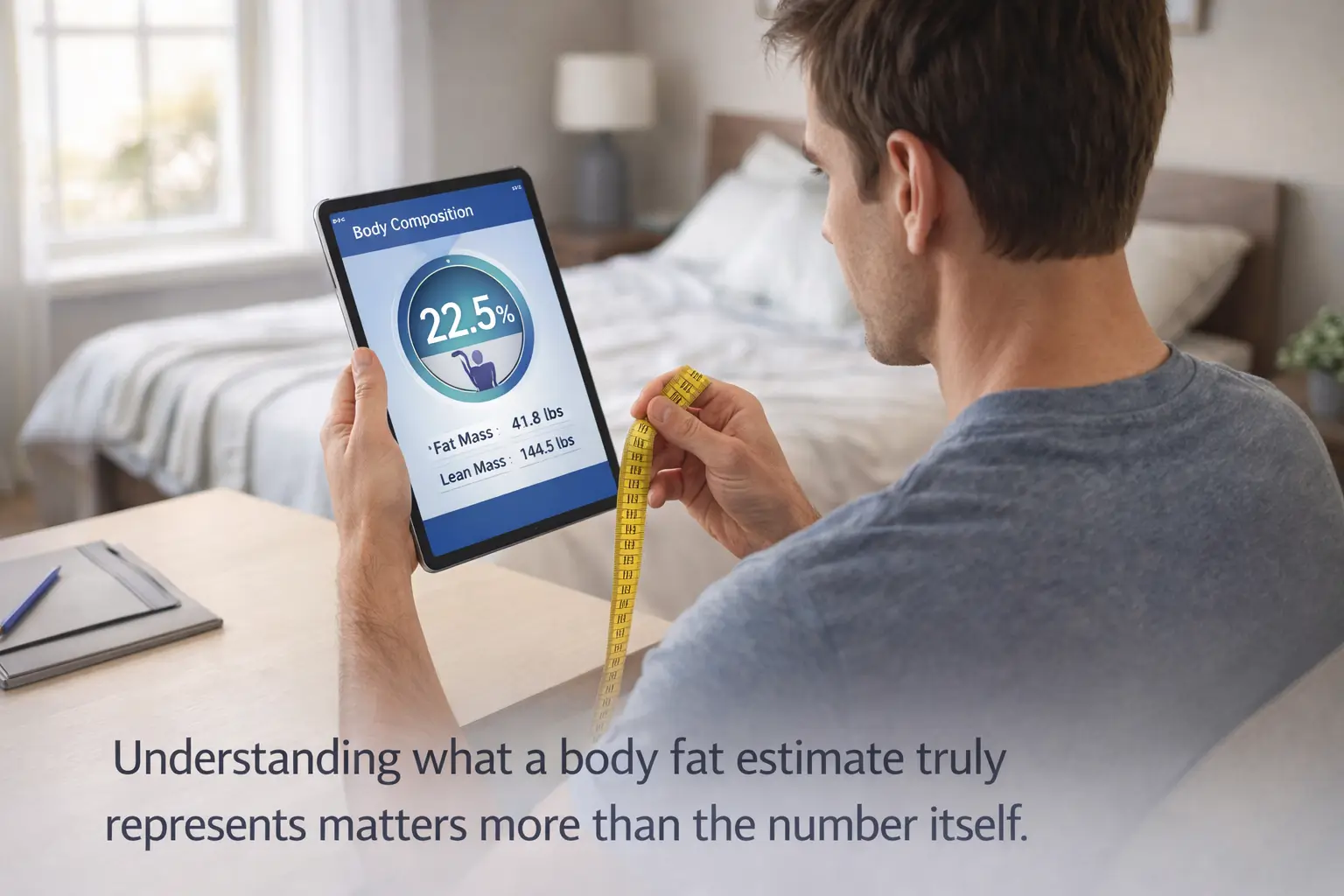
A number on a screen can look definitive. Enter your height, weight, age, and gender into a Body Fat Percentage Calculator, and within seconds you receive a figure that appears to describe your health, fitness, and progress. Yet for many people, that number becomes a source of confusion rather than clarity. It changes from one calculator to another, shifts overnight without explanation, and sometimes contradicts what the mirror and your clothes are telling you.
Before you trust the result, it is worth understanding what these calculators actually measure, what they cannot capture, and which checks matter most if you want a meaningful estimate.

Why body fat percentage matters more than weight
Weight alone says little about health. Two people with the same weight and height can have very different metabolic profiles, cardiovascular risk, and physical performance. Body fat percentage attempts to separate fat mass from lean mass, offering insight into:
- Risk of metabolic conditions such as insulin resistance and dyslipidaemia
- Cardiovascular strain and inflammatory load
- Athletic performance and recovery
- Hormonal balance and fertility
- Long-term weight-management outcomes
In clinical practice and sports science, body composition is often more predictive of health than body mass index. That is why calculators have become popular in gyms, health apps, and medical portals.
What a body fat percentage calculator is actually estimating
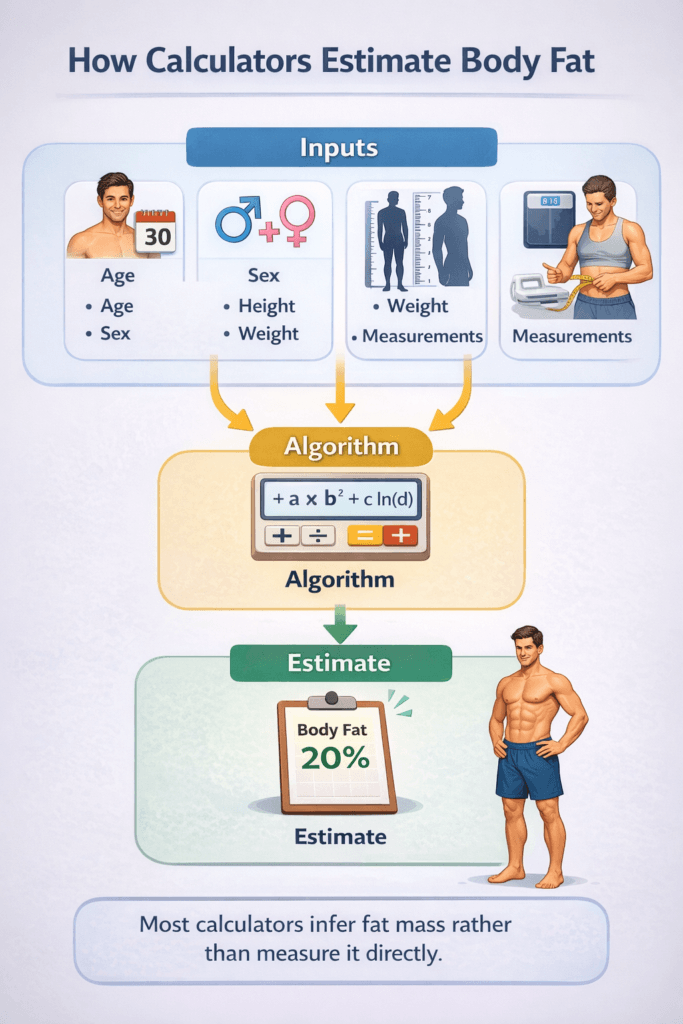
Most online and app-based tools do not measure fat directly. They infer it using statistical models built on population data. Common inputs include:
- Height and weight
- Age and sex
- Waist, hip, neck, or thigh circumference (in some versions)
From these, formulas estimate the proportion of body mass likely to be fat tissue. The most widely used models include:
- Deurenberg equation (BMI-based)
- U.S. Navy circumference method
- YMCA and Jackson-Pollock derived equations
These formulas work reasonably well at a population level. At an individual level, their accuracy varies widely depending on body type, ethnicity, training status, and fat distribution.

First check: which method is the calculator using?
The single most important question is methodological.
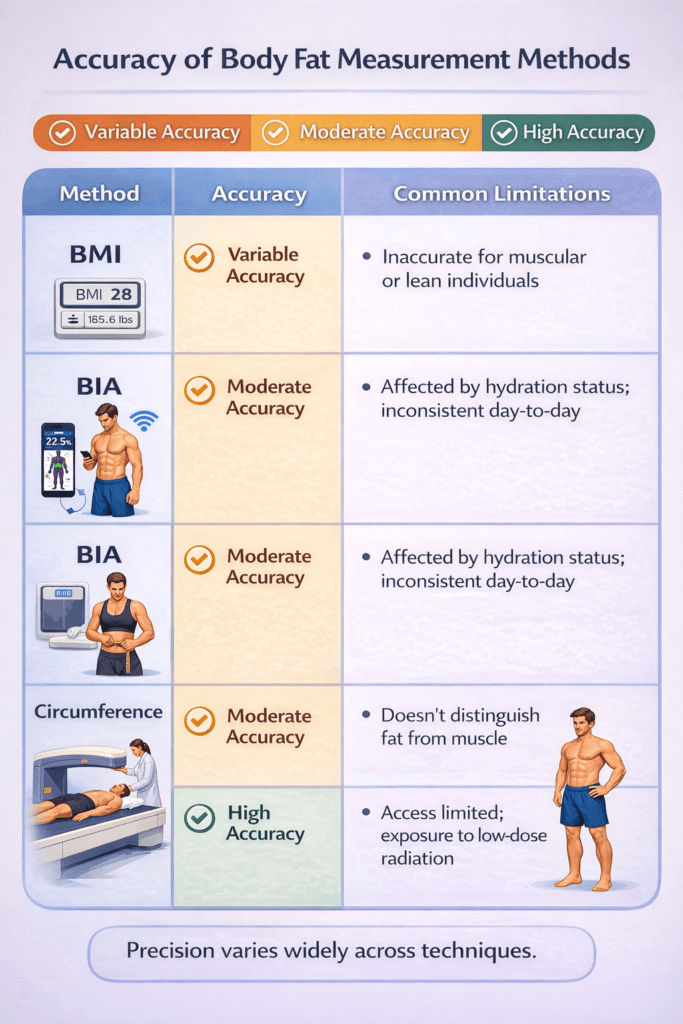
BMI-based calculators
These rely on body mass index combined with age and sex. They are easy to use and widely available, but they assume an “average” body composition for a given BMI.
Limitations:
- Overestimate fat in muscular individuals
- Underestimate fat in people with low muscle mass
- Perform poorly at very high or very low BMI ranges
Circumference-based calculators
These incorporate waist, hip, or neck measurements to capture fat distribution.
Strengths:
- Better reflects central fat accumulation
- More accurate for general populations
Risks:
- Sensitive to tape placement and posture
- Errors of 1–2 cm can shift results significantly
Device-based calculators (BIA)
Many smart scales and gym machines use bioelectrical impedance analysis, sending a small electrical current through the body.
Advantages:
- Quick and repeatable
- Tracks trends over time
Limitations:
- Highly sensitive to hydration, meals, caffeine, and exercise
- Different devices produce different values
If the calculator does not clearly state its method, treat the result as a rough orientation rather than a precise measure.
Second check: are your inputs realistic and consistent?
Small input errors propagate into large output changes.
Common sources of distortion include:
- Measuring waist at the wrong level (above the navel instead of mid-abdomen)
- Holding the tape too tight or too loose
- Rounding height or weight inconsistently
- Measuring after exercise or large meals
For repeat measurements:
- Measure at the same time of day
- Use the same tape, posture, and breathing phase
- Avoid comparing values from different calculators
Consistency matters more than the absolute number when tracking progress.
Third check: does the result fit your body type?
Population formulas assume an “average” fat-to-muscle ratio. Many people fall outside that assumption.
Athletes and resistance-trained individuals
High muscle mass pushes BMI upward, inflating fat estimates. A lean athlete may be reported as “overfat” despite low true body fat.
Older adults
Age-related muscle loss leads to fat underestimation. Two individuals with the same BMI at 25 and 65 do not have the same body composition.
Ethnic variation
Research shows systematic differences in fat distribution between South Asian, East Asian, European, and African populations at the same BMI. South Asians, in particular, tend to accumulate visceral fat at lower body weights.
Most generic calculators do not adjust adequately for these patterns.
Fourth check: is the number biologically plausible?
Healthy body fat ranges differ by sex and life stage.
Approximate reference ranges:
Men
- Essential fat: 2–5%
- Athletes: 6–13%
- Fitness: 14–17%
- Average: 18–24%
- Obese: ≥25%
Women
- Essential fat: 10–13%
- Athletes: 14–20%
- Fitness: 21–24%
- Average: 25–31%
- Obese: ≥32%
If a calculator reports values far outside these ranges without a clear explanation, accuracy is unlikely.
Fifth check: understand day-to-day variation
True fat mass does not change overnight. Yet calculators often report shifts of 1–3 percentage points in 24 hours.
The main drivers are:
- Hydration status
- Glycogen levels after exercise
- Sodium intake
- Gastrointestinal contents
- Skin temperature and blood flow
This is especially relevant for BIA-based systems.
Interpret short-term fluctuations cautiously. Look for multi-week trends, not daily changes.
When calculators are useful — and when they are not
Useful for
- Monitoring long-term direction of change
- Comparing against your own baseline
- Screening large populations
- Motivational tracking when used consistently
Not reliable for
- Clinical diagnosis
- Athletic performance optimisation
- Medical decision-making
- Assessing visceral fat risk precisely
For higher accuracy, reference methods include:
- Dual-energy X-ray absorptiometry (DEXA)
- Air displacement plethysmography (Bod Pod)
- Hydrostatic weighing
- MRI or CT for visceral fat assessment
These are costlier and less accessible, but far more precise.
Interpreting results in a health context
Body fat percentage should never be read in isolation. Clinicians interpret it alongside:
- Waist circumference and waist-to-hip ratio
- Blood glucose and lipid profile
- Blood pressure
- Fitness capacity
- Inflammatory markers
A moderate fat percentage with high visceral fat may carry more risk than a higher total fat percentage with peripheral distribution.
Practical guidance for everyday users
If you rely on a Body Fat Percentage Calculator, follow these principles:
- Use one method consistently rather than switching tools
- Measure under similar conditions each time
- Focus on trend direction, not single readings
- Cross-check with waist measurements and fitness indicators
- Treat results as estimates, not diagnoses
For most people, waist circumference and strength-to-weight progress are often more informative than precise fat percentages.
Where current tools are improving
Recent trends include:
- Ethnicity-adjusted algorithms in clinical research
- Multi-frequency BIA for better fluid discrimination
- Integration with metabolic and activity data
- AI-assisted segmentation in imaging-based assessments
However, no consumer-grade tool currently provides laboratory-level accuracy outside controlled conditions.
Where current tools are improving
Recent trends include:
- Ethnicity-adjusted algorithms in clinical research
- Multi-frequency BIA for better fluid discrimination
- Integration with metabolic and activity data
- AI-assisted segmentation in imaging-based assessments
However, no consumer-grade tool currently provides laboratory-level accuracy outside controlled conditions.
Final perspective
A body fat percentage number can be helpful, but only if you understand its origin, limits, and context. Calculators are best viewed as navigational aids rather than measuring instruments. The most meaningful insight comes not from the decimal point, but from how your body functions, performs, and responds over time.
Disclaimer
This article is for informational purposes only and does not replace medical advice, diagnosis, or professional health assessment.