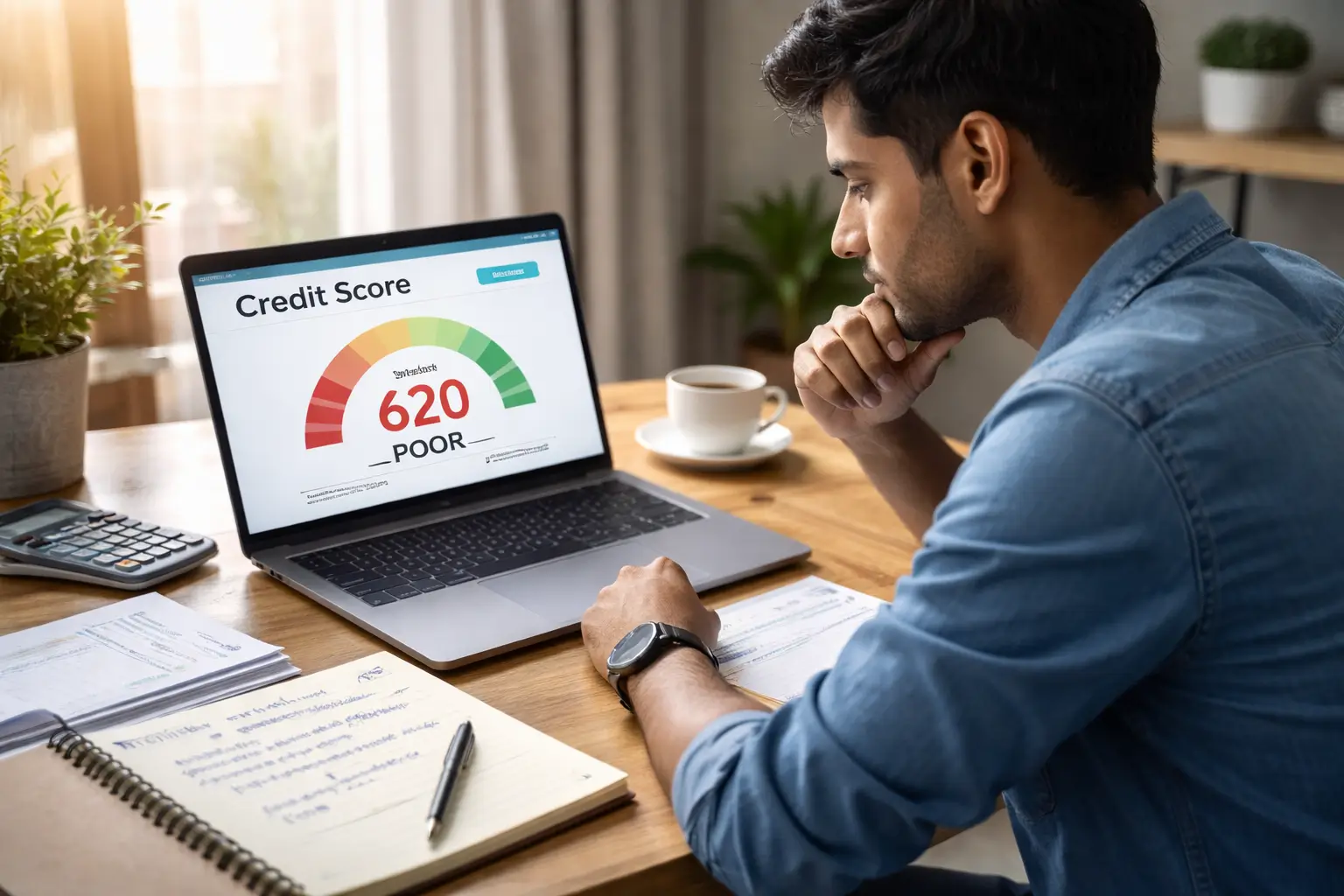
You check your credit report and see 650 or lower.
Instant tension.
Loan reject ho jayega? Credit card milega? Home loan ka kya hoga?
If you’re searching “credit score below 650 what to do”, you’re probably planning something important — a loan, credit card, or maybe you just got rejected.
Take a breath.
A score below 650 is not the end. It’s a warning signal — and signals can be corrected.
In this detailed guide, I’ll explain:
- What a 650 credit score actually means
- Why it drops
- Safe and practical steps to improve it
- What to avoid
- Realistic recovery timeline
This advice is based on how Indian credit bureaus like CIBIL, Experian, and Equifax evaluate profiles — not shortcuts or risky hacks.
What Does Credit Score Below 650 Mean?
A credit score below 650 generally indicates higher credit risk to lenders. It often results from missed payments, high credit utilization, loan defaults, or limited credit history. While approval becomes harder, improving repayment behavior and reducing debt can gradually raise the score.
Is 650 a Very Bad Credit Score?
Not “very bad.” But it is considered below average.
Here’s a simplified range (India context):
| Credit Score Range | Meaning |
|---|---|
| 750 – 900 | Excellent |
| 700 – 749 | Good |
| 650 – 699 | Fair / Average |
| Below 650 | Risky for lenders |
At below 650:
- Loan approvals become stricter
- Interest rates may be higher
- Credit card approvals reduce
- NBFCs may still approve but at higher cost
So the real question is:
Credit score below 650 what to do next?
Let’s break it step by step.
Why Did Your Credit Score Drop Below 650?
Before fixing, understand the cause.
1️⃣ Late or Missed EMI Payments
Even one 30-day delay can hurt.
Payment history contributes nearly 30–35% of your score.
2️⃣ High Credit Utilization Ratio
If you’re using more than 30–40% of your credit card limit regularly, score drops.
Example:
- Credit limit: ₹1,00,000
- Usage: ₹80,000
- Utilization = 80% (high risk signal)
3️⃣ Multiple Loan Applications
Every hard inquiry reduces score slightly.
Too many applications = desperation signal.
4️⃣ Loan Settlement Instead of Closure
Settlement is reported negatively.
It tells lenders you didn’t repay full amount.
5️⃣ Errors in Credit Report
Sometimes:
- Wrong account marked
- Closed loan shown active
- Duplicate entries
This is more common than people think.
Credit Score Below 650 What to Do – Step-by-Step Action Plan
Let’s move from stress to solution.
Step 1: Download Your Credit Report First
Do not guess.
Check your report from:
- CIBIL
- Experian
- Equifax
Look for:
- Late payment remarks
- High balances
- Errors
- Written-off or settled accounts
Without diagnosis, improvement is blind.
Step 2: Clear All Overdue Payments Immediately
If any EMI is overdue:
Pay it first.
Even partial payment helps show intent.
Then ensure:
- No future delays
- Auto-debit activated
- EMI reminder set
Consistency builds score faster than one-time correction.
Step 3: Reduce Credit Utilization to Below 30%
This is one of the fastest improvements.
Example:
If your limit is ₹1,00,000:
Try to keep usage under ₹30,000.
If possible:
- Pay twice per month
- Increase limit (without increasing spending)
Lower utilization = higher score.
Step 4: Avoid New Loan Applications for 3–6 Months
If your score is below 650:
Stop applying everywhere.
Each rejection hurts confidence and score.
Instead:
Focus on repairing profile first.
Step 5: Correct Errors Through Dispute Process
If you find mistakes:
File dispute directly through bureau portal.
Resolution time: 15–30 days typically.
Keep:
- Loan closure proof
- NOC certificates
- Settlement letters
Documentation is important.
Step 6: Consider Secured Credit Card
If your score is very low (600–630 range):
Apply for:
- Secured credit card against FD
This helps:
- Build positive history
- Improve payment track
Use it lightly and pay full bill.
Step 7: Maintain Positive Activity for 6 Months
Credit score recovery needs:
- Time
- Discipline
- Clean repayment
No shortcut works long term.
How Long Does It Take to Improve from Below 650?
Realistically:
| Action | Expected Impact Timeline |
|---|---|
| Clearing overdue | 30–60 days |
| Reducing utilization | 1–2 billing cycles |
| Dispute correction | 1 month |
| Consistent repayment | 3–6 months |
| Major recovery | 6–12 months |
Important: Big jumps overnight are rare.
Steady improvement is normal.
Can You Still Get a Loan with Credit Score Below 650?
Yes — but conditions apply.
Possible Options:
- NBFC personal loans
- Secured loans (gold loan, FD-backed)
- Co-applicant with strong score
But:
Interest rate will be higher.
Best approach:
Improve score before major loans like home loan.
Things You Should NOT Do
When people search “credit score below 650 what to do”, they often fall for shortcuts.
Avoid:
❌ Paying companies claiming “instant score boost”
❌ Loan cycling (taking new loan to pay old one repeatedly)
❌ Credit repair scams
❌ Closing old credit card (it reduces credit history length)
❌ Settling accounts casually
Safe improvement takes time, not tricks.
Pros & Cons of Taking Immediate Loan Below 650
Pros
- Urgent financial need fulfilled
- Opportunity to rebuild via timely repayment
Cons
- Higher interest rate
- Processing fees
- Risk of deeper debt trap
If possible, improve first.
Emotional Side: Don’t Panic
Financial stress is real.
But a low score doesn’t mean:
- You are irresponsible
- You can’t recover
- Your future is ruined
Many salaried professionals temporarily drop below 650 due to:
- Medical emergencies
- Job switch delays
- Unexpected expenses
Recovery is common.
Credit Score Below 650 What to Do – Quick Summary
If you want a simplified checklist:
- Download credit report
- Pay overdue EMIs
- Reduce utilization below 30%
- Avoid new loans
- Dispute errors
- Use secured card if needed
- Maintain discipline for 6 months
Consistency > urgency.
Frequently Asked Questions (FAQs)
1. Can credit score increase 100 points in 3 months?
Possible but depends on reason for drop. Clearing overdue + lowering utilization can create noticeable improvement, but not guaranteed.
2. Does checking credit score reduce it?
No. Checking your own score is a soft inquiry and does not impact score.
3. Is 650 enough for personal loan in India?
Some lenders may approve, but interest rate could be higher. Above 700 is safer.
4. How many points does one missed EMI reduce?
Depends on profile. It can reduce 20–80 points depending on severity and history.
5. Should I close my credit card to improve score?
No. Closing reduces credit history length and total available credit, which may hurt score.
6. Does loan settlement permanently damage credit score?
It affects profile negatively for several years. Full repayment is always better.
7. What is ideal credit utilization ratio?
Below 30% is considered healthy.
Conclusion
If your credit score is below 650, the most important thing is clarity — not panic.
The solution is not aggressive borrowing or risky shortcuts.
It’s disciplined repayment, lower utilization, and patience.
Financial credibility is built slowly — but once rebuilt, it stays strong.
If you’re serious about improving your financial profile, start today with your credit report review.
Small corrections today prevent major loan rejection tomorrow.
Disclaimer
This article provides general financial education and does not constitute financial advice. Loan approval policies vary by lender. Always verify details directly with financial institutions before making decisions.