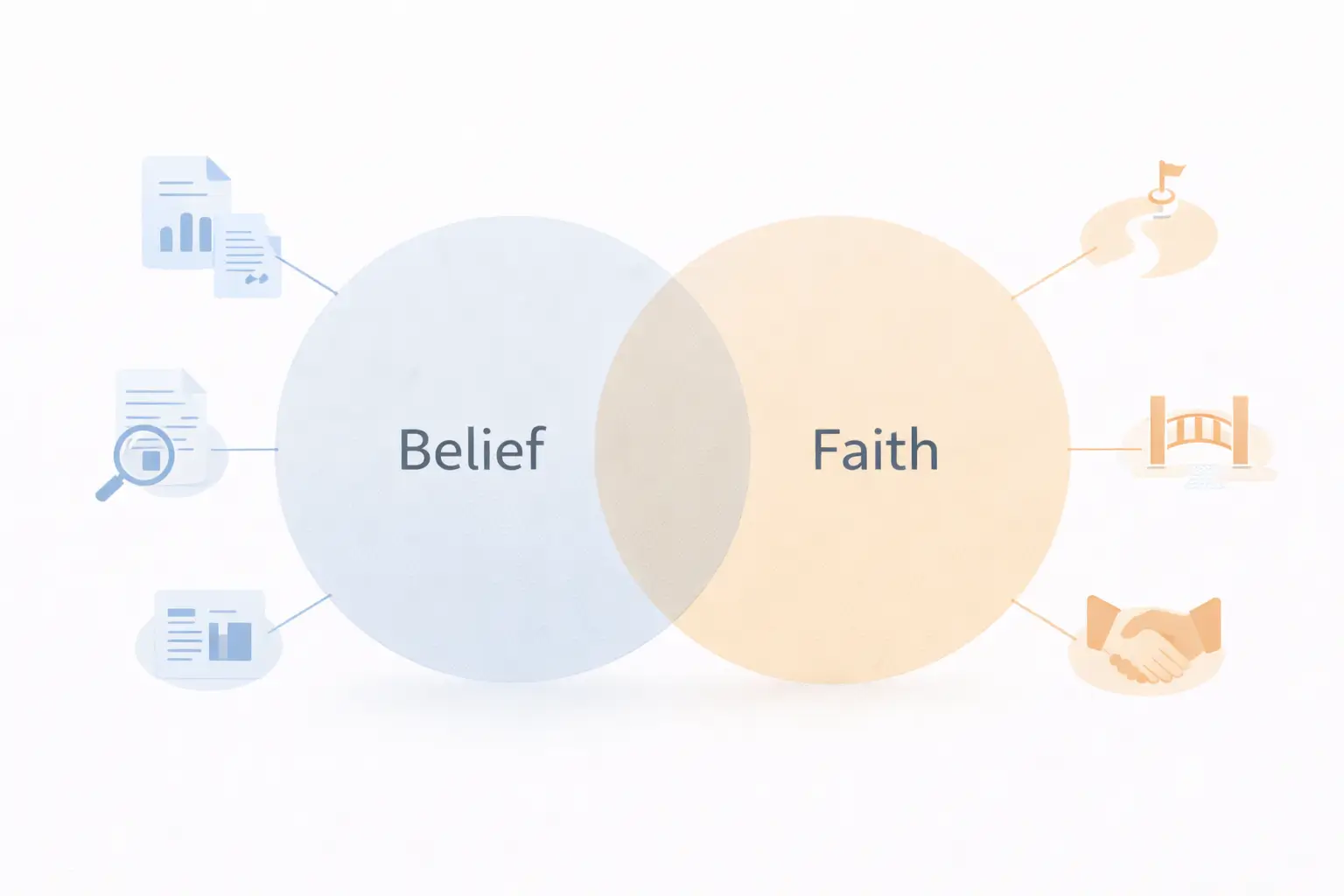
The difference between faith and belief is straightforward once the terms are separated by how they function. Belief is acceptance that something is true, usually based on information, experience, or evidence. Faith is commitment or trust that continues even when evidence is incomplete or absent. People often use the words interchangeably, but they describe different mental and emotional positions.
Understanding this distinction helps clarify conversations about religion, relationships, decision-making, and personal values.
What belief means in simple terms
Belief is primarily cognitive. It refers to what the mind accepts as true.
Core characteristics of belief
- Formed through information, observation, or reasoning
- Can change when new evidence appears
- Often conditional and revisable
- Does not require emotional commitment
Examples:
- Believing it will rain because the forecast predicts it
- Believing a fact after reading reliable data
- Believing someone’s explanation based on past accuracy
Beliefs operate like conclusions the mind reaches and can update.
What faith means in simple terms
Faith is primarily relational and emotional. It involves trust, reliance, or confidence that goes beyond proof.
Core characteristics of faith
- Sustained even without full evidence
- Involves personal commitment
- Often linked to values or identity
- Less dependent on constant verification
Examples:
- Having faith in a person despite uncertainty
- Having faith in a principle or path during difficulty
- Having faith that effort will lead to meaning, even without guarantees
Faith operates like a stance or posture toward uncertainty.
The core difference between faith and belief
The difference between faith and belief lies in certainty versus trust.
| Aspect | Belief | Faith |
|---|---|---|
| Basis | Evidence or information | Trust without full proof |
| Nature | Intellectual | Emotional and volitional |
| Flexibility | Easily revised | More enduring |
| Requirement | Convincing reasons | Commitment despite uncertainty |
Belief answers “What do I think is true?”
Faith answers “What am I willing to trust or stand by?”
How belief can exist without faith
A person can hold a belief without any deep commitment to it.
Examples:
- Believing a statistic without caring about its outcome
- Believing a rule exists but not trusting it to be fair
- Believing a method works but not relying on it personally
In these cases, belief stays at the level of acknowledgment.
How faith can exist without belief
Faith does not always require detailed belief.
Examples:
- Trusting a process without understanding it
- Having faith in someone while doubting specific outcomes
- Committing to a path despite unanswered questions
Here, faith functions as commitment in uncertainty.
Difference between faith and belief in religion
In religious contexts, the distinction becomes clearer.
- Belief often refers to accepting doctrines or teachings
- Faith refers to trusting, following, or committing to those teachings
A person may believe religious ideas intellectually without practicing them. Another may practice faithfully while struggling with belief. This distinction explains why belief alone is often not considered sufficient for faith-based commitment.
Difference between faith and belief in daily life
Outside religion, the difference appears in practical decisions.
In relationships
- Belief: thinking someone is reliable
- Faith: trusting them even when circumstances are unclear
In work or goals
- Belief: thinking success is possible
- Faith: continuing effort despite setbacks
In values
- Belief: agreeing with an idea
- Faith: living by it consistently
Faith shows up in action more than in opinion.
Why people confuse faith and belief
They are often confused because:
- They overlap in language
- Both relate to truth and trust
- Everyday speech treats them as synonyms
However, confusion leads to misunderstanding, especially in debates where one person is discussing evidence while the other is discussing commitment.
Why the distinction matters
Understanding the difference between faith and belief helps in several ways:
- Clarifies disagreements by identifying whether the issue is evidence or trust
- Improves communication in personal and professional settings
- Prevents false assumptions about motives or certainty
- Helps individuals examine their own thinking more accurately
It allows people to articulate whether they are asking for proof or asking for trust.
A simple way to remember the difference
- Belief is about what you accept as true
- Faith is about what you commit to despite uncertainty
Belief is something you hold.
Faith is something you stand on.