Search is not just about keywords anymore.
In 2026, Google understands entities, relationships, and context more than ever. If you’re still optimizing only for keywords, you’re already behind.
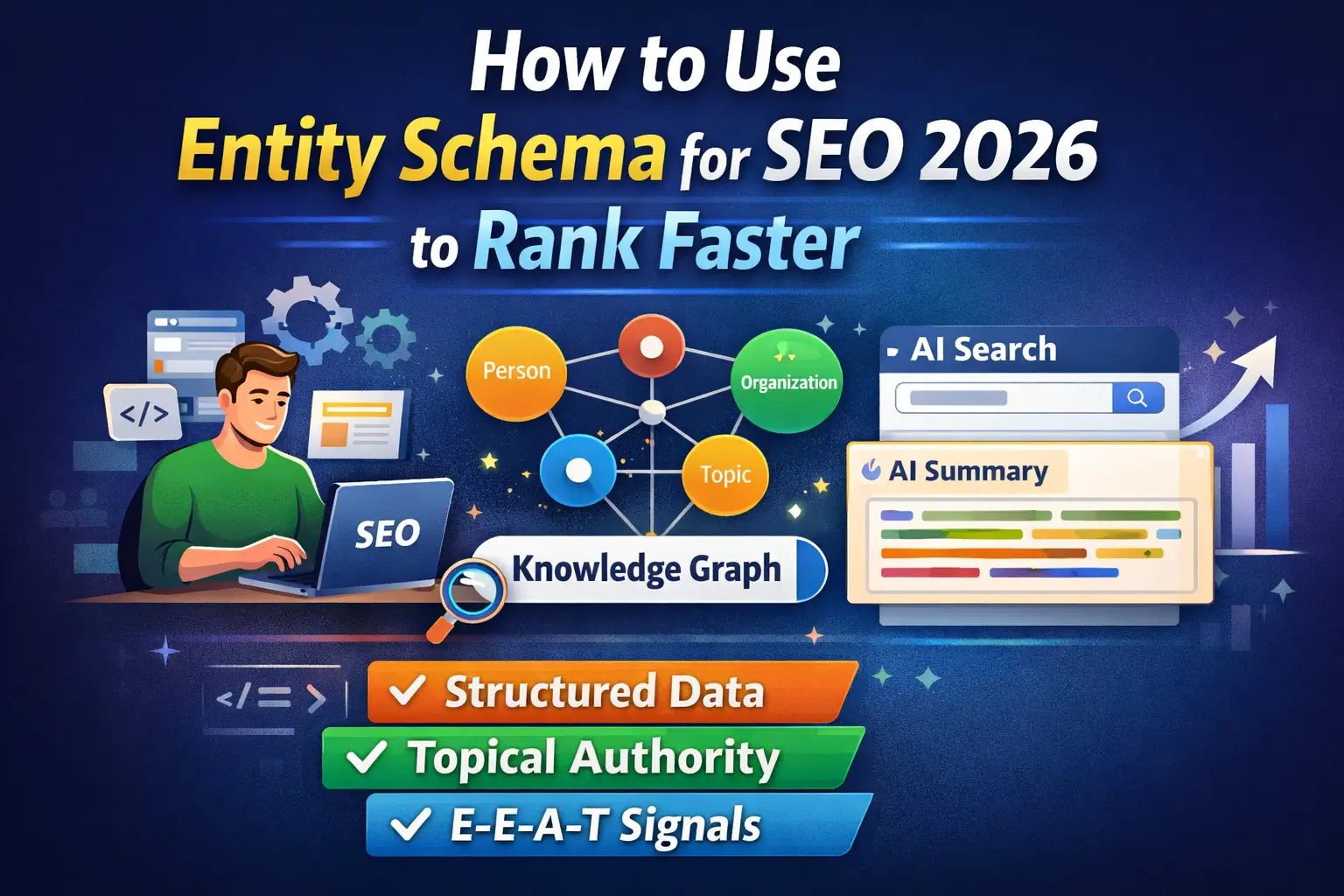
In this guide, I’ll explain how to use entity schema for SEO 2026 in a practical, real-world way — no theory overload, no coding drama. Just clear steps that actually help you rank faster and build authority.
I’ve implemented entity-based schema for niche blogs, local businesses, and authority sites — and the ranking difference is visible when done correctly.
Let’s break it down.
What Is Entity Schema? (Featured Snippet Definition)
Entity schema is structured data that helps search engines understand people, places, organizations, and concepts as unique entities, not just keywords. It connects your content to Google’s Knowledge Graph and improves contextual relevance, authority signals, and AI search visibility.
Simple words:
Entity schema tells Google who you are, what you’re about, and how you connect to other topics.
Why Entity SEO Matters More in 2026
Search has changed in 3 major ways:
- AI-driven search results
- Knowledge Graph expansion
- E-E-A-T evaluation signals
Google now evaluates:
- Topical authority
- Brand signals
- Entity connections
- Content relationships
If your site clearly defines its entity relationships, Google trusts you faster.
That means:
- Faster indexing
- Better topical clustering
- Improved semantic rankings
- Higher chance of appearing in AI summaries
How to Use Entity Schema for SEO 2026 (Step-by-Step)
Let’s go practical.
Step 1: Define Your Primary Website Entity
Every site must clearly define:
- Organization
- Person (author)
- Website
- Brand
Use These Schema Types:
OrganizationPersonWebSite
Example (Conceptual Structure)
- Website → belongs to → Organization
- Articles → written by → Person
- Person → works for → Organization
This structured clarity improves trust signals.
Step 2: Build Author Entity Properly (Critical for E-E-A-T)
In 2026, author identity is extremely important.
Your author page must include:
- Full name
- Expertise area
- Real experience
- Social profiles (LinkedIn, X, etc.)
- Same As schema links
Why?
Because Google connects:
Author → Topic → Website → Industry
If you write about SEO, your entity must consistently align with SEO topics — not random niches.
Step 3: Add Structured Data to Every Article
For blog posts, use:
ArticleBlogPostingBreadcrumbListFAQPage(if FAQ exists)
Make sure:
- Headline matches page title
- Author linked properly
- Published date visible
- MainEntityOfPage defined
Consistency is key.
Step 4: Strengthen Topical Entity Relationships
Entity SEO is not just schema markup.
It includes:
- Internal linking clusters
- Consistent terminology
- Contextual keyword usage
- Topic silos
Example:
If your topic is:
how to use entity schema for SEO 2026
Related supporting content should include:
- Semantic SEO
- Knowledge Graph
- Structured data
- E-E-A-T optimization
- Google AI search
This builds topical authority.
Step 5: Use SameAs & External Entity References
Link your entity to:
- Official social profiles
- Wikidata (if applicable)
- Crunchbase (for brands)
- Industry listings
This confirms identity consistency.
Think of it as digital identity verification.
Step 6: Optimize for AI & SGE-Style Results
AI search engines rely heavily on entity relationships.
To align:
- Use clear definitions
- Answer direct questions
- Structure headings logically
- Use short paragraphs
- Avoid fluff
AI prefers structured clarity.
Common Mistakes to Avoid
❌ Adding random schema without structure
❌ Using outdated markup formats
❌ Mixing multiple authors incorrectly
❌ Not linking author entity properly
❌ Ignoring topical consistency
Entity schema works only when your entire site ecosystem supports it.
Pros and Cons of Entity Schema SEO
| Pros | Cons |
|---|---|
| Stronger contextual relevance | Requires proper planning |
| Better AI visibility | Technical setup needed |
| Improved E-E-A-T signals | Results not instant |
| Helps Knowledge Graph inclusion | Needs consistent maintenance |
Real-World Insight (Experience-Based Tip)
From practical implementation:
Sites that combine:
- Strong entity schema
- Clean internal linking
- Consistent author identity
See ranking stability during algorithm updates.
Entity clarity reduces volatility.
FAQ: How to Use Entity Schema for SEO 2026
1. Is entity schema mandatory for SEO in 2026?
Not mandatory, but highly recommended. It strengthens contextual understanding and improves trust signals.
2. Can beginners implement entity schema?
Yes. Many SEO plugins allow structured data setup without coding.
3. Does entity schema guarantee rankings?
No. It supports ranking by improving clarity and authority, but content quality still matters.
4. How long does it take to see results?
Typically weeks to months, depending on site authority and competition.
5. Is entity SEO different from keyword SEO?
Yes. Keyword SEO focuses on phrases; entity SEO focuses on meaning and relationships.
6. Should small blogs use entity schema?
Absolutely. It helps smaller sites build structured authority faster.
Key Takeaways
- SEO in 2026 is entity-driven, not just keyword-driven.
- Define your brand, author, and website clearly.
- Maintain topical consistency.
- Use structured data strategically.
- Align with AI search systems.
Conclusion
If you truly want to rank faster in 2026, you need to think beyond keywords.
Entity schema is about clarity, identity, and authority.
When search engines clearly understand:
- Who you are
- What you specialize in
- How your content connects
Ranking becomes easier and more stable.
Start small. Define your primary entity. Build clean relationships. Stay consistent.
SEO is evolving — adapt before your competitors do.