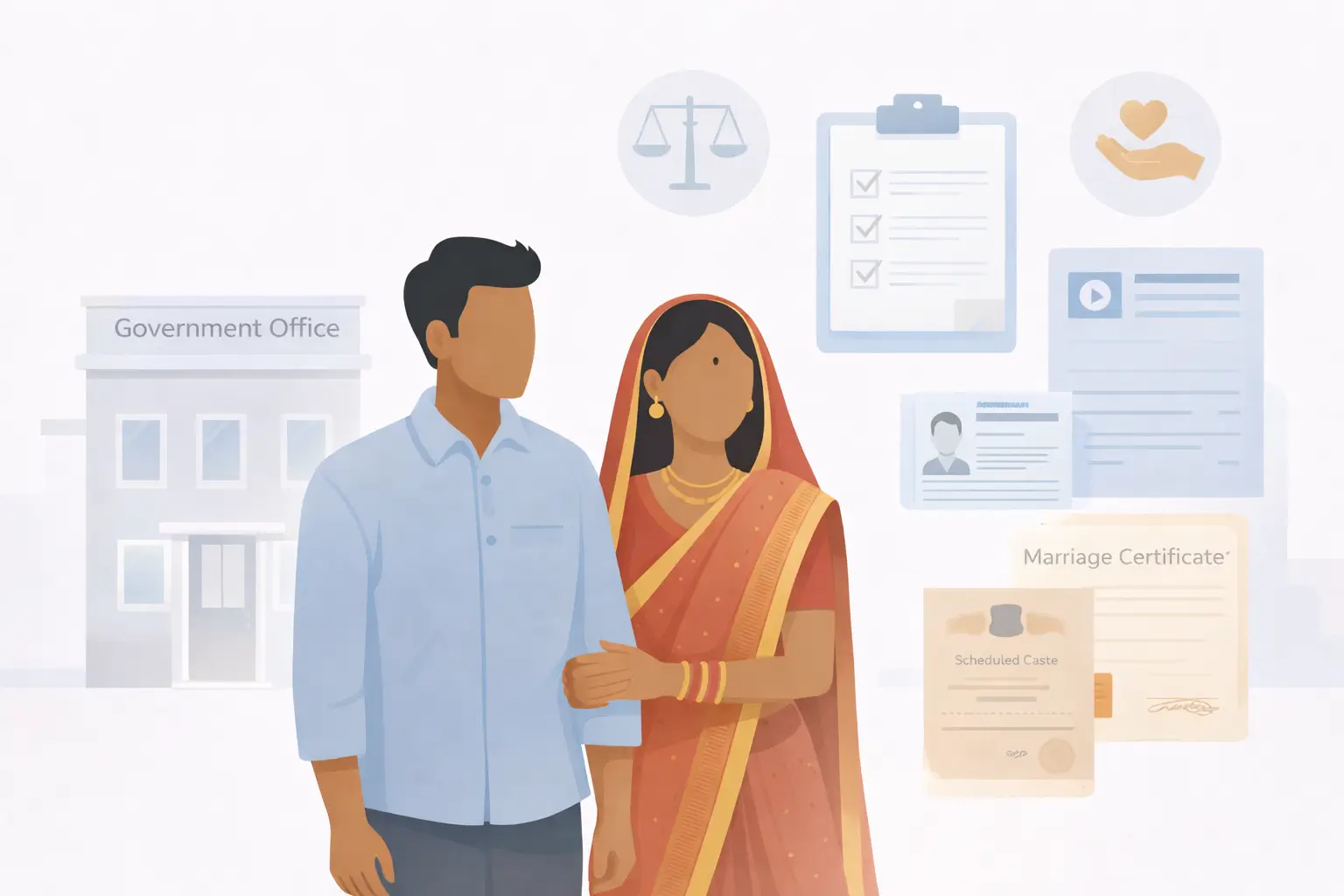
Marrying across caste lines is a deeply personal choice, but in India it often comes with social and financial pressures. That is why the inter caste marriage scheme exists: to support couples who marry outside traditional caste boundaries, especially when one partner belongs to a Scheduled Caste (SC). The scheme offers financial assistance and formal recognition, but only if specific rules and eligibility conditions are met.
This guide explains those rules clearly, outlines who qualifies, and shows how the process works in practice. If you are planning to apply—or advising someone who is—this article focuses only on what matters.
Why the inter caste marriage scheme matters today
Despite legal equality, caste-based discrimination still affects many marriages. Couples may face resistance from families, loss of financial support, or social isolation. The inter caste marriage scheme is designed to:
- Encourage social integration
- Reduce caste-based segregation
- Provide financial stability to newly married couples
- Support marriages involving Scheduled Castes
Understanding the scheme properly helps couples avoid missed benefits or rejected applications.
What the inter caste marriage scheme is
The inter caste marriage scheme is a government-backed incentive program that provides financial assistance to eligible couples where:
- One spouse belongs to a Scheduled Caste
- The other spouse belongs to a non-SC community
The scheme exists at both central and state levels, with variations in amount, rules, and application procedures.
Who is eligible under the inter caste marriage scheme
Eligibility is the most critical part of the process. Applications are rejected mainly due to misunderstanding these criteria.
Basic eligibility conditions
To qualify under the inter caste marriage scheme:
- One spouse must belong to a Scheduled Caste
- The other spouse must belong to a non-SC community
- The marriage must be legally registered
- Both partners must be Indian citizens
- The marriage must be the first marriage for both partners
Age requirements
- Groom must meet the legal minimum age for marriage
- Bride must meet the legal minimum age for marriage
Age proof is mandatory.
Marriage registration requirements
Unregistered marriages are not accepted under the scheme.
What is required
- Marriage certificate issued by a competent authority
- Registration within the specified time limit (often within 1 year of marriage)
Late registration is one of the most common reasons for rejection.
Income criteria and financial limits
Income rules vary depending on whether the scheme is central or state-based.
Common income-related conditions
- Some states impose an annual income ceiling
- Others provide benefits regardless of income
- Income certificates may be required from local authorities
Applicants should always check state-specific income limits.
Financial assistance under the inter caste marriage scheme
The incentive amount differs by scheme and state.
Typical benefit structure
- One-time financial assistance
- Amount usually ranges from ₹50,000 to ₹2.5 lakh
- Funds may be released in installments
How the money is paid
- Direct bank transfer
- Joint account in the couple’s name
- Sometimes split into fixed deposit and cash
The aim is long-term financial security, not immediate spending.
Central government inter caste marriage scheme
The central government offers a well-known scheme aimed specifically at SC–non-SC marriages.
Key features
- Uniform eligibility rules across states
- Financial incentive provided after verification
- Focus on social inclusion and equality
Applications usually go through district social welfare offices.
State government inter caste marriage schemes
Many states run their own schemes alongside the central one.
How state schemes differ
- Higher or lower incentive amounts
- Different income thresholds
- Varying application timelines
- Additional local documentation
Some states allow couples to apply for either central or state schemes, not both.
Documents required for application
Accurate documentation is essential.
Commonly required documents
- Caste certificate of SC spouse
- Community certificate of non-SC spouse
- Marriage registration certificate
- Aadhaar cards of both spouses
- Income certificate (if applicable)
- Bank account details
- Passport-size photographs
Missing or inconsistent documents delay approval.
Step-by-step application process
While procedures differ slightly, the basic process remains similar.
Step 1: Register the marriage
Ensure the marriage is legally registered within the allowed timeframe.
Step 2: Collect certificates
Obtain caste, income, and residence certificates if required.
Step 3: Submit application
Apply through:
- District social welfare office
- State welfare portal
- Designated government department
Step 4: Verification
Officials verify documents and may conduct field checks.
Step 5: Approval and payment
Once approved, funds are transferred to the designated bank account.
Time limits you must not miss
Timing is crucial under the inter caste marriage scheme.
Common deadlines
- Application must usually be filed within 1 year of marriage
- Some states allow up to 2 years
- Late applications are rarely accepted
Applicants should apply as early as possible.
Common reasons for rejection
Understanding rejection causes helps avoid mistakes.
Frequent issues
- Marriage not registered on time
- Incorrect caste documentation
- Income exceeding state limits
- Previous marriage history
- Incomplete application
Rejections are often final, with limited appeal options.
Benefits beyond financial assistance
While money is the main incentive, the scheme also offers:
- Legal recognition and support
- Social validation of inter caste marriages
- Access to other welfare schemes in some states
For many couples, official recognition itself is valuable.
Limitations and challenges
The scheme is not without issues.
Practical limitations
- Lack of awareness in rural areas
- Complex paperwork
- Delays in fund release
- Social pressure despite official support
Applicants should prepare for administrative follow-ups.
Real-world scenario: how couples typically use the scheme
Most couples use the incentive for:
- Setting up a household
- Education or skill training
- Long-term savings
The scheme is designed for stability, not short-term relief.
FAQ: Inter caste marriage scheme
Who can apply for the inter caste marriage scheme?
Couples where one spouse is from a Scheduled Caste and the other from a non-SC community, provided the marriage is legally registered.
Is the inter caste marriage scheme available in all states?
Yes, either through central or state government schemes, though rules differ.
Can both spouses apply separately?
No. Applications are submitted jointly.
Is income always considered?
Not always. Some schemes have income limits, others do not.
Can divorced or remarried couples apply?
No. Most schemes apply only to first marriages.
How long does approval take?
Processing can take several months depending on verification.
Is the incentive taxable?
Generally, government incentives are not taxable, but applicants should confirm locally.
Can couples apply online?
Many states now accept online applications through official portals.
Conclusion
The inter caste marriage scheme is a targeted effort to support couples who challenge social barriers through marriage. Understanding the rules and eligibility conditions is essential to avoid rejection and delays. When applied correctly, the scheme provides not just financial assistance but also institutional support at a crucial stage of life.
For couples willing to navigate the process carefully, the scheme remains a meaningful step toward social equality.
Disclaimer
Scheme rules, benefits, and eligibility conditions may change over time and vary by state. Applicants should always verify details with official government departments or portals before applying.