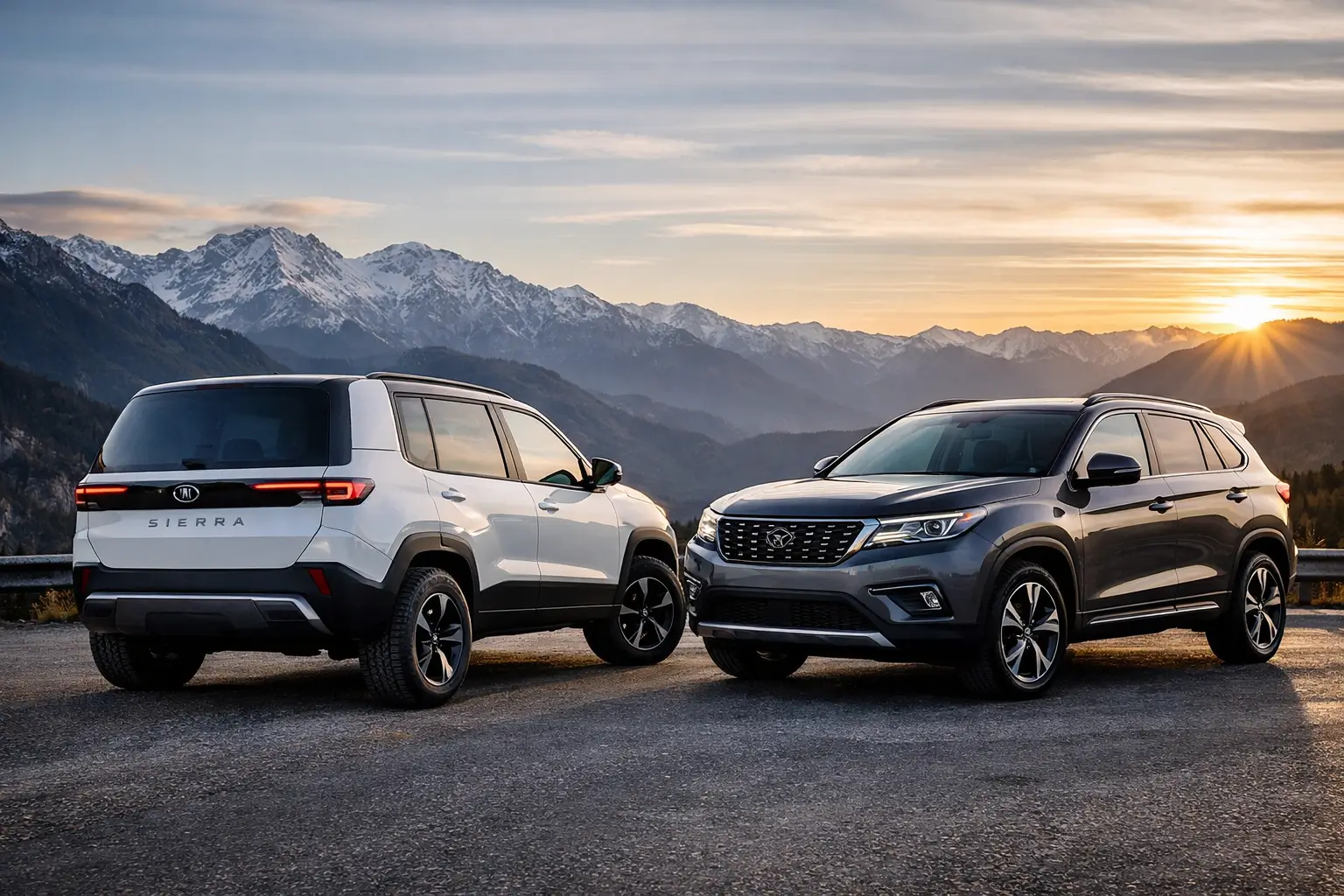
The return of the TATA Sierra arrives at a moment when the Indian SUV market is more crowded, technologically advanced, and design-conscious than at any point in its history. Once remembered for its distinctive glasshouse and lifestyle appeal, the Sierra now re-enters as a modern electric SUV with the burden of nostalgia and the pressure of competing against a generation of highly refined vehicles.
This is no longer a segment shaped by size alone. It is defined by platforms, software, safety architectures, charging ecosystems, and perceived brand maturity. Where the TATA Sierra finally stands will depend less on its legacy and more on how convincingly it performs against today’s benchmarks.
The Segment Has Changed Fundamentally
Mid-size and compact SUVs in India now operate across three overlapping dimensions:
- Urban family mobility with high comfort expectations
- Tech-forward personal vehicles with connected ecosystems
- Electrification as a long-term ownership decision
Where earlier competitors focused on ride height and styling, today’s buyers evaluate:
- Platform sophistication
- ADAS capability
- Software reliability
- Long-term battery confidence
This places the TATA Sierra EV, as it is expected to be positioned, in direct comparison with modern ICE and electric SUVs such as the Creta, Seltos, Grand Vitara, MG ZS EV, BYD Atto 3, and Tata’s own Nexon EV and Curvv EV lineup.
Design Positioning: Identity Versus Convention
The most immediate difference between the Sierra and contemporary SUVs is philosophical rather than dimensional.
Modern SUVs follow a predictable formula:
- Upright grilles
- Sharp LED lighting signatures
- Heavily contoured body panels
The new Sierra, by contrast, draws heavily from its original silhouette:
- Long glass area
- Flat shoulder line
- Wide stance without visual aggression
This places it closer to global lifestyle SUVs than mainstream crossovers.
Where It Gains Advantage
- Distinct identity in a sea of similar profiles
- Strong brand recall among mature buyers
- Clean EV-friendly proportions without grille dependency
Where It Faces Risk
- Conservative design may underwhelm younger buyers
- Limited visual differentiation from Tata’s own future EVs
Platform and Architecture: The Real Battleground
Modern SUVs no longer compete on body shells alone. Their platforms define ride quality, safety, scalability, and long-term upgrade potential.
The Sierra is expected to be based on Tata’s Gen 2 EV architecture, derived from the Alpha and Omega platforms adapted for electrification.
Key characteristics likely include:
- Flat floor battery integration
- Multi-link rear suspension
- High torsional rigidity
- Scalable wheelbase for future variants
By comparison, most modern ICE SUVs in this class still rely on:
- Modified hatchback platforms
- Torsion beam rear setups
- Limited electrical headroom for future ADAS upgrades
This gives the TATA Sierra EV a structural advantage in ride stability, packaging efficiency, and future software capability.
Powertrain Strategy: Electric First, Not Electric Later
Where most current SUVs treat electrification as an extension, the Sierra is expected to be electric by design.
Anticipated Specifications
- Battery capacity: 50–60 kWh range
- Real-world driving range: 400–500 km
- Front-wheel drive initially, AWD potential later
- DC fast charging capability above 100 kW
This positions it above compact EVs and below premium imports.
Compared to ICE competitors:
- Instant torque delivery
- Lower NVH profile
- Significantly lower running costs
Compared to existing EV SUVs:
- Larger cabin potential than Nexon EV
- More lifestyle positioning than MG ZS EV
- More attainable pricing than BYD Atto 3
Interior Philosophy: Space, Light, and Digital Balance
Modern SUVs have moved decisively toward screen-led cabins:
- Dual 10–12 inch displays
- Minimal physical buttons
- Ambient lighting as standard
The Sierra is expected to take a slightly different route.
Likely Cabin Themes
- Panoramic glass integration
- Lounge-like rear seating
- Floating centre console
- Clean dashboard with layered materials
Where it must compete decisively:
- connected car technology stability
- digital instrument cluster readability
- Software update reliability
Tata’s recent vehicles have shown improvement in interface design, but long-term consistency remains an area under observation.
Safety and Driver Assistance: Table Stakes, Not Differentiators
Modern SUVs in this class increasingly treat safety as standard equipment rather than a premium option.
Expected baseline for Sierra:
- Six airbags
- Electronic stability control
- All-wheel disc brakes
- ISOFIX mounts
Where positioning becomes critical is in ADAS in SUVs.
Potential offerings:
- Adaptive cruise control
- Lane keep assist
- Autonomous emergency braking
- Blind spot monitoring
Several rivals already offer partial ADAS packages. To remain credible, the Sierra must deliver not only features, but reliable calibration suited to Indian traffic patterns.
Ride, Handling, and Daily Usability
This segment increasingly rewards composure over outright sportiness.
With its EV architecture, the Sierra benefits from:
- Low centre of gravity
- Even weight distribution
- Flat floor packaging
Expected driving character:
- Stable highway manners
- Soft-edged urban ride
- Predictable cornering behaviour
Where traditional SUVs still hold advantage:
- Faster refuelling cycles
- Wider service familiarity
- Proven long-distance flexibility
Market Positioning: Between Segments by Design
The Sierra does not sit neatly in any single category.
It is:
- Larger than compact SUVs
- More lifestyle-oriented than family crossovers
- More attainable than premium EV imports
This places it strategically between:
- Hyundai Creta / Kia Seltos class
- MG ZS EV and upcoming Curvv EV
- Entry luxury crossovers
Expected Price Band
- ₹18 lakh to ₹25 lakh (ex-showroom, projected)
At this level, the Sierra competes as much on perception as on specification.
Ownership Ecosystem: Where Long-Term Battles Are Won
Modern SUV ownership is no longer limited to showroom experience.
Critical differentiators now include:
- Charging network access
- Battery warranty clarity
- Software update cadence
- Service predictability
Tata’s advantage lies in:
- Expanding public charging footprint
- In-house battery integration
- Familiar dealer network
Where caution remains:
- Long-term battery degradation data
- Residual value clarity for lifestyle EVs
Where the Sierra Will Ultimately Stand
Against modern SUVs, the Sierra will not win on conventional metrics alone.
It competes instead on:
- Architectural freshness
- Lifestyle positioning
- EV-native packaging
- Brand nostalgia executed in a modern frame
Its success will depend less on headline features and more on execution discipline: software reliability, charging confidence, and real-world refinement.
In a market crowded with capable choices, the Sierra’s advantage lies in being genuinely different without being impractical.
Disclaimer
This article is based on currently available information, manufacturer disclosures, and industry observations. Specifications, features, and pricing may change before official launch. Readers should verify details with authorized sources before making purchase decisions.