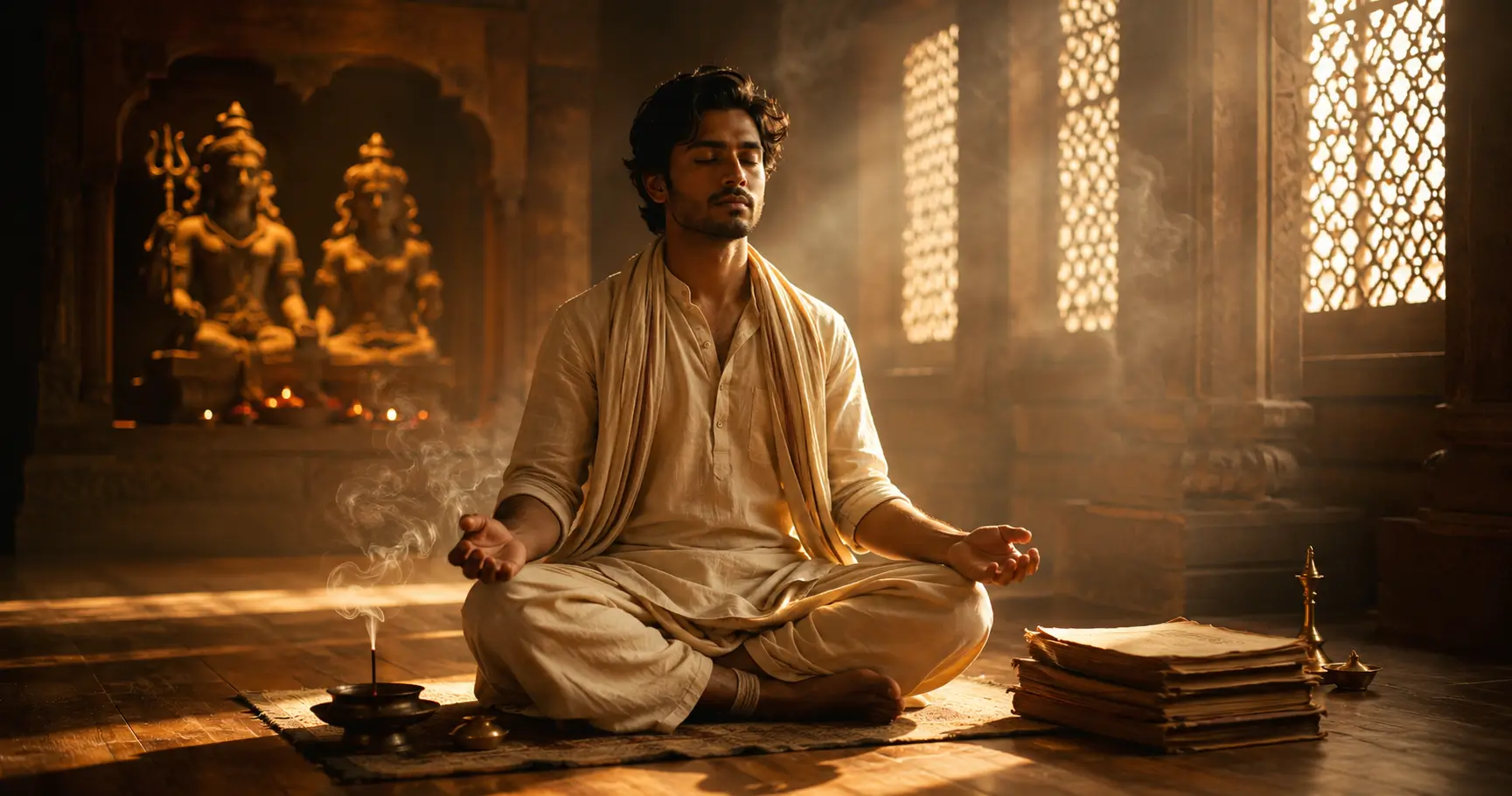
What Is Vigyan Bhairav Tantra?
What if meditation did not require you to escape ordinary life—but instead asked you to pay closer attention to it?
That question sits near the heart of Vigyan Bhairav Tantra, better known in scholarly transliteration as Vijñāna Bhairava Tantra. It is a Sanskrit Shaiva text associated with the Trika tradition of Kashmir Shaivism and presents a dialogue between Bhairava and Bhairavi. The text contains 163 verses and presents roughly 112 contemplative methods or dhāraṇās.
Rather than giving one single meditation technique, the text explores many doorways into heightened awareness. Breath, sound, sensation, concentration, visualization and everyday experiences can all become starting points for contemplation.
That makes the text unusual—and explains why it continues to attract readers interested in meditation and Indian philosophy centuries after its composition.
The Meaning Behind Vigyan Bhairav Tantra
The Sanskrit title is commonly rendered in different ways, so simple word-for-word translations can be misleading.
Vijñāna relates to knowing, discernment or direct knowledge. Bhairava is a major Shaiva term associated with the supreme reality or consciousness in this philosophical context. Tantra can refer to a tradition, teaching or method rather than simply the modern popular meaning of the word.
The important point is that the text is not primarily a collection of rituals.
Jaideva Singh’s influential translation describes the work as containing 112 types of yoga and places it within the non-dual Shaiva philosophical tradition.
In practical terms, the text repeatedly turns attention toward experience itself.
Instead of asking only, “What should I believe?” it asks something closer to:
“What happens when awareness is placed directly on this experience?”
That distinction is crucial for understanding the text.
Why Are There 112 Meditation Techniques?
The number 112 is one of the most recognizable features of the Vigyan Bhairav Tantra.
The methods are presented as compact contemplative instructions rather than long meditation manuals. They explore different entry points into awareness, including:
- Breath and the movement between inhalation and exhalation
- Sound and inner listening
- Sensory perception
- Concentration
- Visualization
- Stillness
- Emotional states
- Awareness of the body
- Space and emptiness
- Non-dual contemplation
Scholarly and traditional editions describe these as yogic or contemplative approaches rather than a single standardized meditation program.
This is important because the 112 methods should not be interpreted as 112 modern wellness exercises.
They belong to a philosophical and spiritual framework concerned with consciousness and self-realization.
How the Shiva–Bhairavi Dialogue Works
The text begins with Bhairavi questioning Bhairava about fundamental reality.
Her questions concern the nature of reality, consciousness and existence. Instead of answering with a long philosophical theory, Bhairava responds through methods of direct contemplation.
This structure is one reason the work remains so compelling.
The seeker is not simply handed an intellectual explanation.
The underlying approach is:
- Understand the principle.
- Direct attention toward experience.
- Remain aware of what is occurring.
- Allow deeper insight to emerge through contemplation.
The tradition therefore places considerable importance on direct experience rather than purely conceptual knowledge. Jaideva Singh’s edition specifically characterizes the text as moving toward the relationship between human consciousness and the divine rather than concentrating on external ceremonial worship.
The Four Major Themes Behind the 112 Methods
Although the 112 methods are diverse, several recurring themes make them easier to understand.
1. Breath as an Anchor
Several practices focus attention on breathing.
The significant point is not simply “take deep breaths.” Instead, awareness is directed toward subtle transitions in the breathing process.
The pauses, changes in direction and sensation of breathing become objects of contemplation.
Modern takeaway: Breath awareness can function as a simple way of bringing attention back to the present moment, although the spiritual interpretation in the original tradition goes much further.
2. Awareness Through the Senses
The text does something unusual with ordinary sensory experience.
Instead of treating sight, sound or sensation merely as distractions, certain methods use them as objects of awareness.
For example, a practitioner might pay exceptionally close attention to a sound rather than automatically labeling or judging it.
The purpose is not entertainment.
It is the shift from unconscious perception to deliberate awareness.
3. Sound and Inner Attention
Sound also appears repeatedly in the contemplative framework.
This includes attention to external sounds as well as subtler forms of auditory awareness.
The underlying idea is simple:
When attention becomes completely absorbed in an experience, ordinary mental chatter can temporarily become less dominant.
Traditional interpretations connect such experiences to deeper states of consciousness.
4. The Space Between Experiences
Another recurring idea is the recognition of transitions.
The moment between one breath and another is one example.
The gap between sounds, thoughts or movements can also become a contemplative focus.
This explains why seemingly insignificant moments receive so much attention.
The method is not necessarily about creating something extraordinary.
It is about noticing what is normally overlooked.
How to Approach Vigyan Bhairav Tantra as a Beginner
A common mistake is to treat the 112 methods like a checklist.
That approach misses much of the text’s character.
A better starting framework is:
- Read the philosophical background first.
- Choose one method rather than attempting all 112.
- Understand the instruction before practicing it.
- Practice gently and without forcing unusual experiences.
- Observe what actually happens.
- Keep a simple meditation journal.
- Study a reliable translation or commentary.
The original techniques are often extremely compressed. A scholarly translation with explanatory notes can therefore be much more useful than a social-media list presenting each technique as a quick “life hack.”
Jaideva Singh’s edition, for example, includes Sanskrit text, translation, explanatory notes and a glossary.
A Simple Example of the Approach
Imagine sitting quietly and observing your breathing.
Instead of deliberately changing the breath, you notice:
inhale → transition → exhale → transition → inhale
The ordinary process suddenly becomes an object of sustained attention.
A beginner might think the goal is to control the breath.
That is not necessarily the point.
The deeper practice is noticing.
This illustrates an important principle found throughout the text: something ordinary can become a doorway to concentrated awareness when attention changes.
What Makes the Text Different From Modern Meditation Apps?
Modern mindfulness programs often present meditation as a structured practice for goals such as relaxation, attention training or stress management.
Vigyan Bhairav Tantra comes from a different intellectual and religious context.
Its central concern is not simply productivity or relaxation.
It is connected with self-realization and the recognition of consciousness within Kashmir Shaivism. Traditional and scholarly sources therefore place its methods within a much larger philosophical system.
This difference matters.
Calling every technique a “stress-relief exercise” can make the text easier to market but less accurate historically.
Vigyan Bhairav Tantra vs. Tantra in Popular Culture
The word Tantra often creates confusion.
In modern popular culture, Tantra is frequently associated almost entirely with sexuality or romantic practices.
That is far too narrow.
Vigyan Bhairav Tantra belongs to a specific Shaiva philosophical and contemplative tradition. Its 112 methods include breath awareness, concentration, sensory contemplation, visualization and other approaches.
Therefore:
| Popular assumption | More accurate understanding |
|---|---|
| Tantra means only sexuality | Tantra refers to broader religious and philosophical traditions |
| The text is a ritual manual | It emphasizes contemplative methods |
| All 112 methods are identical | They use diverse objects and approaches |
| It is simply modern mindfulness | It comes from a specific Shaiva philosophical context |
| “112 techniques” means 112 guaranteed results | Traditional practice does not work like a guaranteed formula |
Myths vs. Facts
Myth: Vigyan Bhairav Tantra is simply a book of magic techniques.
Fact: It is a Sanskrit Shaiva contemplative text concerned with consciousness, meditation and realization.
Myth: The 112 techniques are all easy modern meditation exercises.
Fact: Many instructions are highly compressed and depend on philosophical context and interpretation.
Myth: Tantra in this text primarily means sexual practice.
Fact: The text encompasses a much wider range of contemplative methods, including breath, sound, sensation and awareness.
Myth: Every technique must be practiced.
Fact: The text presents multiple approaches. A reader should study the methods carefully rather than treating them as a mandatory sequence.
Common Mistakes Beginners Make
Trying to master all 112 methods
More is not necessarily better.
One carefully understood method can be more meaningful than rushing through dozens.
Treating ancient instructions like modern medical advice
The text belongs to a spiritual-philosophical tradition.
Its claims about consciousness should not automatically be presented as scientifically established medical or psychological facts.
Using random internet translations
Small translation choices can substantially affect the interpretation of Sanskrit philosophical texts.
A reputable scholarly edition is preferable.
Chasing dramatic experiences
Meditation can become counterproductive when every session is judged by whether something mystical happened.
Consistency and careful observation are more useful than chasing extraordinary sensations.
What Can a Modern Reader Learn From It?
Even without adopting its religious worldview, a modern reader can find several interesting principles in the text.
Attention can transform ordinary experience.
Breathing is ordinary.
Hearing is ordinary.
Seeing is ordinary.
Feeling is ordinary.
Thinking is ordinary.
The distinctive move made by the text is to ask what happens when these ordinary experiences become objects of sustained awareness.
That makes Vigyan Bhairav Tantra relevant to contemporary discussions about meditation while still requiring respect for its original philosophical context.
Why the Text Still Matters
The continuing publication of translations and commentaries suggests that interest in the text remains strong.
Jaideva Singh’s Vijnanabhairava has been published in multiple editions, while more recent books continue to introduce the 112 meditative approaches to contemporary readers.
Its enduring appeal may come from a deceptively simple proposition:
You do not necessarily need a completely different life to begin paying attention differently.
That idea gives the text unusual psychological and philosophical depth.
But it is equally important not to erase its historical identity.
Vigyan Bhairav Tantra is not simply a modern mindfulness manual with an ancient name. It is a work rooted in the sophisticated metaphysics and contemplative culture of Kashmir Shaivism.
FAQ
What is Vigyan Bhairav Tantra?
Vigyan Bhairav Tantra is a Sanskrit Shaiva contemplative text associated with Kashmir Shaivism. It presents a dialogue between Bhairava and Bhairavi and describes approximately 112 meditation or centering methods.
What are the 112 techniques in Vigyan Bhairav Tantra?
The 112 methods are diverse contemplative practices involving breath, sound, sensory awareness, concentration, visualization, emotions, stillness and other experiences. They are presented as concise instructions rather than a single meditation routine.
Is Vigyan Bhairav Tantra part of Kashmir Shaivism?
Yes. The text is traditionally associated with the Trika/Kaula traditions of Kashmir Shaivism and is regarded as an important work within the Shaiva contemplative literature.
Can beginners practice Vigyan Bhairav Tantra meditation?
Beginners can study introductory versions of its contemplative approaches, but the original instructions can be highly compressed. A reliable translation or knowledgeable teacher can help provide the philosophical context needed to understand them properly.
Is Vigyan Bhairav Tantra about Tantra and sexuality?
No. That is an overly narrow modern interpretation of Tantra. Vigyan Bhairav Tantra contains many contemplative approaches involving breath, sound, perception, concentration and awareness.
What is the main purpose of Vigyan Bhairav Tantra?
Within its traditional philosophical context, the methods are intended as pathways toward direct recognition of consciousness or ultimate reality rather than merely relaxation or stress reduction.
Conclusion
Vigyan Bhairav Tantra is far more than a list of 112 meditation exercises.
It is a compact but remarkably broad exploration of attention, consciousness, perception and direct experience within the Shaiva tradition of Kashmir. Its methods turn toward experiences that most people encounter every day—breathing, hearing, sensing, thinking and observing—and ask what becomes possible when attention is radically refined.
The most important points to remember are:
- Vigyan Bhairav Tantra is associated with Kashmir Shaivism.
- The text contains approximately 112 contemplative methods.
- Its methods include breath, sound, sensation, concentration, visualization and awareness.
- It should be understood within its original philosophical and religious context.
- Tantra should not be reduced to its modern sexualized meaning.
- A reliable translation is valuable because the original instructions are often extremely concise.
- The purpose of the traditional practices extends beyond ordinary relaxation toward questions of consciousness and self-realization.
Perhaps that is why this ancient text continues to attract modern readers.
Its central invitation is surprisingly contemporary: instead of constantly looking for a new experience, learn to look more deeply at the experience already happening.
Disclaimer
Disclaimer: This article is provided for educational, cultural and informational purposes only. Vigyan Bhairav Tantra belongs to a specific historical and philosophical tradition associated with Kashmir Shaivism, and interpretations of its Sanskrit verses can differ among translations, teachers and schools of thought.
Descriptions of meditation practices in this article should not be interpreted as medical, psychological or therapeutic advice, nor should spiritual claims be treated as scientifically established medical facts. Readers who have a medical or psychological condition, or who experience distress during meditation, should consult an appropriately qualified healthcare professional.
For serious study, readers should consult reputable Sanskrit translations, scholarly editions and qualified teachers familiar with the relevant tradition.