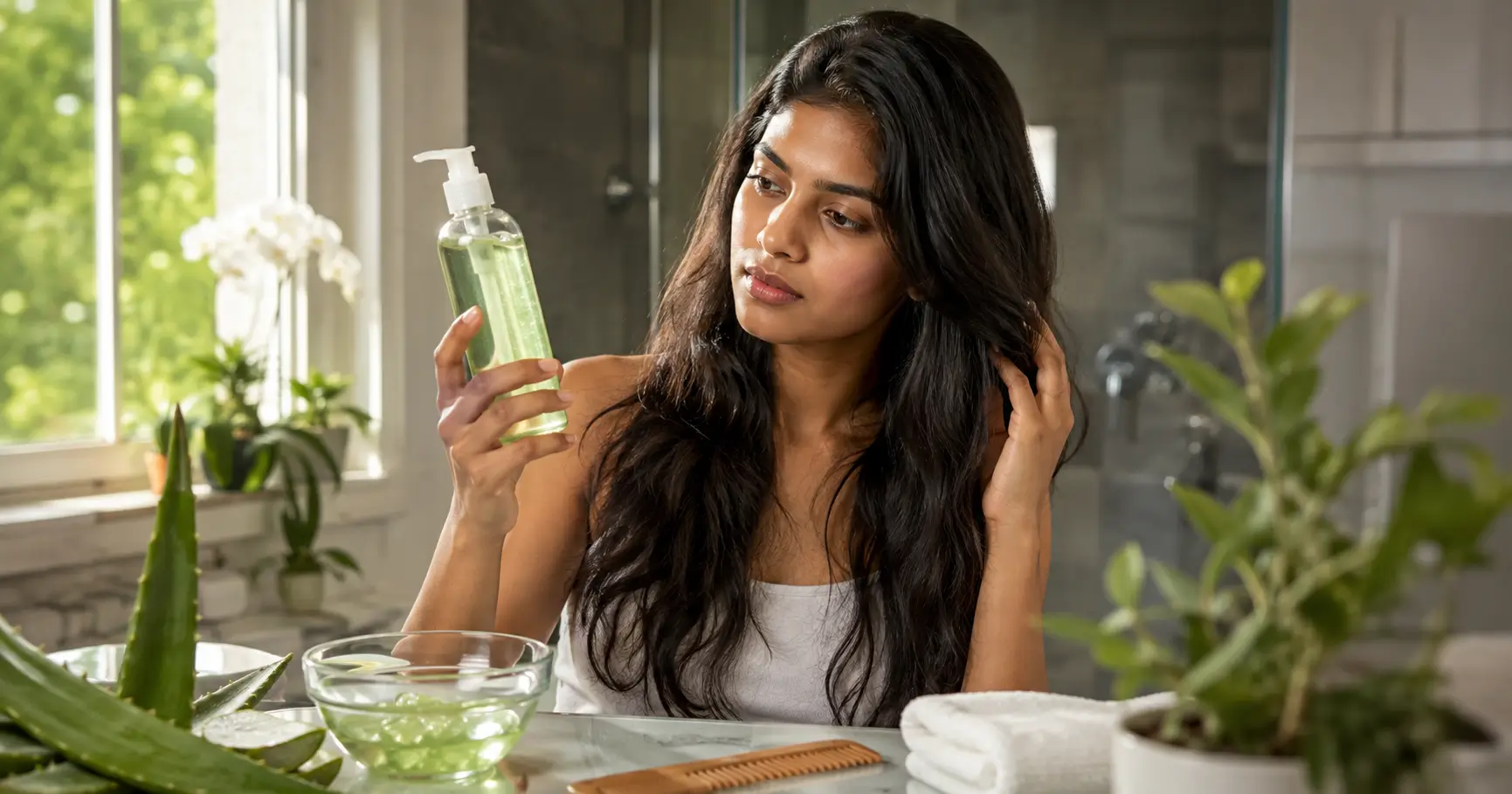
Aloe vera gel has become a staple in many hair-care routines, but there is a problem: not every product sold as aloe vera gel is equally suitable for your hair or scalp.
Some formulas are simple and lightweight. Others contain fragrance, colorants, alcohols, thickeners or several additional ingredients that may not suit a sensitive scalp.
So, what is the best aloe vera gel for hair?
The answer isn’t necessarily the product with the biggest “99% pure” claim on the label. A better choice depends on your scalp, hair type, ingredient list and intended use.
And there is another important distinction: aloe vera may help condition and soothe the scalp, but that does not mean it is a proven hair-growth treatment.
Here’s how to choose intelligently.
What does aloe vera gel actually do for hair?
Aloe vera is a succulent plant whose inner gel contains water and numerous naturally occurring compounds.
For hair care, its most useful role is generally hydration, conditioning and scalp comfort, rather than acting as a proven hair-growth drug.
Research into topical aloe vera has produced some promising findings for inflammatory and dermatological conditions, but researchers have also pointed out that stronger clinical evidence is still needed.
That means aloe vera can have a useful place in a hair-care routine without making exaggerated claims about regrowing hair.
The realistic benefits
Depending on the formulation and individual response, aloe vera gel may:
- Provide lightweight hydration
- Make hair feel softer
- Help reduce the feeling of scalp dryness
- Provide temporary soothing for an irritated-feeling scalp
- Add slip to hair
- Help control some frizz
- Work as a lightweight styling product
However, these benefits should not be confused with treating the underlying cause of hair loss.
The American Academy of Dermatology notes that hair loss has many possible causes, including hereditary hair loss, certain medical conditions, medications and physical or styling-related factors. Finding the cause is important before choosing treatment.
How to choose the best aloe vera gel for hair
The ingredient list matters more than the front of the package.
A product can prominently advertise aloe vera while containing many other ingredients that affect how it feels and performs.
1. Look at the ingredient list
For a simple hair or scalp application, look for products where aloe vera is a prominent ingredient.
You don’t necessarily need a product containing literally nothing except aloe. Preservatives can be necessary in commercial water-based products to prevent microbial contamination.
The goal is a well-formulated product, not simply the shortest ingredient list.
2. Avoid unnecessary fragrance if your scalp is sensitive
Fragrance isn’t automatically harmful, but it can be an unnecessary source of irritation for people with sensitive skin.
If your scalp frequently becomes itchy, red or irritated, choosing a fragrance-free or minimally fragranced formula can be a sensible starting point.
Topical aloe itself is generally well tolerated, but the U.S. National Center for Complementary and Integrative Health notes that burning, itching, rash and eczema have occasionally been reported.
3. Don’t assume “100% pure” means “best”
This is one of the biggest mistakes buyers make.
A percentage printed prominently on the packaging does not tell you everything about:
- Preservation
- Fragrance
- Added ingredients
- Product stability
- Texture
- Packaging
- Your individual tolerance
Formula quality matters more than marketing language.
4. Choose according to your hair type
Different hair types can respond differently to the same gel.
| Hair/scalp concern | What to look for |
|---|---|
| Oily scalp | Lightweight, non-heavy formula |
| Dry hair | Hydrating formula with good conditioning properties |
| Curly hair | Lightweight gel with slip and low buildup |
| Frizzy hair | Conditioning, film-forming texture |
| Sensitive scalp | Minimal fragrance and fewer unnecessary additives |
| Fine hair | Lightweight formula that doesn’t leave heavy residue |
The “best” gel is therefore not one universal product.
It is the formula that solves your particular problem without creating another one.
Best aloe vera gel for hair: the buying checklist
Before purchasing, run through this quick checklist.
Check these seven things
- Aloe vera should be a meaningful ingredient.
- Read the complete ingredient list.
- Consider fragrance if your scalp is sensitive.
- Avoid choosing solely because of a “natural” or “pure” claim.
- Check the texture and intended use.
- Look at packaging and storage instructions.
- Buy from a reliable seller to reduce the risk of counterfeit or poorly stored products.
Commercial aloe vera products are widely available in India, and current beauty roundups include formulas from several established brands. However, formulations and prices can change, so readers should verify the current ingredient list before purchasing.
Can aloe vera gel make hair grow faster?
This is where expectations need to be realistic.
There isn’t strong clinical evidence that ordinary aloe vera gel directly stimulates substantial new hair growth in people with common forms of hair loss.
Aloe vera may support a healthier-feeling scalp environment and condition the hair, but that is different from treating androgenetic alopecia, alopecia areata or other causes of hair loss.
The American Academy of Dermatology emphasizes that effective hair-loss treatment begins with identifying the cause.
So if someone notices significant thinning, widening of the part, bald patches or persistent shedding, replacing their hair-care product with aloe vera shouldn’t be the only strategy.
The correct question is not “Which gel grows hair fastest?” but “What is causing my hair loss, and what treatment is appropriate for that cause?”
How to use aloe vera gel on your hair
Aloe vera is easy to incorporate into a routine.
Method 1: Pre-shampoo scalp treatment
This is one of the simplest approaches.
- Start with a small amount of aloe vera gel.
- Apply a thin layer to the scalp.
- Massage gently rather than aggressively rubbing.
- Leave it on for a short period.
- Rinse thoroughly.
- Shampoo and condition as usual.
Start once or twice a week rather than immediately using it every day.
Method 2: Hair-conditioning treatment
If your hair feels dry, apply a small amount through the lengths rather than saturating your scalp.
Leave it briefly and rinse.
This approach is particularly useful when your goal is softness and manageability rather than scalp treatment.
Method 3: Lightweight styling gel
Some aloe-based gels can work as lightweight styling products.
Apply a small amount to damp hair and distribute it evenly.
This can provide light hold and may help reduce the appearance of frizz.
If your hair becomes stiff, sticky or coated, reduce the quantity or switch to a product specifically designed for styling.
Aloe vera for dandruff: does it work?
Aloe vera should not be considered a replacement for proven dandruff treatments.
Some research has investigated aloe vera in inflammatory scalp and skin conditions, and a recent review discussed aloe among plant-derived ingredients being investigated for dandruff and seborrheic dermatitis. However, the review also emphasized the need for further clinical investigation.
For persistent dandruff, dermatologists recommend established active ingredients such as ketoconazole, selenium sulfide, salicylic acid, sulfur or other appropriate dandruff treatments depending on the individual situation.
A useful rule
Mild occasional dryness: aloe may be worth trying.
Persistent dandruff, redness or severe itching: investigate the cause instead of relying on aloe alone.
Dandruff can overlap with conditions such as seborrheic dermatitis, psoriasis, eczema and fungal infections.
Fresh aloe vera vs commercial aloe vera gel
Fresh aloe vera sounds like the most natural option, but “natural” does not automatically mean better.
Freshly extracted gel can be messy, difficult to store and more vulnerable to contamination.
Commercial products offer:
- More consistent texture
- Better convenience
- Longer shelf life
- Controlled preservation
- Easier application
The trade-off is that commercial gels contain additional ingredients required for formulation and preservation.
For routine hair care, a well-formulated commercial gel can be more practical than homemade gel.
Common mistakes people make
Using too much gel
More product doesn’t necessarily mean better results.
Too much can leave hair sticky, weighed down or coated.
Leaving it on indefinitely
Aloe vera is not automatically more effective simply because you leave it on overnight.
If your scalp becomes irritated, prolonged contact can make the situation worse.
Mixing it with everything
A popular DIY routine may combine aloe with coconut oil, lemon juice, essential oils and other ingredients.
That doesn’t automatically make the treatment better.
More ingredients mean more opportunities for irritation.
Using aloe instead of treating hair loss
This is the most important mistake.
If you’re experiencing genuine hair loss, aloe should not delay professional evaluation.
Ignoring irritation
If you develop burning, itching, redness or a rash, stop using the product.
NCCIH notes that topical aloe is generally well tolerated but that these reactions can occasionally occur.
Myths vs facts
| Myth | Fact |
|---|---|
| Aloe vera automatically grows new hair | Evidence for direct hair growth is limited |
| The highest aloe percentage is always best | The entire formulation matters |
| Natural products cannot irritate skin | Natural ingredients can still cause reactions |
| More gel produces better results | Excess product can create buildup |
| Aloe can replace dandruff medication | Persistent dandruff may require proven treatment |
| Fresh aloe is always superior | Commercial formulations can offer better consistency and preservation |
A simple aloe vera hair routine
If you’re new to aloe vera, keep the routine uncomplicated.
Day 1: Patch-test a small amount.
Day 2–3: If there is no reaction, apply a thin layer to a small scalp area.
Once or twice weekly: Use it as a short pre-shampoo treatment.
After several uses: Assess whether your hair actually feels softer, less dry or easier to manage.
This approach is better than adding five new products at once.
It also makes it easier to determine what is helping and what isn’t.
When you should see a dermatologist
Aloe vera is a cosmetic hair-care ingredient, not a diagnostic tool.
Consider professional evaluation if you have:
- Sudden or rapid hair loss
- Round bald patches
- Significant scalp redness
- Pain or swelling
- Persistent severe itching
- Thick scaling or crusting
- Hair loss accompanied by other symptoms
- Progressive thinning despite changing your routine
The AAD recommends dermatologist evaluation because hair loss can have many different causes and treatment is more effective when the underlying cause is identified.
The bottom line
The best aloe vera gel for hair isn’t necessarily the most expensive product or the one with the biggest percentage printed on the label.
Look for a well-formulated, suitable product with aloe vera prominently represented, minimal unnecessary irritants for your needs, and a texture compatible with your hair type.
Use aloe vera for realistic goals such as conditioning, hydration and scalp comfort.
But don’t expect it to replace evidence-based treatment for significant hair loss or persistent scalp disease.
Choose the formula, not the marketing claim.
FAQ
Is aloe vera gel good for hair?
Yes. Aloe vera gel can provide lightweight hydration, conditioning and scalp comfort. However, evidence that aloe vera directly promotes significant new hair growth is limited.
Which aloe vera gel is best for hair?
The best option is generally a well-formulated gel with aloe vera as a prominent ingredient that suits your hair type and scalp sensitivity. Avoid choosing solely based on a percentage claim.
Can aloe vera gel help hair growth?
Aloe vera may support scalp and hair conditioning, but it is not established as a proven treatment for common causes of hair loss. Persistent or significant hair loss should be evaluated to identify its cause.
Can I apply aloe vera gel directly to my scalp?
Yes, many people use topical aloe vera on the scalp. Start with a small amount and patch-test first, particularly if you have sensitive skin. Stop if burning, itching, redness or a rash develops.
Is aloe vera good for dandruff?
Aloe vera may provide soothing benefits, but it shouldn’t replace proven dandruff treatments when dandruff is persistent. Dermatologists recommend appropriate anti-dandruff ingredients depending on the condition.
How often should I use aloe vera gel on my hair?
A practical starting point is once or twice a week, particularly when using it as a pre-shampoo treatment. Adjust according to how your scalp and hair respond.
Conclusion
Aloe vera can be a useful addition to a simple hair-care routine—but choosing the right product matters more than chasing the highest “pure aloe” percentage.
The strongest approach is to select a well-formulated gel that matches your hair type, keep the routine simple, patch-test before wider use and avoid exaggerated hair-growth promises.
Remember the key points:
- Choose the formula, not just the marketing claim.
- Look for aloe vera as a meaningful ingredient.
- Consider fragrance and other additives if your scalp is sensitive.
- Use small amounts to avoid buildup.
- Aloe can support conditioning and scalp comfort, but it isn’t a proven cure for hair loss.
- Persistent dandruff or significant hair loss deserves proper evaluation.
If you’re buying aloe vera gel today, don’t simply ask “Which one has the highest percentage?”
Ask the more useful question:
“Which formulation is actually appropriate for my hair and scalp?”
That small change in how you shop can make your hair-care routine considerably smarter.
Disclaimer
Disclaimer: This article is provided for general educational and informational purposes only and does not constitute medical advice, diagnosis or treatment. Aloe vera products can affect people differently, and topical aloe may occasionally cause irritation or allergic-type reactions. Always check the current product ingredient list and follow the manufacturer’s directions. If you experience persistent scalp irritation, severe dandruff, sudden hair loss, bald patches or unexplained changes in your hair or scalp, consult a qualified dermatologist or healthcare professional. Product availability, formulations, prices and claims may change over time.