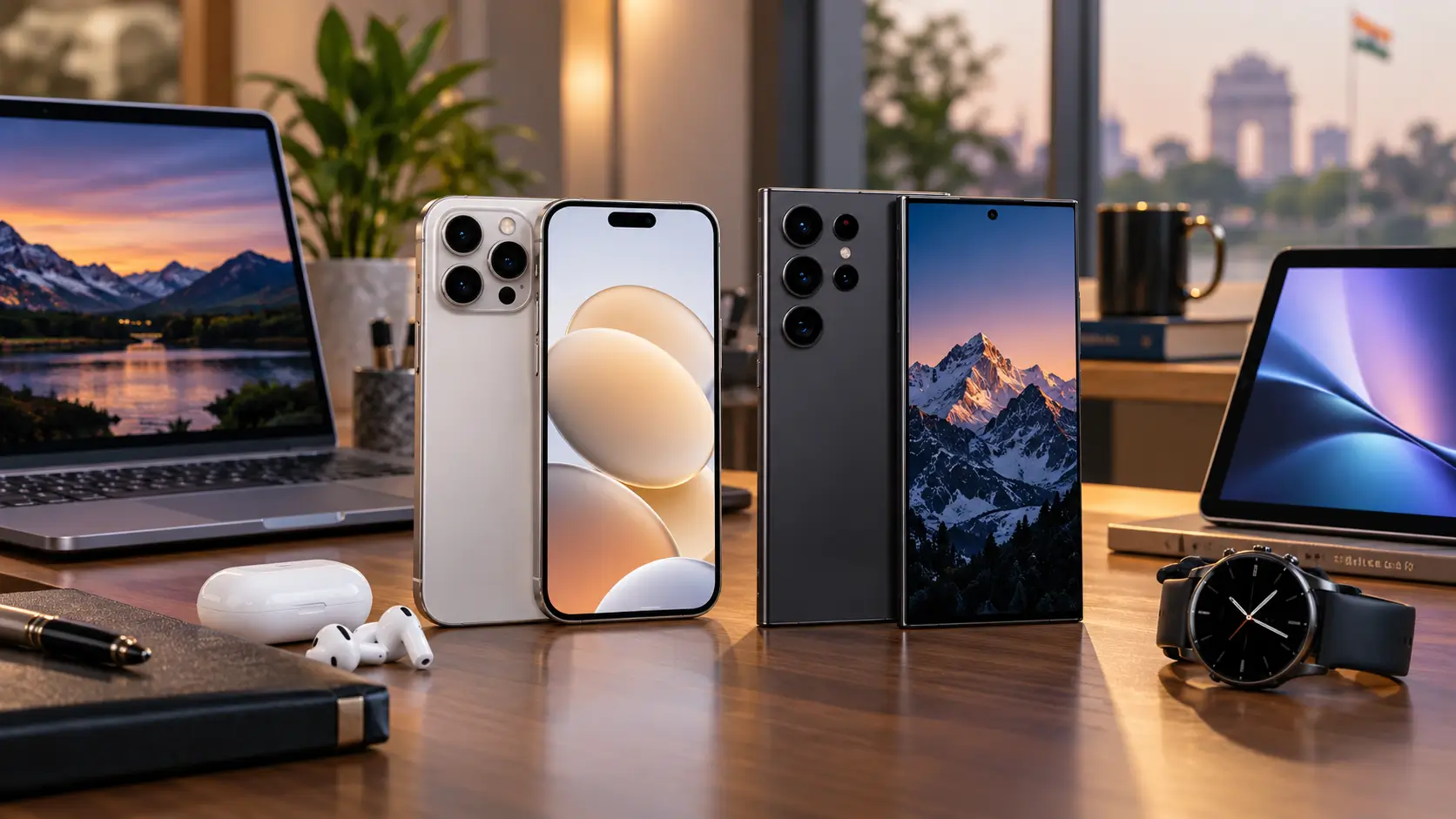
Apple and Samsung remain two of the most recognizable names in premium smartphones, but comparing them is no longer just a matter of counting cameras, processor cores or battery capacity. In 2026, the bigger difference is the ecosystem each company builds around its phones.
Apple’s latest flagship generation is the iPhone 18 Pro and iPhone 18 Pro Max, which became available in September 2026. Samsung’s flagship range is the Galaxy S26 family, including the Galaxy S26, S26+ and S26 Ultra. Both companies now offer powerful hardware, advanced cameras and AI features, but they approach the smartphone experience differently.
For Indian buyers, the practical choice depends on what matters most: software simplicity, customization, cameras, productivity, ecosystem integration, accessories, AI features, pricing or the devices already owned.
Quick answer
There is no universal winner between Apple and Samsung.
Apple’s approach is built around tight integration between the iPhone, iOS and products such as Mac, iPad, Apple Watch and AirPods. The iPhone 18 Pro also brings Apple’s A20 Pro chip, Apple Intelligence, Siri AI and a 48MP Pro Fusion camera system.
Samsung’s approach is more closely tied to Android and a broader range of hardware and software options. The Galaxy S26 series includes Galaxy AI, while the Galaxy S26 Ultra adds features such as an integrated S Pen and Privacy Display.
The better fit depends on the user’s priorities rather than the brand name alone.
Apple vs Samsung: the fundamental difference
Apple controls both the hardware and operating system used by the iPhone. That allows the company to design many parts of the experience around a common platform.
Samsung operates within Android while adding its own Galaxy hardware, One UI software and services.
That creates two different philosophies.
Apple: controlled, integrated and relatively consistent.
Samsung: flexible, customizable and available across a wider range of device types and configurations.
Neither description means that one platform is universally superior. They represent different approaches to smartphone ownership.
iPhone vs Samsung Galaxy: current flagship landscape
Apple’s current premium models include the iPhone 18 Pro and iPhone 18 Pro Max. Apple lists 6.3-inch and 6.9-inch OLED displays, ProMotion up to 120Hz, the A20 Pro chip, and storage options ranging from 256GB to 2TB.
Samsung’s Galaxy S26 range includes three flagship models. The S26 Ultra is the most feature-rich model in the family, with a 17.49cm display, a 5,000mAh rated battery and an integrated S Pen.
This is important because a direct “iPhone vs Samsung” comparison can become misleading. Apple’s Pro Max and Samsung’s Ultra models are closer comparisons than an entry-level Galaxy and an iPhone Pro.
Design and display
Apple’s iPhone 18 Pro uses an aluminium unibody design with Ceramic Shield 2 on the front and Ceramic Shield on the back. Its display supports adaptive refresh rates up to 120Hz.
Samsung’s Galaxy S26 Ultra takes a different design approach and adds a built-in Privacy Display designed to reduce visibility from side angles.
For most buyers, the practical difference is less about which display has the better specification and more about which features are useful.
Someone who frequently works with sensitive information in public places may find Samsung’s Privacy Display particularly relevant. A buyer already invested in Apple’s ecosystem may place greater importance on how the iPhone integrates with their other Apple devices.
Camera and video
Both companies now offer sophisticated multi-camera systems.
The iPhone 18 Pro has three 48MP rear cameras: a Fusion Main camera with variable aperture, an Ultra Wide camera and a Fusion Telephoto camera. Apple lists optical-quality zoom options extending to 8x and extensive professional video capabilities including ProRes and Apple Log 2.
Samsung’s Galaxy S26 Ultra uses a different camera strategy, including a 200MP main camera, telephoto hardware and Samsung’s computational photography and ProVisual Engine.
Rather than declaring one camera system universally better, buyers should consider how they shoot.
For people who place a particularly high priority on video workflows and Apple’s professional capture formats, the iPhone’s feature set is significant.
For people who value long-range photography and Samsung’s extensive camera controls, the Galaxy Ultra approach can be attractive.
Actual image quality also depends on lighting, shooting mode, subject movement and software processing. A specification such as “200MP” does not by itself establish that one camera produces better photographs.
Performance
Apple’s iPhone 18 Pro uses the A20 Pro chip with a six-core CPU, seven-core GPU and dual 16-core Neural Engine. Apple also highlights a next-generation vapour chamber for sustained performance.
Samsung’s flagship platform is designed around high-end Android performance and Galaxy AI features.
For everyday users, both are firmly in the premium-performance category. The more important question is what the phone does with that performance.
A user editing video, playing demanding games or running AI-assisted applications may notice differences between platforms, but benchmark numbers should not be treated as a substitute for the actual workflow.
Battery and charging
Apple’s official specifications rate the iPhone 18 Pro at up to 34 hours of video playback and the iPhone 18 Pro Max at up to 43 hours. Apple also supports faster wired charging under specified adapter conditions.
Samsung lists a 5,000mAh rated battery for the Galaxy S26 Ultra and says the device can reach up to 69% charge in around 30 minutes under its specified charging conditions.
These figures are not directly interchangeable. Battery capacity and Apple’s video-playback figure measure different things.
For a buying decision, real-world battery life should be considered alongside screen size, refresh rate, cellular usage, camera use, gaming and software optimization.
Software and customization
This is one of the most important differences.
The iPhone runs Apple’s iOS platform. Apple controls the hardware and operating system, which creates a highly integrated experience.
Samsung uses Android with its own software layer and services. Android generally gives users more flexibility over interface behavior, default applications, file management and customization.
That makes Samsung particularly relevant to buyers who want greater control over how their phone works.
Apple can make more sense for someone who values consistency across Apple devices and prefers a more controlled software environment.
AI features
AI has become a major part of both platforms.
Apple’s iPhone 18 Pro integrates Apple Intelligence and Siri AI into iOS 27. Apple describes Siri AI as a more personal and capable assistant, with Apple Intelligence integrated into everyday apps and experiences.
Samsung’s Galaxy S26 Ultra promotes Galaxy AI and additional AI-powered features across the device. Samsung also positions the S26 series around AI-assisted everyday functions and productivity.
The important point is that “AI” is not a single feature.
Before buying, check the specific AI functions you actually expect to use, whether they are available in India, what languages they support and whether they require an internet connection.
Privacy and security
Apple and Samsung both invest heavily in device security, but their approaches differ.
Apple emphasizes privacy as part of its platform design and integrates hardware and software security into the iPhone ecosystem.
Samsung also provides multiple security technologies and adds enterprise-oriented features through its Galaxy platform.
A simple statement that one company is “100% more secure” would not be technically responsible. Security depends on the operating system, update status, application sources, account security, user behavior and the particular device.
Ecosystem: perhaps the biggest difference
This is where the Apple vs Samsung comparison becomes more meaningful.
Apple’s ecosystem includes iPhone, Mac, iPad, Apple Watch, AirPods, iCloud and other services. Features that connect these devices can make switching away from the platform less convenient for an existing Apple household.
Samsung’s ecosystem includes Galaxy smartphones, tablets, watches, Buds and other products. Samsung also offers features such as DeX on compatible devices, which can turn a supported Galaxy phone into a more desktop-like computing environment.
Therefore, someone who already owns a MacBook and Apple Watch has a different buying equation from someone who owns a Windows laptop, Galaxy Buds and Galaxy Watch.
The existing ecosystem should be considered before the phone itself.
Price in India
Current flagship pricing illustrates another difference.
Apple’s India store lists the iPhone 18 Pro from ₹1,64,900.
Samsung’s India store lists the Galaxy S26 Ultra with a 256GB/12GB configuration at an MRP of ₹1,39,999, although the page may display promotional pricing, exchange benefits and other offers separately.
Prices can change significantly during Indian festive sales, exchange promotions, bank offers and manufacturer campaigns.
For that reason, buyers should compare the final effective price rather than relying only on launch or MRP figures.
Which ecosystem fits which user?
Consider Apple if you value:
- integration with Mac and iPad
- Apple Watch and AirPods integration
- iOS
- Apple’s video features and professional recording formats
- a tightly controlled software ecosystem
- Apple’s broader device continuity features
Consider Samsung if you value:
- Android
- extensive customization
- Galaxy AI
- S Pen functionality on compatible models
- Samsung DeX on compatible devices
- more hardware variety
- features such as Privacy Display on the Galaxy S26 Ultra
These are not rules. They are practical matching points.
What Indian buyers should consider
India has a particularly important price consideration.
IDC reported that India’s smartphone shipments declined 4.1% year over year in Q1 2026, while the average selling price reached a record $302. IDC also reported that Apple held fourth place by shipment share but led the market by value with a 28% share in that quarter.
That means premium smartphone purchasing is increasingly important even as the overall market faces pressure.
Buyers should therefore compare:
- Actual street price
- Exchange value
- Bank offers
- Storage configuration
- Warranty and service availability
- Accessory costs
- Existing devices
- Software ecosystem
- Expected ownership period
A phone that looks more expensive at launch can have a different effective cost after exchange and financing offers.
Bottom line
Apple vs Samsung is no longer a simple hardware contest.
The iPhone 18 Pro family and Galaxy S26 family both represent high-end smartphone technology, but they prioritize different experiences. Apple puts substantial emphasis on its integrated hardware-software ecosystem, while Samsung combines Android flexibility with Galaxy-specific hardware, AI and productivity features.
For an Indian buyer, the most useful decision is therefore to start with the ecosystem and features you actually use, then compare the specific iPhone and Galaxy models that fit your budget.
Instead of asking “Which brand is better?”, ask:
Which phone will work better with the devices I already own, the software I use and the way I actually use my smartphone?
That question produces a much more useful buying decision than a generic brand-versus-brand argument.
FAQ
Is Apple better than Samsung?
Neither brand is universally better. Apple emphasizes its integrated iPhone/iOS ecosystem, while Samsung offers Android flexibility, Galaxy AI and features such as S Pen and DeX on compatible devices.
Which is better, iPhone or Samsung?
It depends on the user’s priorities. iPhone may fit users invested in Apple’s ecosystem, while Samsung may suit users who prioritize Android customization and Galaxy-specific productivity features.
Which has better camera, iPhone or Samsung?
Both have advanced camera systems. The iPhone 18 Pro emphasizes its 48MP Pro Fusion system and professional video features, while the Galaxy S26 Ultra uses a high-resolution multi-camera system with Samsung’s computational photography features.
Which has better battery life, iPhone or Samsung?
Battery life cannot be determined simply from battery capacity. Apple’s official figures and Samsung’s rated battery specifications use different measurement methods, so buyers should compare independent standardized testing where available.
Which is more customizable, iPhone or Samsung?
Samsung’s Android-based software generally provides more customization options than Apple’s iOS.
Which is better for content creators?
The answer depends on the workflow. Apple’s iPhone 18 Pro provides extensive professional video features, while Samsung offers a broad set of camera controls and Galaxy ecosystem features.
Is Samsung cheaper than iPhone in India?
Current flagship pricing varies by model and promotion. For example, Apple’s iPhone 18 Pro starts at ₹1,64,900 in India, while Samsung lists the Galaxy S26 Ultra 256GB at an MRP of ₹1,39,999.
Should I switch from Android to iPhone?
Consider switching if Apple’s ecosystem, iOS experience and services fit your needs. Before switching, check compatibility with your current apps, accessories, smartwatch and other devices.
DISCLAIMER
Product information disclaimer: Prices, specifications, availability and promotional offers can change. Verify the latest details with Apple, Samsung or an authorized Indian retailer before purchasing.