AI glasses have moved from an experimental idea to a real consumer-technology category.
In India, Meta’s Ray-Ban Meta glasses are already officially available, while Google and Samsung are developing Android XR-based intelligent eyewear and Meta has expanded its AI-glasses portfolio again in September 2026.
But there is an important distinction that often gets lost in the excitement: not every pair of AI glasses has a display, and not every pair of smart glasses is an augmented-reality device.
Some products mainly combine a camera, microphones, speakers and an AI assistant. Others add an actual display in the lens. More advanced XR glasses are designed to put digital information into your field of view.
So what exactly are AI glasses, what can they do today, how much do they cost in India, and are they actually useful?
Quick answer
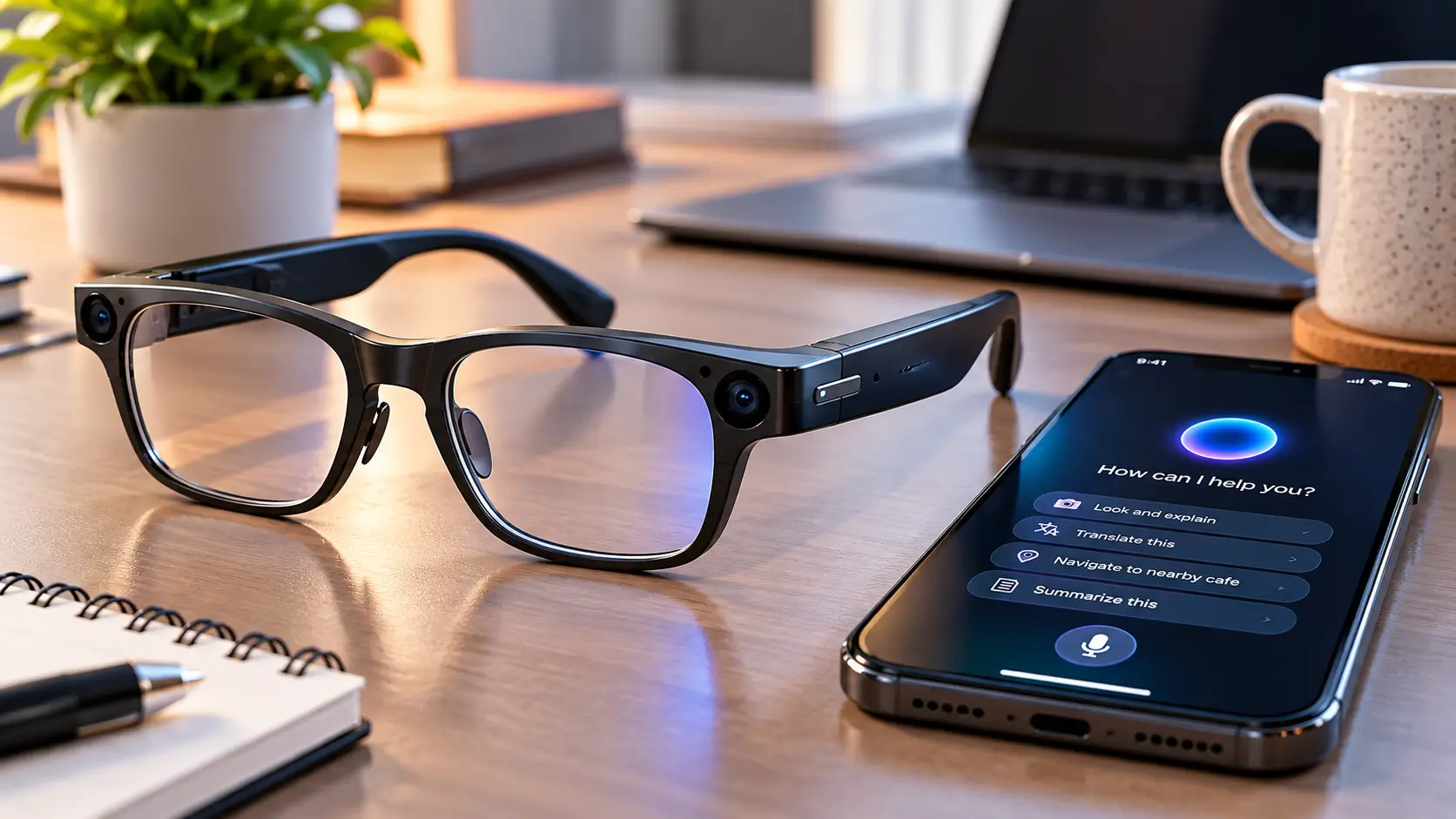
AI glasses are wearable computers built into an eyewear form factor. Depending on the model, they can use cameras, microphones, speakers, wireless connectivity, AI assistants and sometimes displays to perform tasks without requiring you to hold a phone.
Today’s AI glasses can potentially:
- answer questions about what you see;
- take photos and videos;
- make calls;
- play music and podcasts;
- translate conversations;
- provide navigation;
- send messages;
- summarize information;
- interact with AI assistants;
- provide hands-free contextual assistance.
However, the category is divided into very different products.
Some have no display at all. Others provide information through audio. Display-equipped models can put text, notifications, navigation or other visual information in front of your eyes.
That difference is one of the most important things to understand before buying.
What are AI glasses?
AI glasses are glasses with computing hardware and artificial intelligence integrated into or connected to the frame.
A typical camera-equipped AI-glasses system may contain:
- one or more cameras;
- microphones;
- open-ear speakers;
- processor;
- battery;
- wireless connectivity;
- touch or physical controls;
- companion smartphone software;
- an AI assistant.
The camera allows the system to understand or capture aspects of the wearer’s surroundings. Microphones capture voice and environmental audio. Speakers provide responses without requiring headphones.
The phone and cloud infrastructure may handle some of the heavier processing.
This creates a different interaction model from a smartphone.
Instead of:
See something → take out phone → open app → type or photograph → wait for result
the intended interaction becomes:
See something → ask the glasses → receive assistance
Google’s Android XR approach illustrates this idea. Google says its intelligent eyewear can use Gemini to answer questions about what the wearer sees, provide navigation, handle calls and messages, translate speech and text, capture photos and interact with phone applications.
AI glasses do not always have a display
This is perhaps the biggest misconception about the category.
If you hear “AI glasses,” you might imagine a futuristic lens showing floating information like a science-fiction movie.
Many current products do not work that way.
Camera-and-audio AI glasses
These glasses use:
- cameras;
- microphones;
- speakers;
- AI;
- smartphone connectivity.
The AI response is generally delivered through audio.
Meta’s Ray-Ban Meta line is a prominent example. Its current Indian product information describes Meta AI, camera capture, open-ear speakers, microphones and smartphone connectivity.
Display AI glasses
A different class of product adds a visual display.
Meta Ray-Ban Display, for example, incorporates an in-lens display and Meta Neural Band controls. Meta says the glasses can show information such as notifications and navigation-related content.
AR/XR glasses
Augmented-reality or extended-reality glasses can go further by placing digital objects or information into the user’s field of view.
That makes the category more technically demanding.
AI capability and visual augmentation are therefore separate dimensions.
A pair of glasses can have sophisticated AI without having a display.
The four broad types of AI and smart glasses
The terminology is still evolving, but consumers can use this practical classification.
| Type | Main hardware | Typical experience |
|---|---|---|
| Audio AI glasses | Speakers, microphones, AI | Ask questions and hear responses |
| Camera AI glasses | Camera + audio + AI | Capture and understand surroundings |
| Display AI glasses | AI + camera/audio + display | See notifications, information or navigation |
| AR/XR glasses | Advanced displays + sensors | Digital content integrated with the environment |
There can be overlap between these categories.
A product can be both camera-equipped and display-equipped, for example.
What can AI glasses actually do?
The useful applications are becoming more practical.
1. Ask questions without taking out your phone
You can ask an AI assistant about something around you.
Google’s Android XR demonstrations include asking Gemini about objects and surroundings. Meta’s glasses similarly use Meta AI for contextual assistance.
The appeal is not that the AI suddenly becomes more intelligent because it is inside glasses.
The advantage is context and convenience.
The camera and microphones can give the assistant information about the user’s immediate environment.
2. Take hands-free photos and videos
This is already one of the most mature uses.
Meta’s Ray-Ban Meta Gen 2 has a 12MP camera and can record video at up to 3K, according to Ray-Ban India’s specifications. Meta’s newly announced Gen 3 continues with a 12MP camera and 3K Ultra HD video recording.
This changes the camera experience because the wearer doesn’t have to hold a phone.
That can be useful for:
- walking;
- cycling;
- travel;
- demonstrations;
- cooking;
- documenting events;
- short-form content creation.
But it also introduces a major privacy question: the camera is attached to your face and can point at other people.
3. Listen to music and make calls
Open-ear audio is another major use case.
The glasses sit on your face but don’t completely seal your ears like traditional earbuds.
Meta says its new Ray-Ban Meta Audio glasses are designed around this concept and can provide music, calls and AI interaction for up to 12 hours on a charge, with additional charging through the case.
For some people, that may be more compelling than the AI itself.
The glasses effectively combine part of the functionality of:
sunglasses + earbuds + camera + voice assistant
into one device.
4. Live translation
Translation is becoming one of the more interesting AI-glasses applications.
Google says its Android XR eyewear is being designed to translate speech and written text, while Meta has also expanded translation capabilities across its AI-glasses ecosystem.
Imagine travelling through a city and asking the glasses to explain a sign without reaching for your phone.
The technology is particularly interesting in multilingual environments.
For India, however, language and regional feature availability matter.
A manufacturer may support a feature globally while limiting specific languages, AI functions or services to selected markets.
Therefore, Indian buyers should verify language support rather than assuming that a feature demonstrated in the US will work identically in India.
5. Navigation
AI glasses can make navigation more conversational.
Google says its intelligent eyewear can use the user’s position and direction to provide turn-by-turn assistance.
Meta’s display glasses have also introduced heads-up navigation features, including walking, cycling and public-transit information in supported markets.
This illustrates the advantage of having information available without continuously looking down at a phone.
However, this should not be confused with fully autonomous navigation.
The glasses still depend on:
- location services;
- connectivity;
- supported software;
- maps;
- phone integration;
- regional availability.
6. Remembering and summarizing information
This is potentially more important than taking photographs.
AI glasses can become an interface for memory-related tasks: recalling information, summarizing conversations or helping the wearer retrieve context.
Meta’s latest direction with its Muse AI agent is explicitly aimed at making AI more proactive and useful throughout the day.
This is where AI glasses become fundamentally different from ordinary Bluetooth glasses.
The device is no longer simply an accessory.
It becomes a context-aware computing interface.
But that also creates the category’s most difficult question:
How much of your daily life should an AI system be allowed to observe?
AI glasses vs smart glasses vs AR glasses
These terms are often used interchangeably, but they are not identical.
Smart glasses
A broad term for glasses containing electronics.
They could include:
- speakers;
- microphones;
- cameras;
- displays;
- sensors;
- connectivity.
AI glasses
Smart glasses where AI is a central part of the interaction.
The user can communicate with an AI assistant, receive contextual information or use AI-powered functions.
AR glasses
Glasses designed to overlay digital information or objects onto the user’s view of the real world.
XR glasses
A broader category covering extended-reality experiences, including augmented, mixed and other spatial-computing applications.
The boundaries are increasingly blurred, which is why consumers should focus on what the hardware actually does rather than the label printed on the box.
Meta, Google and Samsung are approaching AI glasses differently
The current market is particularly interesting because major technology companies are building different pieces of the category.
Meta
Meta has built one of the most visible consumer AI-glasses ecosystems through Ray-Ban Meta and Oakley Meta.
Its Ray-Ban Meta Gen 2 glasses are officially sold in India. Ray-Ban India’s current information lists India among supported markets, while Meta announced the Gen 2 Indian launch at ₹39,900.
Meta announced Ray-Ban Meta Gen 3 at Connect 2026. The new generation has a slimmer design, up to nine hours of battery life, a customizable action button, a 12MP camera and 3K video recording. Meta lists a starting price of $449 in the US.
Meta also introduced Ray-Ban Meta Audio, which removes the camera and focuses on audio and AI. It starts at $349 in the US and is scheduled to ship October 13, 2026.
This is significant because it shows that Meta is not betting on one definition of AI glasses.
It is building several versions around different levels of:
camera → audio → AI → display
Google and Samsung
Google and Samsung are building the Android XR ecosystem.
Google says its intelligent eyewear will initially come in two broad forms:
- audio glasses;
- display glasses.
The audio glasses are scheduled to launch in fall 2026, with designs from Gentle Monster and Warby Parker. Google’s announced experiences include Gemini assistance, navigation, translation, calls, messages, photography and access to phone apps.
Samsung has also introduced intelligent eyewear as part of its Galaxy ecosystem.
Samsung says its intelligent eyewear incorporates cameras, microphones and speakers and is designed to work alongside Galaxy phones and other Galaxy devices. Samsung also says the glasses can support experiences such as real-time guidance, live translation and contextual assistance.
Samsung’s published information also emphasizes engineering issues that are easy to overlook: weight, thermal management, battery efficiency, fit and durability.
That is important because glasses have to work on someone’s face all day.
A phone can be heavy.
A pair of glasses cannot be comfortably heavy.
What AI glasses cost in India
Prices vary substantially depending on the technology and brand.
Meta’s Ray-Ban Meta Gen 2 officially launched in India starting at ₹39,900. Current Ray-Ban India listings show different Gen 2 configurations around the ₹39,900–₹45,700 range depending on frame and lens choices.
Recent Indian reporting also puts the Ray-Ban Meta Gen 3 at a starting price of ₹44,300 in India.
But price comparisons require caution.
A ₹40,000 camera-and-audio AI pair is not directly comparable with a display-equipped XR device.
The right question is:
What hardware am I paying for?
| Product category | What you’re mainly paying for |
|---|---|
| Audio AI glasses | Speakers, microphones, AI and battery |
| Camera AI glasses | Camera + audio + AI |
| Display AI glasses | AI + camera/audio + visual display |
| XR glasses | Display, spatial computing and sensors |
Do AI glasses need a phone?
For many products, yes, at least for important parts of the experience.
Ray-Ban India’s FAQ says Ray-Ban Meta requires a compatible smartphone, Meta’s companion software and wireless internet access.
Google’s Android XR glasses are also designed to work with phones and their apps. Google says its intelligent eyewear can pair with both Android and iOS phones.
That means an AI-glasses product is often better understood as:
Glasses + phone + AI service
rather than a completely independent computer.
Some processing can happen on the glasses, but more demanding AI functions may require a phone or cloud service.
Meta’s engineering documentation explicitly describes this trade-off: some interactions can happen on-device, while more advanced AI requires larger models and additional computing resources.
Battery life is one of the real limitations
Battery specifications can look impressive until you consider how the glasses are being used.
Listening to audio is different from:
- continuously recording video;
- using AI;
- making calls;
- using navigation;
- processing contextual information.
Meta’s Ray-Ban Meta Gen 2 is rated for up to eight hours under specified conditions, while Gen 3 is rated for up to nine hours. Meta’s new Audio glasses claim up to 12 hours.
Samsung says its intelligent eyewear can provide up to nine hours of active use under its specified conditions.
These numbers should not be interpreted as universal real-world battery life.
A buyer should ask:
How long will the glasses last with the features I actually intend to use?
Privacy may be the biggest challenge for AI glasses
This is where AI glasses differ from most ordinary wearables.
A smartwatch primarily observes the wearer.
A camera-equipped pair of glasses can observe other people.
That creates a social-consent problem.
A person standing in front of someone wearing AI glasses may not know whether the glasses are:
- recording video;
- taking a photograph;
- listening to audio;
- processing an AI query;
- doing nothing.
Meta says its AI glasses use a capture LED to indicate when content is being captured and says covering or disabling the LED disables the camera.
Samsung has described a similar approach for its intelligent eyewear, including a bystander-facing LED, an internal indicator and a mechanism designed to disable recording if the external LED is blocked. Samsung also says certain audio, video and screen-sharing data from its intelligent eyewear are not used to train AI models.
These are manufacturer-described safeguards, not proof that every privacy concern has been solved.
Recent reporting shows why the issue remains important. Reuters reported in September 2026 that privacy concerns around AI glasses have intensified internationally, including concerns over recording, consent and potential misuse. French authorities have also increased scrutiny of smart glasses.
For Indian users, the practical rule is simple:
Don’t assume that because recording is technically legal or technically possible, every situation is socially or legally appropriate.
Before recording people, private conversations or sensitive environments, consider consent and applicable rules.
Camera-free AI glasses could become an important category
The privacy debate is already influencing product design.
At Connect 2026, Meta introduced audio-first Ray-Ban Meta Audio glasses without the camera, emphasizing AI and open-ear audio instead.
That creates an interesting alternative:
What if you want an AI assistant on your face but don’t want a camera?
Camera-free glasses can still provide:
- music;
- calls;
- AI conversations;
- voice assistance;
- reminders;
- other audio-based functions.
They cannot provide the same visual understanding or first-person photo/video capabilities as camera-equipped glasses.
So removing the camera is not necessarily a technological disadvantage.
It can instead represent a different privacy trade-off.
Are AI glasses replacing smartphones?
Not yet.
The current products are better understood as companions to smartphones.
Samsung explicitly describes its intelligent eyewear as a companion to Galaxy phones rather than a replacement.
Google similarly describes its glasses as connected to phone applications.
The likely near-term model is therefore:
Phone = primary computing device
AI glasses = hands-free interface
That distinction matters.
You might use glasses to ask a question, take a photo, hear a translation or respond to a message.
You would still use the phone for:
- long documents;
- complex editing;
- banking;
- detailed browsing;
- configuration;
- many conventional applications.
The glasses reduce the number of times you need to reach for the phone.
They do not eliminate the phone.
What should Indian buyers check before buying AI glasses?
Don’t start with the AI feature list.
Start with your actual use case.
1. Do you want a camera?
If not, consider audio-first glasses.
If yes, examine the recording indicator and privacy controls carefully.
2. Do you need a display?
If your main goal is:
- music;
- calls;
- AI questions;
- photography;
a display may not be necessary.
If you want visual notifications or navigation, a display becomes more relevant.
3. Does it officially work in India?
This is critical.
A product demonstrated internationally may not be officially sold or fully supported in India.
Check:
- official India availability;
- warranty;
- service;
- supported AI features;
- supported languages;
- app availability.
4. Does it work with your phone?
Check Android/iOS compatibility and the minimum operating-system requirements.
5. Can you use your prescription lenses?
If you wear spectacles, verify prescription compatibility before purchasing.
Meta’s Ray-Ban ecosystem includes prescription options, while other products can have different limitations.
6. How long will the battery last for your use?
Don’t compare headline battery numbers alone.
Ask how much camera, audio and AI use you expect.
7. What happens when the internet is unavailable?
Some functions may operate locally, while others require connectivity.
This distinction is especially important when travelling.
8. What happens to your recordings and AI data?
Read the privacy policy.
Find out:
- what is stored;
- where it is processed;
- how long it is retained;
- whether recordings can be reviewed;
- whether data is used for AI training;
- what controls the user has.
9. Are the glasses comfortable?
This sounds obvious, but it may be the most important hardware test.
Samsung’s engineering discussion emphasizes that even small changes in weight, fit, thermal management and balance matter when electronics are placed on the face.
10. Can you return them?
This is particularly important for eyewear.
Fit is personal, and some markets or sellers may have restrictions on returns for AI glasses or prescription eyewear.
Ray-Ban India’s current FAQ, for example, says its Ray-Ban Meta AI glasses are not returnable in India.
AI glasses buying checklist
Before paying, ask these questions:
- Camera? Do I actually need one?
- Display? Is visual information important to me?
- AI? Which assistant powers it?
- Phone? Which smartphones are supported?
- Internet? Which functions work offline?
- Battery? How long under my usage?
- Privacy? Is recording visibly indicated?
- Prescription? Can my lenses be fitted?
- India? Is the product officially supported here?
- Warranty? Who handles repairs?
- Returns? Can I return it if the fit is uncomfortable?
- Data? What happens to my recordings?
This checklist is more useful than simply comparing the number of AI features advertised on each product.
What is confirmed, what is developing and what remains uncertain?
What is confirmed
- Meta sells Ray-Ban Meta AI glasses in India.
- Meta has announced Ray-Ban Meta Gen 3 and Ray-Ban Meta Audio at Connect 2026.
- Google has announced Android XR intelligent eyewear with Gemini and says audio glasses are coming in fall 2026.
- Samsung has introduced intelligent eyewear and described its integration with Galaxy devices.
- Display-equipped AI glasses such as Meta Ray-Ban Display exist as a separate product class.
What is developing
- More AI agents are moving onto glasses.
- More products are adding displays.
- Camera-free AI glasses are emerging.
- Translation and contextual AI are becoming important use cases.
- Companies are experimenting with hands-free control and wearable AI agents.
What remains uncertain
- Whether most consumers will want to wear AI glasses throughout the day.
- How quickly display-equipped models become affordable.
- How governments and businesses will handle recording in public and private environments.
- How much AI processing will move onto the glasses themselves.
- Whether consumers will view AI glasses as essential or simply another smartphone accessory.
The bigger question is not whether AI glasses work
The technology now works well enough for real consumer use.
The harder question is whether wearing an AI-enabled computer on your face provides enough value to justify the cost, battery management, privacy trade-offs and social awkwardness.
That is a different question.
For someone who frequently takes first-person videos, makes hands-free calls, travels, uses translation or wants an AI assistant available without touching a phone, the form factor can solve a genuine problem.
For someone who primarily wants an AI chatbot, the phone may remain simpler.
And for someone who wants digital information visibly overlaid on the world, ordinary camera-and-audio AI glasses may not be the right category at all.
The market is therefore moving toward several different definitions of “AI glasses” rather than one universal product.
The bottom line
AI glasses are becoming a real consumer category, but they are not one single technology.
Today’s products range from relatively simple audio-and-AI eyewear to camera-equipped glasses and increasingly sophisticated display-based systems.
In India, Meta’s Ray-Ban Meta products provide one of the clearest examples of commercially available AI eyewear, while Google and Samsung are pushing the Android XR ecosystem toward a broader combination of AI, displays and hands-free computing.
The most important development may not be a particular new feature.
It is the change in the interface.
Instead of asking users to stop what they are doing, take out a phone and interact with a screen, AI glasses attempt to make computing ambient, conversational and hands-free.
Whether that becomes the next major computing interface will depend on something technology companies cannot solve with specifications alone:
whether people are comfortable having a computer that can see, hear and respond from the bridge of their nose — and whether the people around them are comfortable with it too.
FAQ
What are AI glasses?
AI glasses are wearable glasses containing or connecting to cameras, microphones, speakers, processors and AI services. Depending on the product, they can answer questions, take photos, make calls, translate information and provide contextual assistance.
Do all AI glasses have a display?
No. Many current AI glasses primarily use cameras, microphones and speakers. Display-equipped products form a separate and more advanced part of the category.
Are AI glasses available in India?
Yes. Meta’s Ray-Ban Meta AI glasses are officially available in India. Meta launched Gen 2 in India starting at ₹39,900, and Ray-Ban India continues to list the product range.
Do AI glasses need a smartphone?
Many do. Ray-Ban Meta requires a compatible smartphone and companion software. Other platforms, including Google’s Android XR ecosystem, are also designed to connect with phones and their applications.
Can AI glasses take photos and videos?
Yes, camera-equipped models can. Ray-Ban Meta Gen 2 and Gen 3 include cameras capable of hands-free photo and video capture.
Are AI glasses the same as AR glasses?
No. AI glasses can provide AI assistance without displaying digital information over the user’s view. AR glasses specifically focus on augmenting the visual environment with digital content.
Are AI glasses a privacy risk?
They can create privacy concerns because camera-equipped glasses can record people and surroundings from the wearer’s perspective. Manufacturers have introduced recording indicators and other safeguards, but privacy questions around consent and appropriate use remain an active issue.
Are AI glasses worth buying?
That depends on the use case. They are more compelling for someone who frequently wants hands-free photography, calls, audio, translation or AI assistance. Someone who only wants occasional AI chatbot access may find a smartphone more practical.