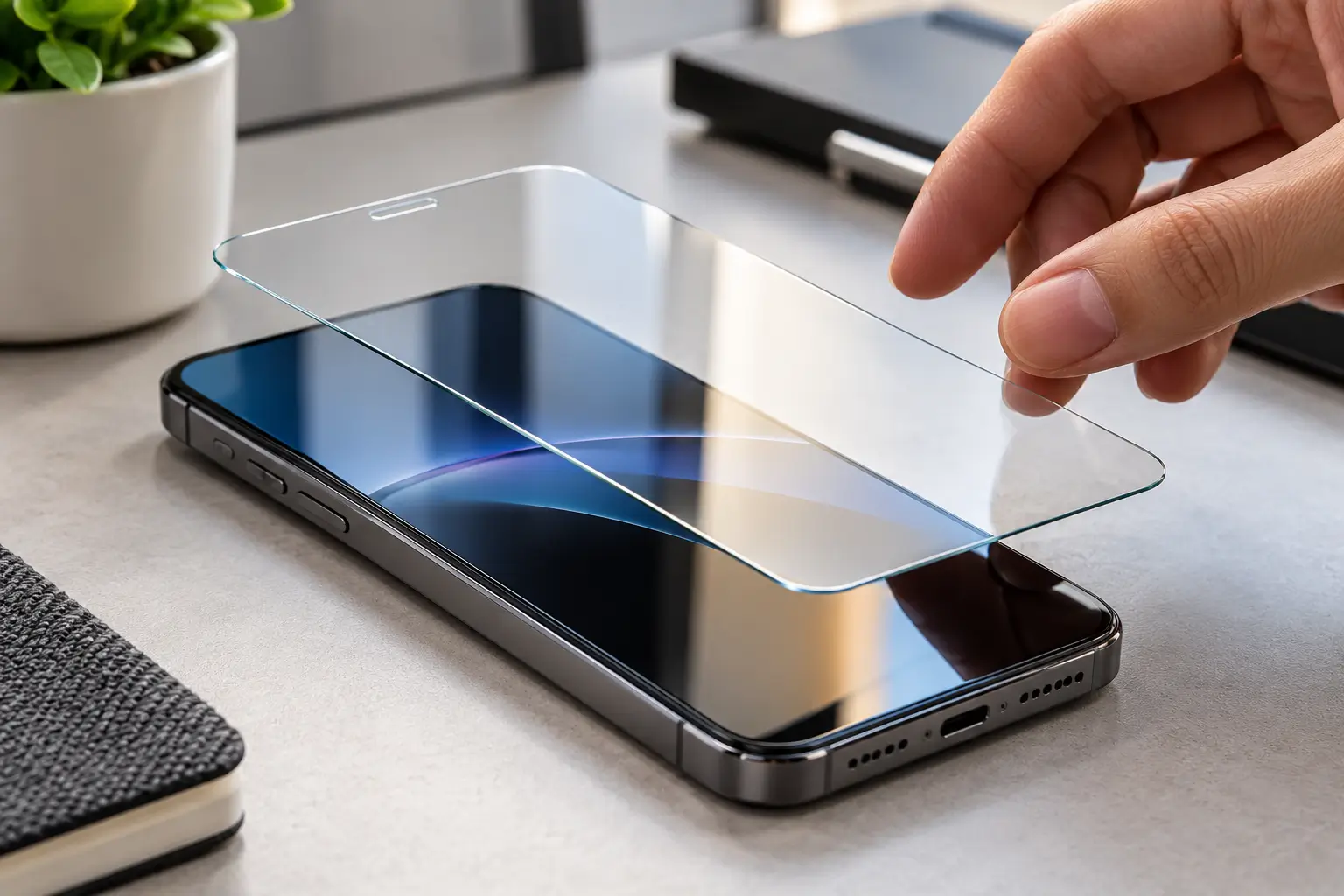
A glass protector, commonly called tempered glass or a screen guard, is a thin protective layer placed over a smartphone’s display. Its main job is to take some of the everyday wear that would otherwise reach the phone’s original cover glass.
But buying one is not as simple as choosing the package that says “9H,” “9D,” “full protection” or “unbreakable.” Those labels describe only parts of the product, and some are much less informative than they appear.
There is also a significant change coming to the Indian market. The Bureau of Indian Standards (BIS) now lists IS 19348:2025, Glass Screen Protector — Specification, while the Ministry of Electronics and Information Technology (MeitY) has added smartphone screen protectors to the compulsory-registration framework. The new requirement is scheduled to apply from 1 April 2027.
That makes this a useful time to understand what a glass protector actually does, what “9H” means, what features matter and what the new Indian rules may mean for buyers.
Quick answer: Is a glass protector worth using?
For many smartphone users, a good glass protector is a practical way to reduce everyday scratches, surface wear and some forms of impact damage to the phone’s original display.
However, it is not a guarantee against a cracked screen.
Modern smartphone cover glass is already engineered for scratch and impact resistance. For example, Corning’s published testing of its cover-glass products distinguishes between scratch resistance, retained strength and drop performance rather than treating “hardness” as a complete measure of durability.
A protector therefore makes more sense as an additional, replaceable layer of protection than as an insurance policy against every type of accident.
What is a glass protector?
A glass protector is a separate protective layer fitted over a smartphone’s display.
Many products use chemically strengthened or tempered glass and may incorporate additional layers or coatings. BIS’s description of IS 19348:2025 identifies “Tempered Glass,” “Screen Protector,” “chemically tempered glass” and “chemically strengthened glass” among the standard’s common terminology.
In practical terms, a protector has several jobs:
- absorb or distribute some physical stress;
- provide a sacrificial surface for scratches;
- reduce direct wear on the phone’s original cover glass;
- provide a surface that can be replaced more cheaply than a damaged display;
- potentially improve resistance to fingerprints, glare or unwanted viewing depending on the design.
The important word is sacrificial.
If a protector cracks after an accident, that does not automatically mean it failed. Its purpose is to be a replaceable layer rather than the phone’s permanent display.
Glass protector vs the phone’s original display glass
These are not the same thing.
A smartphone manufacturer can use specially engineered cover glass as part of the device itself. Corning, for example, develops cover glass with different combinations of scratch resistance, drop performance and retained strength. Its Gorilla Glass portfolio illustrates why durability involves multiple properties rather than one simple hardness number.
A screen protector is an additional accessory.
That distinction matters because a protector can crack while the original display remains intact, but the opposite can also happen: the protector may survive while an impact damages the phone underneath.
The result depends on factors such as:
- where the phone hits;
- the shape and hardness of the surface;
- impact energy;
- the phone’s frame and display design;
- the protector’s construction;
- edge coverage;
- adhesive quality;
- installation;
- whether the case interferes with the protector.
There is therefore no responsible basis for treating a “9H” label as a promise of shatter-proof protection.
What does 9H mean on a glass protector?
This is one of the most misunderstood terms in the screen-protector market.
9H does not mean Mohs hardness level 9.
It generally refers to a pencil-hardness test used to characterize surface hardness. ASTM’s D3363 standard describes pencil hardness as a test for determining the hardness of an organic coating in terms of drawing or pencil leads of known hardness. ISO 15184 similarly specifies determining film hardness by pushing pencils of known hardness across a surface.
That means “9H” should not be interpreted as:
“This glass is almost as hard as diamond.”
It is not a Mohs-scale rating.
It also does not measure every important form of durability.
What 9H can tell you
It can provide information about a surface’s resistance in a particular pencil-hardness test.
What 9H cannot tell you
It does not by itself tell you:
- how the protector performs in a drop;
- how strong its edges are;
- how well it adheres to the phone;
- whether it will crack during installation;
- how well it fits under a case;
- how resistant it is to fingerprints;
- how much glare it produces;
- whether it works well with a fingerprint sensor;
- whether it will prevent the phone’s original display from breaking.
ASTM also cautions that pencil-hardness results can vary depending on pencils, substrates and testing conditions.
Bottom line: treat 9H as one technical characteristic, not a complete quality score.
What should you look for instead of only “9H”?
A better way to evaluate a glass protector is to look at the whole product.
| Feature | Why it matters |
|---|---|
| Correct phone model | Prevents alignment and coverage problems |
| Glass construction | Influences durability and feel |
| Adhesive | Affects touch response, bubbles and longevity |
| Edge design | Can affect cracking and case compatibility |
| Optical clarity | Important for display quality |
| Surface coating | Affects fingerprints and cleaning |
| Thickness | Can affect feel, fit and compatibility |
| Fingerprint compatibility | Particularly important for some Android phones |
| Case compatibility | Prevents the case from lifting the protector |
| Installation quality | Poor fitting can undermine a good protector |
| Warranty/replacement policy | Useful if the protector cracks or develops defects |
This is also where India’s new standard becomes interesting: the Indian standard is not simply a “9H requirement.” BIS lists IS 19348:2025 as a product specification, and reporting on the standard identifies areas including dimensions, glass strength, optical characteristics and various additional layers and coatings.
Types of glass protectors
There is no single protector that is ideal for every phone and every user.
1. Standard clear tempered glass
This is the conventional choice.
It aims to preserve the appearance of the display while adding a replaceable protective layer.
For most users, the important considerations are fit, clarity, adhesive quality and compatibility with the phone case.
2. Full-coverage glass
Full-coverage designs attempt to cover more of the visible display.
They can provide a cleaner appearance, but compatibility with the phone’s curved edges and case should be checked carefully.
A protector that extends too far toward the edge can be pushed upward by a case.
3. Privacy glass
Privacy protectors are designed to restrict viewing from certain angles.
That can be useful for people who regularly use their phones in public places, offices or public transport.
The trade-off is that privacy filters can change how the display looks from off-axis and may reduce perceived brightness depending on the product.
Interestingly, privacy films are also among the additional features addressed within the IS 19348:2025 framework.
4. Anti-glare glass
Anti-glare treatments are intended to reduce reflections.
This can be useful in bright environments, but a matte or anti-glare surface can change the visual character of the display compared with a conventional clear protector.
5. Blue-light filtering protectors
Some protectors incorporate blue-light filtering layers.
The important point for buyers is not to assume that the presence of a blue-light claim automatically means a product provides a particular health benefit. The feature should be considered separately from the protector’s basic physical protection.
6. UV-installed or liquid-adhesive protectors
Some curved-display protectors use liquid adhesive and UV curing.
These can achieve a close fit on certain curved screens, but installation is more involved than simply placing a conventional pre-cut protector on the display.
For these products, following the manufacturer’s installation procedure is particularly important.
Does a glass protector prevent a phone screen from breaking?
No protector can honestly guarantee that.
A screen protector may help reduce damage in some situations, but smartphone breakage is affected by impact location and conditions.
The original display glass also has its own engineering characteristics. Corning’s published testing illustrates the difference between scratch performance and drop performance: its Gorilla Glass 5, for example, was tested separately for scratch and drop behaviour.
This is why claims such as:
- “unbreakable”
- “100% protection”
- “drop-proof”
- “never cracks”
should be treated cautiously unless the manufacturer provides meaningful test information defining exactly what was tested.
A better description is:
A glass protector adds another protective layer, but it cannot eliminate the risk of display damage.
Does thicker glass mean better protection?
Not necessarily.
Thickness is only one characteristic of a protector.
A thicker protector may feel different and can potentially affect case compatibility or touch experience. A thinner protector may offer a more natural feel but still needs adequate construction and installation.
The important question is not simply:
“How thick is it?”
It is:
“Does the product provide the right combination of strength, optical performance, fit and usability for this phone?”
That broader approach is particularly relevant now that India’s dedicated standard addresses more than one characteristic of a glass protector.
Why adhesive quality matters
The glass itself gets most of the marketing attention, but the adhesive layer is important.
Poor bonding can result in:
- bubbles;
- lifting edges;
- dust trapped underneath;
- reduced touch consistency;
- premature separation;
- problems when used with a case.
The fit between the protector, adhesive and phone display is therefore part of the overall product quality.
This is one reason a technically impressive-looking specification list cannot automatically tell you how good a particular protector will feel in everyday use.
India’s new BIS rules for glass screen protectors
This is the biggest recent development for the category in India.
On 21 September 2026, MeitY issued notification S.O. 5190(E) amending the Electronics and Information Technology Goods (Requirement of Compulsory Registration) Order, 2021.
The amendment adds:
“Screen Protectors for smartphones”
as entry number 66 and identifies:
IS 19348:2025 — Glass Screen Protector — Specification
as the applicable Indian Standard.
The notification states that the provisions will apply from 1 April 2027. BIS’s own compulsory-registration listing also records the same product category, standard and notification.
What is IS 19348:2025?
BIS established IS 19348:2025 as a new Indian Standard in July 2025. The BIS standard database describes it as a product specification for glass screen protectors.
Reporting on the standard identifies requirements covering areas such as:
- dimensions;
- thickness;
- glass quality and strength;
- optical/light-transmission characteristics;
- visual defects;
- certain protective layers and coatings;
- product information and packaging.
The important point is that the framework goes beyond the marketing term “9H.”
Does this mean cheap glass protectors are already banned?
No.
The notification was issued in September 2026, but the compulsory-registration provisions for smartphone screen protectors take effect on 1 April 2027. The transition period means the new framework is not an immediate blanket ban on every screen protector currently being sold.
This distinction matters because some headlines have described the development as though all existing screen guards have already been prohibited.
That is not what the notification says.
The relevant compliance date is 1 April 2027.
Will glass protectors become more expensive in India?
That remains uncertain.
Testing, compliance and registration can create additional costs for manufacturers and importers. Some industry representatives have discussed possible market effects, including changes to manufacturing and supply chains.
But the government notification itself does not announce a specific retail-price increase.
Therefore, it would be premature to state that every glass protector will become more expensive.
Actual pricing will depend on factors such as:
- manufacturing costs;
- testing and compliance costs;
- import economics;
- competition;
- retailer margins;
- domestic production;
- product positioning.
Consumers may see changes in pricing or product availability, but the size and direction of those changes cannot yet be established from the notification alone.
What changes for Indian buyers from April 2027?
The practical effect should be a move toward a more formally regulated market for covered smartphone screen protectors.
For consumers, the important change is that manufacturers and importers will have to meet the applicable requirements under the compulsory-registration framework once it takes effect.
That could make product specifications more meaningful because there will be a defined Indian Standard behind the category.
However, buyers should not assume that a regulatory standard eliminates the need to check:
- phone-model compatibility;
- case compatibility;
- optical quality;
- fingerprint performance;
- installation method;
- warranty;
- actual product specifications.
Regulation can establish minimum requirements. It cannot remove the need to choose the right product for a particular phone.
What should you check before buying a glass protector?
Use this checklist rather than choosing solely on price or the biggest number printed on the box.
1. Check the exact phone model
Even phones that look similar can have different display dimensions, camera cut-outs and edge designs.
2. Check case compatibility
If you use a protective case, choose a protector designed to work with it.
3. Don’t buy based only on “9H”
The label provides limited information about surface hardness. It does not describe complete impact protection.
4. Look at the adhesive
Good bonding helps prevent bubbles, lifting and touch problems.
5. Consider fingerprint unlocking
If your phone uses an in-display fingerprint sensor, verify that the protector is intended to work with it.
6. Consider the finish
Choose between clear, anti-glare and privacy options based on how you use the phone.
7. Look at the edges
Poor edge design can lead to chipping, lifting or interference with the case.
8. Don’t assume “full coverage” means maximum protection
Coverage and impact performance are different things.
9. Consider replacement cost
A protector is a consumable accessory. If it cracks, it should generally be easier and cheaper to replace than the phone’s display.
10. From 2027, pay attention to applicable compliance information
As the new Indian requirements take effect, buyers will have another quality-related signal to consider when purchasing covered smartphone screen protectors.
Glass protector buying framework
Instead of asking “Which glass has the highest H rating?”, ask these five questions:
| Question | What it helps determine |
|---|---|
| Does it fit my exact phone? | Basic compatibility |
| Does it work with my case? | Edge and installation compatibility |
| Does it preserve display clarity? | Viewing experience |
| Does it work with my fingerprint/touch system? | Everyday usability |
| Does the manufacturer provide meaningful specifications? | Product transparency |
This is a much more useful decision framework than choosing based on one number.
9H, 9D, 11D and “military grade”: what should you believe?
The biggest problem with accessory marketing is that several terms sound like standardized engineering ratings even when they do not provide a complete picture of performance.
9H
A pencil-hardness designation rather than a Mohs-9 mineral-hardness score.
9D / 11D / similar labels
These should not automatically be interpreted as progressively stronger glass.
The actual technical meaning depends on the manufacturer and product specification.
Military grade
This phrase is only meaningful if a manufacturer identifies the specific test standard, conditions and result behind the claim.
“Unbreakable”
Treat this as marketing language unless accompanied by clearly defined, reproducible testing.
The safest approach is to look for specific test information rather than impressive-sounding labels.
What is confirmed about India’s new glass-protector rules?
Confirmed
- BIS has established IS 19348:2025 — Glass Screen Protector — Specification.
- MeitY added smartphone screen protectors to the compulsory-registration framework through notification S.O. 5190(E) dated 21 September 2026.
- The applicable standard identified in the notification is IS 19348:2025.
- The provisions take effect for the newly added category on 1 April 2027.
Reported
Industry representatives have discussed possible changes in domestic manufacturing, supply chains and the size of the Indian screen-protector market. These are industry estimates and statements, rather than guaranteed outcomes.
Not established yet
- A specific percentage increase in retail prices.
- Exactly how much the average consumer will pay more or less.
- Whether every low-cost protector currently sold will disappear.
- Whether consumers will immediately notice a major difference in everyday durability.
Those outcomes depend on how manufacturers and importers adapt before the April 2027 implementation date.
The bigger takeaway for smartphone users
The glass protector market has traditionally encouraged consumers to compare products using simple labels: 9H, 9D, full coverage, military grade and similar terms.
The more useful approach is to look at the protector as a complete product.
Its glass, adhesive, dimensions, edges, coatings, optical properties and compatibility all contribute to the experience.
India’s new BIS framework is significant because it moves the category toward a formal product standard rather than leaving buyers entirely dependent on marketing descriptions. But it does not mean that every protector will suddenly become identical, nor does it guarantee that a protector can prevent every broken screen.
For consumers, the practical lesson is simple:
Don’t buy a glass protector because the box has the biggest number. Buy one that is properly designed for your phone, fits your case and provides transparent information about what it actually offers.
And from 1 April 2027, India’s regulatory framework will add another layer of quality requirements for covered smartphone screen protectors.
Frequently Asked Questions
Is a glass protector necessary for every smartphone?
Not necessarily. Modern smartphones already use engineered cover glass, so the decision depends on how you use and handle your phone. A protector provides an additional replaceable layer against everyday wear and some forms of damage.
Is 9H the same as Mohs hardness 9?
No. The “9H” terminology commonly refers to a pencil-hardness test, not a Mohs mineral-hardness rating. ASTM D3363 and ISO 15184 describe pencil-hardness testing methods.
Does tempered glass guarantee that my phone screen will not crack?
No. A screen protector cannot guarantee protection against all impacts. Drop angle, impact surface, device construction, frame design and the protector itself all influence the outcome.
What is IS 19348:2025?
It is an Indian Standard titled “Glass Screen Protector — Specification.” BIS lists it as a product specification and identifies it as a new Indian Standard established in 2025.
When do India’s new screen-protector rules take effect?
The compulsory-registration provisions for smartphone screen protectors covered by the notification take effect on 1 April 2027.
Are all existing screen protectors banned in India right now?
No. The September 2026 notification provides a transition period before the new provisions take effect. It does not impose an immediate blanket ban on all currently available screen protectors.
Will glass protectors become more expensive after the new BIS rules?
That cannot be established yet. Compliance may affect manufacturers’ costs, but the government notification does not specify a retail-price increase. Actual pricing will depend on manufacturers, importers, competition and supply-chain changes.
What matters more than a 9H label?
For most buyers, the combination of correct fit, adhesive quality, edge design, optical clarity, case compatibility and compatibility with features such as fingerprint unlocking is more useful than relying on the 9H label alone.