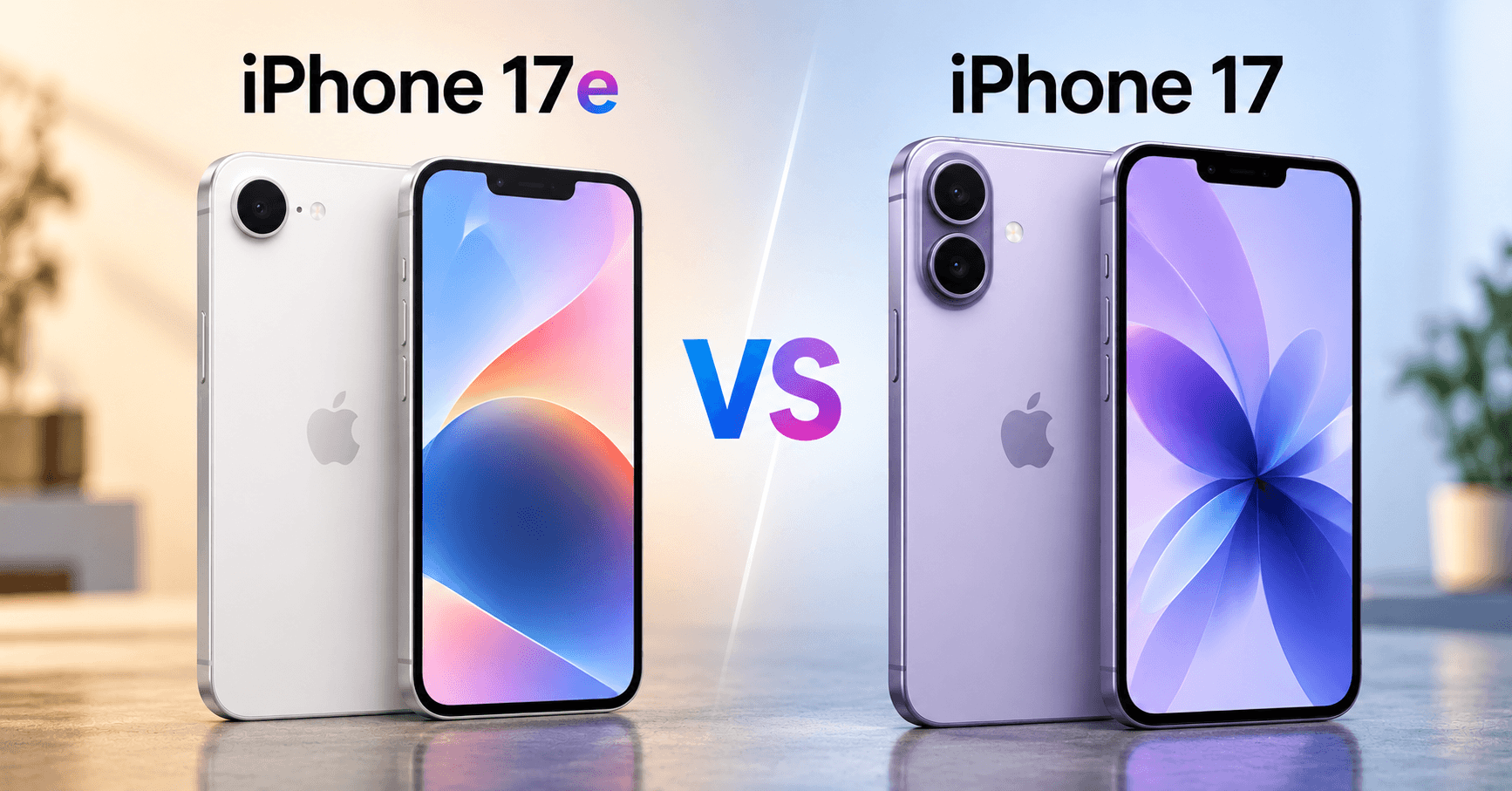
The iPhone 17e and iPhone 17 share Apple’s A19 processor, OLED displays, 48-megapixel main cameras and support for Apple Intelligence. However, they are not identical phones. The standard iPhone 17 has a smoother 120Hz display, an additional ultra-wide rear camera, a more advanced front camera and longer claimed video playback time.
In India, Apple’s launch price for the iPhone 17e started at ₹64,900 for 256GB storage, while the iPhone 17 started at ₹82,900 for the same storage capacity. That is an ₹18,000 difference at launch. The important question is whether the iPhone 17’s additional features are worth that extra amount for your needs.
This comparison looks at the specifications and the practical differences that matter when using either phone.
iPhone 17e vs iPhone 17: Key differences at a glance
| Feature | iPhone 17e | iPhone 17 |
|---|---|---|
| Launch price in India (256GB) | ₹64,900 | ₹82,900 |
| Processor | A19 | A19 |
| CPU | 6-core | 6-core |
| GPU | 4-core | 5-core |
| Display | 6.1-inch OLED | 6.3-inch OLED |
| Refresh rate | 60Hz | Up to 120Hz ProMotion |
| Always-On display | No | Yes |
| Rear cameras | 48MP Fusion | 48MP Fusion + 48MP Ultra Wide |
| Front camera | 12MP TrueDepth | 18MP Center Stage |
| Video playback claim | Up to 26 hours | Up to 30 hours |
| Wireless charging | MagSafe, up to 15W | MagSafe, up to 25W |
| Water resistance | IP68 | IP68 |
| Starting storage | 256GB | 256GB |
| Connectivity | 5G, Wi-Fi 6, Bluetooth 5.3 | 5G, Wi-Fi 7, Bluetooth 6 |
Prices above are the announced Indian launch prices, not a live retailer-price comparison. Battery figures are Apple’s stated maximum video-playback estimates under its testing conditions.
iPhone 17e vs iPhone 17: Price in India
Apple announced the iPhone 17e in March 2026 with a starting price of ₹64,900 for the 256GB version. The iPhone 17 launched in September 2025 at ₹82,900 for its 256GB version.
That creates an ₹18,000 difference between their starting launch prices.
The two phones also have 512GB storage options. However, prices at Apple, authorised retailers and online marketplaces can change with discounts, bank offers, exchange deals and stock availability. Check the final checkout price before comparing them.
The price gap is important because the iPhone 17e already includes the A19 chip, a 48MP main camera, an OLED screen, MagSafe and 256GB of starting storage. The extra money for the iPhone 17 mainly buys a more capable display, additional cameras and connectivity upgrades.
Display: iPhone 17 has a clear hardware advantage
The display is one of the most noticeable differences between these phones.
The iPhone 17e has a 6.1-inch Super Retina XDR OLED display with a resolution of 2532 × 1170 pixels. It supports HDR, True Tone and a peak HDR brightness of 1,200 nits. Its refresh rate is 60Hz.
The iPhone 17 has a larger 6.3-inch OLED display with a resolution of 2622 × 1206 pixels. More importantly, it supports ProMotion with an adaptive refresh rate of up to 120Hz. It also includes an Always-On display and can reach up to 3,000 nits of peak outdoor brightness.
What does 60Hz versus 120Hz mean?
A 60Hz screen refreshes its image up to 60 times per second. A 120Hz screen can refresh up to 120 times per second.
In everyday use, the difference is most noticeable when scrolling through social media, browsing websites, navigating menus and playing games that support higher refresh rates. Animations and movement can look smoother on the iPhone 17.
This does not mean the iPhone 17e has a poor display. Its OLED panel still offers high resolution, HDR support and strong contrast. But buyers who are accustomed to high-refresh-rate phones may notice the 60Hz limit.
Practical difference: Choose the iPhone 17 if display smoothness, outdoor visibility and Always-On functionality matter to you. The iPhone 17e covers standard viewing and everyday use without those higher-end display features.
Performance: Both use A19, but the GPU is not identical
Both phones use Apple’s A19 chip, built using a 3-nanometre process. Each has a six-core CPU and a 16-core Neural Engine.
However, Apple’s specifications list a four-core GPU for the iPhone 17e and a five-core GPU for the iPhone 17.
This distinction matters. The shared A19 name does not mean the two devices have identical graphics hardware. The iPhone 17 has an additional GPU core, which may be relevant for graphics-intensive games and some demanding visual workloads.
For everyday tasks such as messaging, browsing, video streaming, photography and general app use, both phones have modern Apple silicon. A buyer should not assume the iPhone 17e is slow simply because it is the lower-priced model.
Both devices support Apple Intelligence, although feature availability can vary by language, region and software version.
Camera comparison: One rear camera versus two
The camera system is another major reason to compare these phones carefully.
iPhone 17e camera
The iPhone 17e has a 48MP Fusion rear camera with optical image stabilisation. It also supports an optical-quality 2x telephoto option using the main camera system.
Its camera features include Night mode, Portrait mode, Photographic Styles and 4K Dolby Vision video recording.
iPhone 17 camera
The iPhone 17 has a dual rear-camera system:
- 48MP Fusion Main camera
- 48MP Fusion Ultra Wide camera
The ultra-wide camera gives users a wider field of view for landscapes, architecture, group photos and scenes where stepping further back is not practical. The iPhone 17 also supports macro photography.
Why the ultra-wide camera matters
A higher megapixel count does not automatically make a camera system more versatile. The key difference is the additional perspective available from the ultra-wide lens.
For example, someone photographing buildings, landscapes or a large group may find the iPhone 17’s ultra-wide camera useful. Someone who mainly takes regular photos of people, pets, food and everyday scenes may be comfortable with the iPhone 17e’s single rear camera.
The iPhone 17 also has an 18MP Center Stage front camera, while the iPhone 17e has a 12MP TrueDepth front camera. Center Stage can automatically adjust the framing for supported photos and video calls.
Camera takeaway: The iPhone 17 offers more flexibility, particularly for ultra-wide photography, macro shots and front-camera framing. The iPhone 17e still provides a high-resolution main camera with optical stabilisation.
Battery life and charging
Apple rates the iPhone 17e for up to 26 hours of video playback. The iPhone 17 is rated for up to 30 hours.
These are manufacturer estimates, not guaranteed screen-on times. Actual battery life depends on network conditions, brightness, apps, camera use, gaming, settings and battery condition.
The iPhone 17e supports USB-C fast charging and MagSafe wireless charging up to 15W. The iPhone 17 supports MagSafe and Qi2 wireless charging up to 25W. Apple also advertises faster wired charging for the iPhone 17 when paired with a suitable power adapter.
Neither phone includes a power adapter in the box, so buyers should account for a compatible charger if they do not already own one.
Design, durability and size
Both phones use an aluminium design, a glass back and Ceramic Shield 2 on the front. Both carry an IP68 rating for splash, water and dust resistance under controlled laboratory conditions.
The iPhone 17e is slightly smaller and lighter:
- iPhone 17e: 170g, 6.1-inch display
- iPhone 17: 177g, 6.3-inch display
The iPhone 17e is available in Black, White and Soft Pink. The iPhone 17 comes in Black, White, Mist Blue, Sage and Lavender.
The IP68 rating should not be treated as a promise that either phone is waterproof. Water resistance can decrease with normal wear, and liquid damage may not be covered by warranty.
Connectivity and additional features
The iPhone 17e supports 5G, Wi-Fi 6 and Bluetooth 5.3. It uses Apple’s C1X cellular modem.
The iPhone 17 supports 5G, Wi-Fi 7 and Bluetooth 6, and includes Apple’s N1 wireless networking chip. It also has a Camera Control button in addition to the Action button.
These differences are unlikely to matter equally to every buyer. Wi-Fi 7 requires a compatible router and network environment to deliver its potential benefits. Bluetooth 6 support is also dependent on compatible accessories.
For buyers who expect to keep a phone for several years, newer connectivity standards may be worth considering, but they should not outweigh more immediately useful features such as the display and camera system.
Which iPhone should you choose?
The choice depends on how you use your phone rather than simply which model has more features.
Consider the iPhone 17e if:
- You want to spend less at the announced starting price.
- You want Apple’s A19 chip for everyday use.
- You mainly use the main rear camera.
- A 60Hz display is acceptable to you.
- You want 256GB starting storage and MagSafe support.
- You do not regularly need ultra-wide or macro photography.
Consider the iPhone 17 if:
- You prefer a smoother 120Hz ProMotion display.
- You take landscapes, architecture or group photos using an ultra-wide camera.
- You make frequent video calls and want the Center Stage front camera.
- You value the longer stated video-playback time.
- You want Wi-Fi 7, Bluetooth 6 and faster MagSafe charging.
- The additional launch-price difference fits your budget.
Is the iPhone 17e worth buying over the iPhone 17?
The iPhone 17e includes several important features that make it more than a basic entry-level iPhone: an A19 processor, a 48MP main camera, OLED display, 5G, MagSafe and 256GB starting storage.
The iPhone 17 adds features that can make a real difference in daily use, especially its 120Hz display and dual rear-camera system. It also has a more advanced front camera and higher stated battery playback time.
The most useful way to decide is to identify the features you will actually use. If you mostly browse, message, stream content and take regular photos, the iPhone 17e’s feature set may cover your needs. If you frequently take ultra-wide photos, value smoother scrolling or use the front camera for video calls, the iPhone 17’s upgrades may be more relevant.
Before purchasing, compare the current selling prices rather than relying only on launch prices. A substantial discount on the iPhone 17 could change the value calculation.
Frequently asked questions
Is the iPhone 17e better than the iPhone 17?
They serve different requirements. The iPhone 17e has the same A19 processor family and a lower launch price, while the iPhone 17 offers a 120Hz display, an ultra-wide rear camera and a more advanced front camera.
Do both iPhones have the A19 chip?
Yes. Both use Apple’s A19 chip, but the iPhone 17e has a four-core GPU and the iPhone 17 has a five-core GPU.
Does the iPhone 17e have a 120Hz display?
No. Published comparison specifications list it as a 60Hz display. The iPhone 17 supports ProMotion with an adaptive refresh rate of up to 120Hz.
Does the iPhone 17e have an ultra-wide camera?
No. It has a single 48MP Fusion rear camera. The iPhone 17 adds a separate 48MP ultra-wide camera.
Which phone has the better selfie camera?
The iPhone 17 has an 18MP Center Stage front camera, while the iPhone 17e has a 12MP TrueDepth front camera. The iPhone 17’s Center Stage feature can automatically adjust framing in supported situations.
Is the iPhone 17e battery better than the iPhone 17 battery?
Apple’s stated video-playback estimates are up to 26 hours for the iPhone 17e and up to 30 hours for the iPhone 17. These are controlled-test estimates, not guaranteed real-world battery times.
Do both models support MagSafe?
Yes. The iPhone 17e supports MagSafe wireless charging up to 15W, while the iPhone 17 supports up to 25W.
Are both phones water-resistant?
Both have an IP68 rating under controlled laboratory conditions. This does not make either phone waterproof, and water resistance can decrease over time.