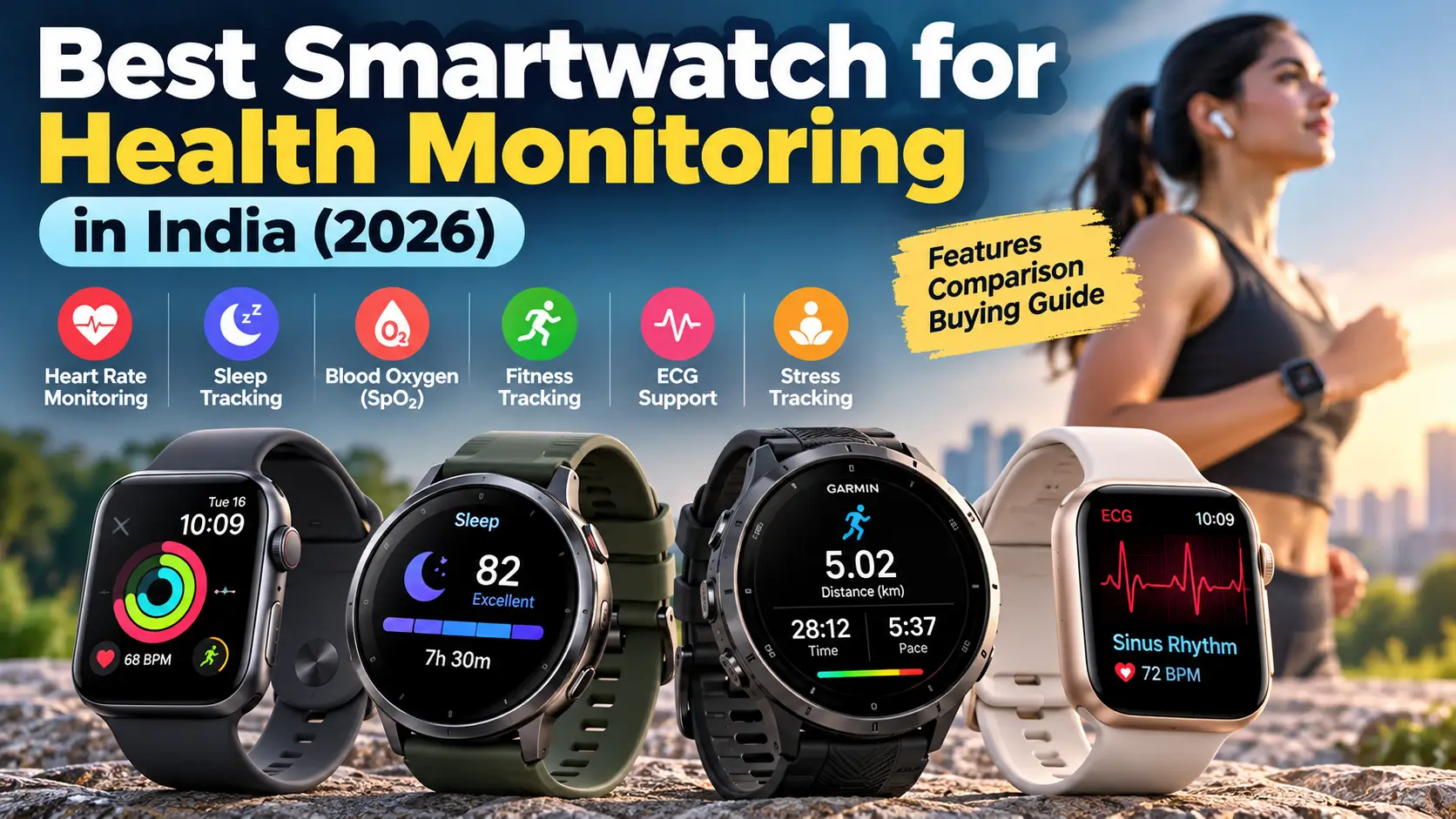
A smartwatch can help you understand your daily activity, resting heart rate, sleep patterns, and exercise habits. Some models also offer features such as electrocardiograms (ECGs), irregular-heart-rhythm notifications, and estimates of blood oxygen saturation. However, these features are not available on every watch, and their availability can depend on the country, smartphone, and software version.
For iPhone owners seeking extensive health features, the Apple Watch Series 12 is a premium choice. Android users can consider the Samsung Galaxy Watch9, while fitness-focused users should also evaluate Garmin’s sports watches. The right choice depends on which measurements you need, how often you exercise, your budget, and how long you want the battery to last.
The important point is this: the smartwatch with the most sensors is not necessarily the best smartwatch for your health. A device that you can wear comfortably, use consistently, and interpret correctly may provide more practical value than one with a longer feature list.
Which health-monitoring features actually matter?
Before comparing specifications, understand what the main measurements can tell you.
Heart-rate monitoring
An optical heart-rate sensor estimates your pulse using light reflected from blood flow near the skin. It can help you understand resting heart rate, observe changes during exercise, and review trends over time.
For useful results, wear the watch snugly and follow the manufacturer’s instructions. Movement, a loose strap, skin contact, and the type of exercise can affect readings. A wrist sensor should not automatically be assumed to match a clinical measurement in every situation.
ECG and irregular-heart-rhythm notifications
An ECG-capable smartwatch can record electrical activity from the heart in a limited, usually single-lead format. Certain devices can help identify signs that warrant medical follow-up, including possible atrial fibrillation.
An ECG app is different from continuous optical heart-rate monitoring. It generally requires the user to perform a recording, and its capabilities depend on the device and regulatory availability. Apple describes its ECG app as producing a single-lead ECG, while Samsung provides ECG functionality through its Health Monitor ecosystem on supported devices.
A smartwatch ECG is not a replacement for a medical ECG or a clinician’s assessment. A normal result also cannot rule out every heart condition.
Blood oxygen (SpO₂)
Blood oxygen monitoring estimates the proportion of oxygenated hemoglobin in the blood. On supported watches, it may provide additional wellness information or help users observe trends.
However, wrist-based measurements can be affected by movement, fit, circulation, skin temperature, and other factors. Do not use a consumer smartwatch as the sole basis for deciding whether breathing difficulties or another potentially serious symptom are safe to ignore.
Also verify that the specific model supports the feature in India. A sensor’s presence does not guarantee that its associated app or measurement is available in every market.
Sleep tracking
Sleep tracking estimates sleep duration and patterns from signals such as movement and heart rate. More advanced models may offer sleep stages, overnight metrics, sleep scores, or breathing-related notifications.
These estimates can be useful for identifying patterns—for example, consistently sleeping too little or noticing a change in routine. They are not equivalent to a sleep study, and a sleep score should not be interpreted as a diagnosis.
Comfort matters here. If the watch is too bulky, irritating, or difficult to charge regularly, you may stop wearing it overnight and lose the benefit of consistent tracking.
HRV, stress, and recovery
Heart-rate variability (HRV) describes variation in the time between consecutive heartbeats. Some wearables use HRV alongside other signals to provide stress, recovery, or readiness estimates.
These scores are derived measurements, not direct readings of your overall health. They can be affected by sleep, exercise, illness, alcohol, medication, and measurement conditions. Use them to observe trends rather than treating a single score as a definitive judgement about your body.
Apple Watch vs Samsung Galaxy Watch vs Garmin
The best choice often depends more on your smartphone and your intended use than on the number of sensors.
| Buying priority | Option to investigate | Why |
|---|---|---|
| Extensive health features for iPhone | Apple Watch Series 12 | Broad health feature set and iPhone integration |
| Lower-cost Apple option | Apple Watch SE 3 | Core heart rate and sleep features |
| Android smartwatch and wellness tracking | Samsung Galaxy Watch 9 | Health insights integrated with Samsung Health |
| Detailed endurance-training data | Garmin Forerunner 970 | Sports-focused metrics and training analysis |
| Everyday fitness with a sports-watch approach | Garmin Venu 3 | Wellness and fitness-oriented feature mix |
Apple’s official Indian listing gives the Series 12 a starting price of ₹56,900 and the SE 3 a starting price of ₹29,900. Prices and availability can change, while Samsung and Garmin pricing depends on the particular model and retailer.
A useful rule: Choose the watch that works with your phone and offers the measurements you will actually use. Do not pay extra for ECG, advanced training analysis, or other features without checking that they are supported and relevant to you.
Are smartwatches accurate enough for health monitoring?
Smartwatch measurements can be useful, but accuracy varies by metric, device, activity, and person. A product’s feature list does not establish that it measures every health variable with clinical accuracy.
For example, an optical sensor may perform differently during steady walking and high-intensity exercise. Sleep stages are estimates, while calorie expenditure is generally an indirect calculation rather than a direct measurement.
When evaluating a watch, look for independent testing that identifies the reference device, testing conditions, number of participants, and size of measurement errors. A review that simply says a sensor is “accurate” without describing its testing is less informative.
For personal use, consistency is often more valuable than reacting to every small fluctuation. Compare similar measurements taken under similar conditions and look for sustained changes rather than treating every notification as a medical finding.
What should Indian buyers check before purchasing?
A smartwatch can have impressive features on paper but still be a poor fit for a particular buyer.
- Phone compatibility: Check whether the watch works with your Android phone or iPhone. Apple Watch is designed for iPhone use; Samsung’s advanced health functions may have additional Samsung phone requirements.
- India-specific availability: Confirm that ECG, blood oxygen, irregular-rhythm alerts, and any other required features work in India on the exact model.
- Total cost: Include replacement straps, charging accessories, possible subscriptions, and warranty coverage.
- Battery life: Consider how often you will need to charge it, especially if you want to monitor sleep overnight.
- Comfort: A lightweight watch that fits properly is more likely to be worn consistently.
- Privacy: Review what health data is collected, where it is stored, and which apps or services can access it.
- After-sales support: Buy from a reliable seller and confirm the local warranty and service arrangements.
Can a smartwatch replace a medical check-up?
No. Smartwatches are best treated as tools for wellness tracking, activity monitoring, and selected screening-related notifications. They do not independently diagnose or rule out heart disease, sleep disorders, or other medical conditions.
If a watch repeatedly flags an unusual reading, discuss it with a qualified healthcare professional instead of diagnosing yourself. If you have severe chest pain, serious breathing difficulty, fainting, or other urgent symptoms, seek emergency medical care rather than relying on a watch reading.
A health-monitoring smartwatch is most useful when its information helps you build better routines, recognize meaningful changes, and have more informed conversations with a healthcare professional.
Final verdict
For Indian buyers, the Apple Watch Series 12 is a strong premium option for iPhone users who want extensive health-monitoring features. The Samsung Galaxy Watch9 is a relevant Android option for users who value integrated wellness insights, while Garmin’s Forerunner and Venu lines deserve consideration for exercise and training-focused needs.
The right choice is not necessarily the most expensive or the one with the longest sensor list. Start with the health metrics you actually want, confirm that they work on your phone in India, and evaluate the quality and limitations of those measurements before buying.
Frequently asked questions
Which smartwatch is best for health monitoring in India?
For iPhone users who want extensive health features, the Apple Watch Series 12 is a strong premium choice. Android users can consider Samsung Galaxy Watch models, while Garmin is worth investigating for sports and training data. Your phone, budget, and required measurements should determine the final choice.
Which smartwatch is best for heart-rate monitoring?
Choose a watch with a well-supported heart-rate sensor and independent testing relevant to your activity. Fit, movement, and exercise intensity affect readings, so avoid choosing solely on a manufacturer’s accuracy claims.
Can a smartwatch measure blood pressure?
Some watch ecosystems offer blood-pressure-related features in supported markets or configurations. Availability and calibration requirements vary. Do not assume that a watch provides clinically reliable blood-pressure measurements simply because it has health sensors.
Is ECG available on smartwatches in India?
ECG is available on selected models, but support depends on the device, app, region and applicable requirements. Confirm availability for your exact model before buying.
Are smartwatch SpO₂ readings accurate?
They are estimates that can be affected by movement, fit and other conditions. A consumer watch should not be used as the sole basis for assessing a potentially serious breathing or oxygen problem.
Can I use an Apple Watch with an Android phone?
Apple Watch is designed for use with an iPhone and is not compatible with Android phones as a conventional paired smartwatch. Android users should look at compatible Wear OS or other Android-compatible wearables.
How much should I spend on a health-monitoring smartwatch?
Set a budget based on the features you will genuinely use. Core activity and heart-rate tracking may not require a premium device. ECG, advanced wellness insights and training analysis can narrow the options and raise the cost.
Can a smartwatch detect heart disease?
A smartwatch may provide certain alerts or recordings that warrant medical follow-up, but it cannot reliably detect every heart condition or replace a medical examination. Discuss concerning readings with a qualified healthcare professional.
Health disclaimer
Smartwatch health measurements are intended primarily for wellness and fitness tracking unless a specific feature has been validated and authorised for a stated medical purpose. They do not replace clinical tests, medical advice or emergency care.