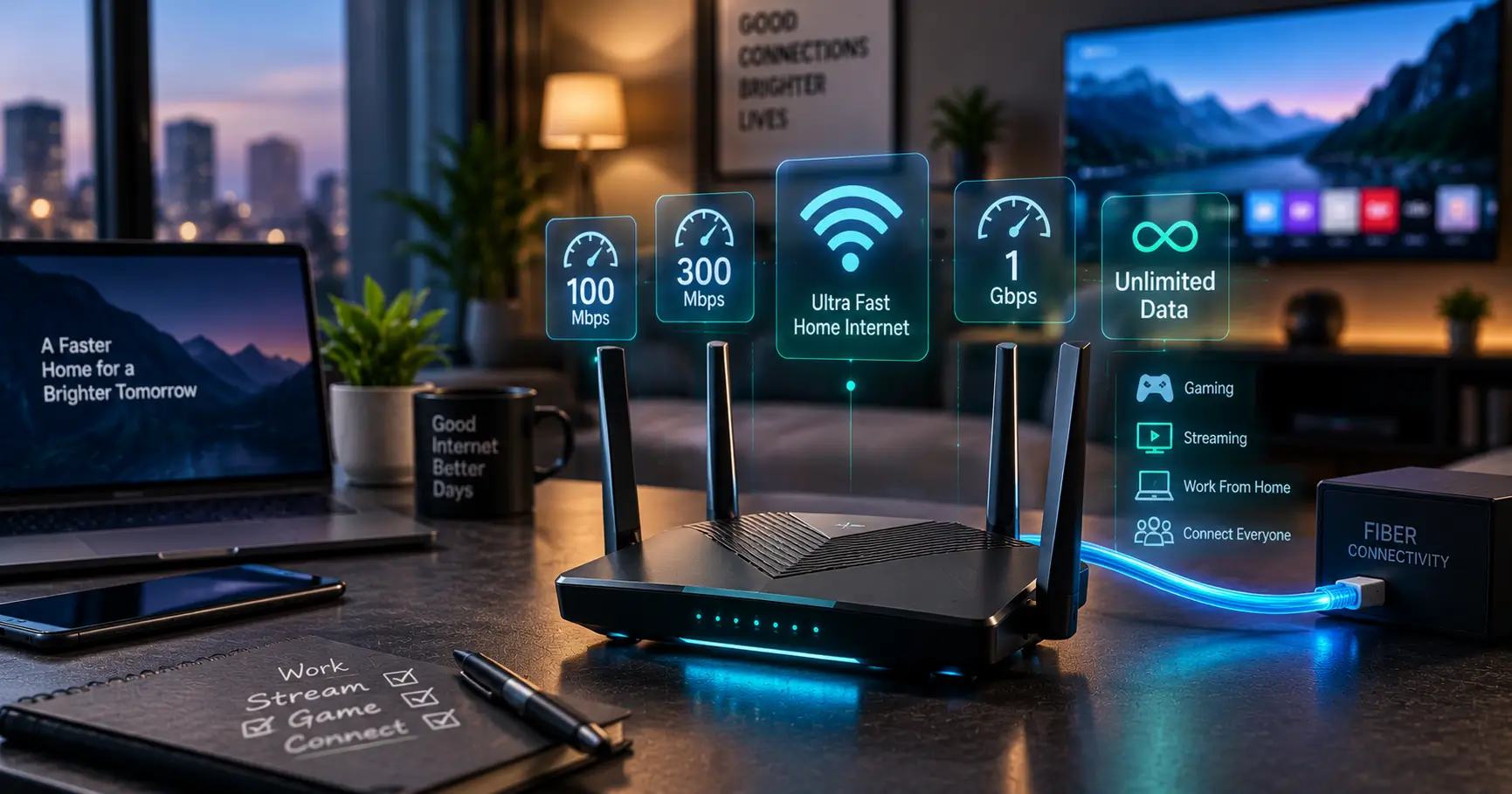
Choosing the best broadband plan in India is not simply about finding the highest Mbps number. For most homes, a reliable 100 Mbps fiber connection offers a strong balance of speed and price, while larger households, heavy streamers and power users may benefit from 300 Mbps or higher.
Among the major options currently listed by providers, JioFiber and Airtel Xstream Fiber offer broad consumer choices, while ACT Fibernet can be attractive where its local network is available. BharatNet also lists lower-cost FTTH plans aimed particularly at rural connectivity. Availability and final pricing can vary by location.
Best Broadband Plans at a Glance
| Provider | Example Plan | Speed | Data | Best For |
|---|---|---|---|---|
| JioFiber | ₹399/month | 30 Mbps | Unlimited | Basic home use |
| JioFiber | ₹699/month | 100 Mbps | Unlimited | Most households |
| Airtel Xstream | ₹499/month | 40 Mbps | Unlimited | Budget users |
| Airtel Xstream | ₹799/month | 100 Mbps | Unlimited | Families and WFH |
| ACT Fibernet* | ₹775/month | 100 Mbps | Unlimited | Work and everyday use |
| Airtel Xstream | ₹1,599/month | 300 Mbps | Unlimited | Heavy users |
| Airtel Xstream | ₹3,999/month | 1 Gbps | Unlimited | Premium/high-speed use |
*ACT examples shown are from current Delhi-area listings, so ACT pricing and availability should be checked for the user’s city. Provider prices can also be subject to taxes and local terms.
JioFiber: Strong Value for Everyday Users
JioFiber currently lists a 30 Mbps plan at ₹399 plus GST and a 100 Mbps plan at ₹699 plus GST, both with unlimited data and voice calling. Its higher-priced options include 150 Mbps and 300 Mbps plans with bundled OTT services.
For a small household, the ₹399 plan can be enough for browsing, social media, video calls and moderate streaming. The 100 Mbps option is more suitable when several devices are connected simultaneously.
Jio also promotes entertainment-focused broadband with digital TV channels and multiple OTT subscriptions on eligible plans.
Best for: Users wanting a straightforward combination of speed, unlimited data and entertainment benefits.
Airtel Xstream Fiber: Good for Families and OTT Users
Airtel’s current broadband lineup starts at ₹499 for up to 40 Mbps and includes higher-speed options such as 100 Mbps, 300 Mbps and 1 Gbps. Its ₹799 plan offers up to 100 Mbps, while the ₹1,599 plan goes up to 300 Mbps. Airtel also offers plans bundled with TV channels and multiple OTT services.
The ₹999 and ₹1,199 100 Mbps plans add larger entertainment bundles, while the ₹3,999 plan offers up to 1 Gbps and a substantial TV/OTT package. Airtel states that listed monthly prices are exclusive of taxes.
Best for: Families that want broadband combined with TV and OTT entertainment.
ACT Fibernet: Worth Considering for Performance-Focused Users
ACT Fibernet’s available plans depend heavily on location. Its current listings show options such as 50 Mbps at ₹699/month with a 1,000 GB allowance and 100 Mbps unlimited at ₹775/month in some Delhi locations. ACT also offers higher-speed tiers and entertainment packages.
ACT’s city-specific availability makes it difficult to name one nationwide “best” plan. If ACT is available at your address, compare its upload speed, latency, data allowance and final bill against Jio and Airtel rather than looking only at the monthly headline price.
Best for: Users who have good ACT coverage locally and care about performance, work or gaming.
BharatNet: An Option for Rural Connectivity
BharatNet’s official FTTH plan page lists rural-oriented options including ₹259/month for 25 Mbps and ₹399/month for 40 Mbps, with data thresholds after which speeds are reduced. Higher plans include 150 Mbps and 250 Mbps options with OTT benefits.
These plans are particularly relevant to eligible rural users. They should not be compared directly with every urban retail fiber plan because availability, eligibility and plan structure differ.
Best for: Eligible rural households seeking fiber broadband at relatively low monthly prices.
What Broadband Speed Do You Actually Need?
You probably do not need 1 Gbps for ordinary home use.
A simple guide is:
- 30–40 Mbps: One or two light users.
- 100 Mbps: Best starting point for many families.
- 200–300 Mbps: Multiple simultaneous streams, large downloads and heavier households.
- 500 Mbps–1 Gbps: Large households, heavy downloads, high-end home networks or users who specifically need very high throughput.
Remember that broadband speed is shared across devices. A 100 Mbps connection can feel very different when one person is browsing compared with four people simultaneously streaming, downloading and gaming.
What to Check Before Buying a Broadband Plan
Do not compare plans using price alone. Check:
1. Fiber availability: FTTH generally provides a better fixed-line foundation than older copper-based broadband.
2. Upload speed: Important for cloud backups, video calls, content creation and sending large files.
3. Data policy: “Unlimited” does not always mean unlimited at maximum speed. Check FUP or commercial-usage conditions.
4. Router quality: A fast broadband connection can still perform poorly if the Wi-Fi router is inadequate or badly positioned.
5. Installation and taxes: Compare the actual first bill and recurring cost, not just the advertised monthly price.
TRAI requires service providers to clearly specify applicable fair-usage limits and typical download/upload speeds in tariff offerings.
Which Broadband Plan Is Best for You?
For many Indian households, 100 Mbps is the sensible middle ground. Jio’s ₹699 100 Mbps option and Airtel’s ₹799 100 Mbps option are useful benchmarks when comparing local plans.
Choose Jio if its local offering gives you the best combination of price and entertainment benefits. Choose Airtel when its TV/OTT bundle or local network performance offers better value. Consider ACT where its network is strong in your area, particularly if performance is important. Rural users should also check BharatNet availability.
The best broadband plan is ultimately the one that delivers reliable speed, suitable upload performance, sensible data terms and good local service at a price you are comfortable paying.
FAQ
Which is the best broadband plan in India in 2026?
There is no single best plan for every location. JioFiber, Airtel Xstream Fiber and ACT Fibernet all offer competitive options, while BharatNet can be relevant in eligible rural areas. Local availability and final pricing should be checked before choosing.
Is 100 Mbps enough for a family?
For many families, yes. A 100 Mbps connection can handle multiple everyday devices, video calls and streaming, although heavy simultaneous downloads and multiple high-resolution streams can increase demand.
Which is better, JioFiber or Airtel Xstream Fiber?
Both have competitive plans. Jio currently lists 100 Mbps at ₹699 plus GST, while Airtel lists 100 Mbps at ₹799 before applicable taxes. The better choice depends on local availability, service quality, router performance and bundled benefits.
What broadband speed is best for work from home?
For one or two people working from home, 50–100 Mbps is generally a practical starting range. Upload speed and connection stability are particularly important for video meetings and cloud-based work.
Is 1 Gbps broadband worth it?
Only for users who can actually use the additional capacity. Large households, heavy downloaders and high-performance home networks may benefit from 1 Gbps, while ordinary users may get better value from 100–300 Mbps.
Are broadband plan prices inclusive of GST?
Not necessarily. Some providers explicitly display prices before GST. For example, Jio lists several plans as “+GST,” while Airtel states that its monthly prices are exclusive of taxes. Always check the final payable amount before ordering.
Disclaimer
Broadband prices, speeds, OTT benefits, taxes and availability can change by provider, city and address. Check the provider’s current plan page and final checkout price before purchasing.