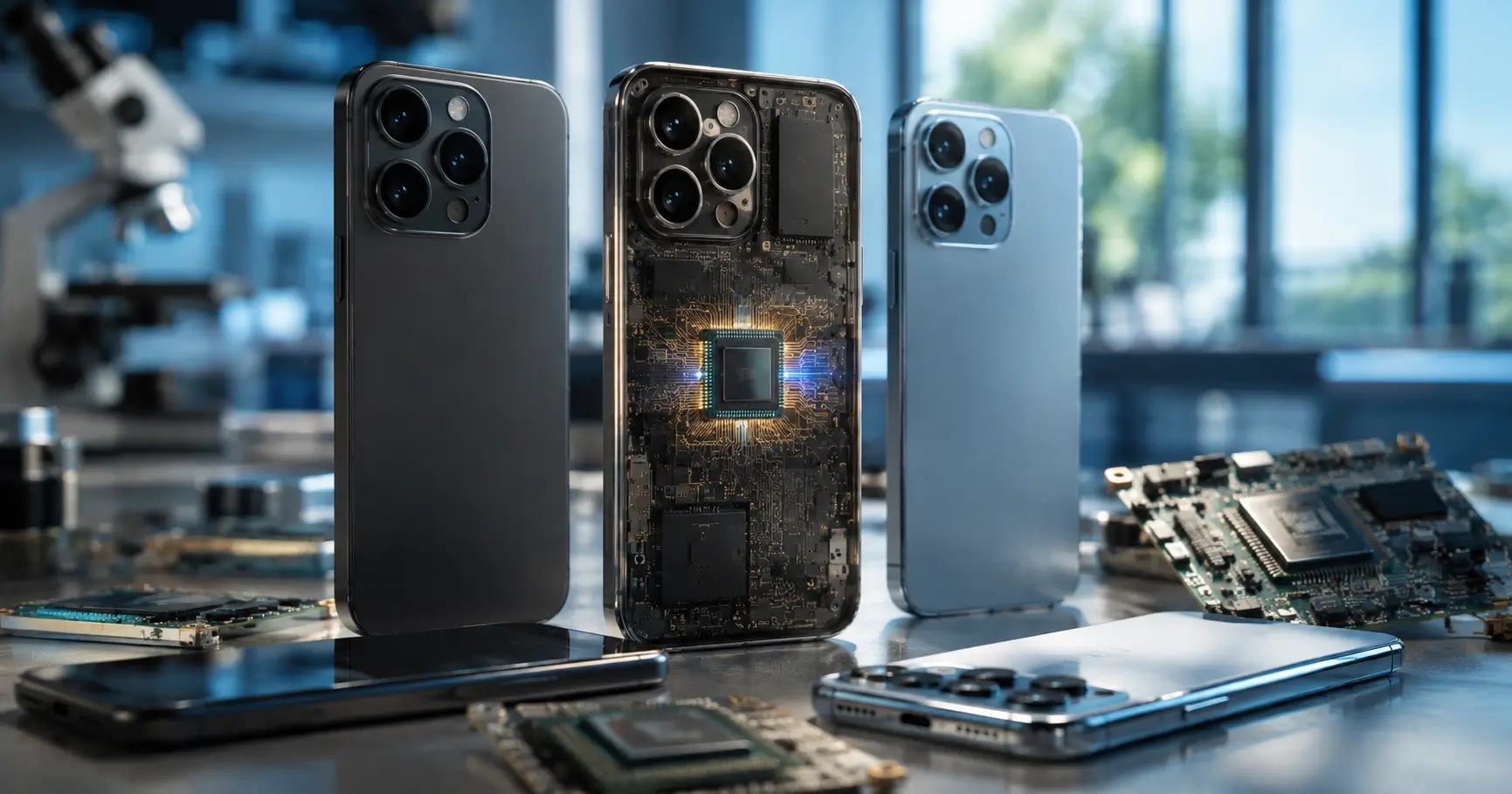
The fastest smartphone processor is no longer an automatic win for the company with the biggest name.
Qualcomm, MediaTek, Samsung, Apple and other chip designers are pushing mobile silicon in different directions. Some prioritize gaming, others AI, efficiency, sustained performance or single-core speed.
So what is the best phone processor in 2026?
Based on current benchmark rankings and processor capabilities, the Snapdragon 8 Elite Gen 5 sits at the top of the mainstream Android performance rankings, followed closely by the MediaTek Dimensity 9500 and Samsung Exynos 2600. Apple’s A19 Pro remains a special case because iOS benchmark results are not directly comparable with Android devices. Current benchmark databases also show the Snapdragon 8 Elite Gen 5 leading several Android performance tables.
But benchmark numbers only tell part of the story.
Let’s rank the leading processors and explain which chip makes the most sense for gaming, everyday performance, AI and long-term use.
Best phone processor ranking in 2026
The following ranking combines current benchmark performance with architecture, GPU capability, efficiency, AI hardware and real-world positioning.
| Rank | Processor | Overall position | Best for |
|---|---|---|---|
| 1 | Snapdragon 8 Elite Gen 5 | Excellent | Gaming + Android performance |
| 2 | MediaTek Dimensity 9500 | Excellent | Performance + efficiency |
| 3 | Samsung Exynos 2600 | Excellent | Galaxy performance + AI |
| 4 | Snapdragon 8 Gen 5 | Excellent | Premium Android phones |
| 5 | Dimensity 9500s | Very strong | Premium performance |
| 6 | Dimensity 9400+ | Very strong | High-end value |
| 7 | Snapdragon 8 Elite | Very strong | Gaming and sustained performance |
| 8 | Dimensity 9400 | Very strong | Flagship Android phones |
| 9 | Apple A19 Pro | Elite | iPhone performance |
| 10 | Snapdragon 8s Gen 4 | High | Performance-focused upper mid-range |
This is an overall performance ranking, not a claim that every chip will be faster in every application.
Current benchmark data places Snapdragon 8 Elite Gen 5 first in several Android processor rankings, with Dimensity 9500 and Exynos 2600 following it.
1. Snapdragon 8 Elite Gen 5
The Snapdragon 8 Elite Gen 5 currently leads the Android flagship processor race.
Qualcomm’s chip uses the third-generation Oryon CPU architecture, an Adreno GPU and a dedicated Hexagon AI engine. Qualcomm lists a CPU clock speed of up to 4.74GHz and support for advanced AI, gaming and connectivity features.
Independent rankings currently place it at the top of the mainstream smartphone processor tables, with very high AnTuTu and Geekbench results.
Why it ranks first
- Extremely strong CPU performance
- Powerful Adreno GPU
- Excellent gaming capability
- Advanced on-device AI
- Strong sustained-performance potential
- Broad Android flagship availability
Qualcomm also lists the Snapdragon 8 Elite Gen 5 in phones including the Galaxy S26 series, giving the chip substantial real-world availability rather than being a theoretical benchmark winner.
Best for: Android gaming, demanding apps, emulation and flagship performance.
2. MediaTek Dimensity 9500
The MediaTek Dimensity 9500 is arguably the most important challenger to Qualcomm’s flagship Snapdragon.
MediaTek uses a third-generation all-big-core architecture with one C1-Ultra core at up to 4.21GHz, three C1-Premium cores and four C1-Pro cores. It is built on a 3nm process and supports UFS 4.1 storage.
The company claims up to 32% higher single-core performance and 17% higher multi-core performance than the Dimensity 9400, while also emphasizing improved power efficiency.
Its GPU is also designed for demanding gaming, with hardware ray tracing and Unreal Engine 5.5-related optimizations.
Why it ranks so highly
The Dimensity 9500 isn’t simply trying to copy Snapdragon.
Its combination of:
- All-big-core CPU design
- 3nm manufacturing
- Large cache
- G1-Ultra GPU
- NPU 990
- UFS 4.1
- Advanced connectivity
makes it a genuine flagship competitor.
Best for: Android users who want flagship performance and strong efficiency.
3. Samsung Exynos 2600
Samsung’s Exynos 2600 is particularly interesting because it uses a 2nm GAA manufacturing process, making it one of the most technically ambitious smartphone chips in Samsung’s lineup.
Current benchmark rankings put the Exynos 2600 in the upper flagship tier, with strong multi-core results and a substantial GPU platform.
The processor combines CPU, GPU and NPU hardware for gaming and on-device AI.
Why it matters
The Exynos 2600 shows that Samsung is competing on more than raw clock speed.
Its 2nm process is important because semiconductor efficiency can affect:
- Battery life
- Heat generation
- Sustained performance
- AI workloads
- Gaming performance
Best for: Galaxy users who want strong performance with Samsung’s ecosystem and AI features.
4. Snapdragon 8 Gen 5
The Snapdragon 8 Gen 5 sits below the Elite Gen 5 but remains a high-performance flagship-class processor.
Current benchmark databases put it comfortably above previous-generation flagship chips and near the top of Android performance charts.
For most users, the practical difference between this chip and more expensive flagship silicon may not be obvious during everyday tasks.
Apps open quickly, games run smoothly and multitasking is extremely capable.
Who should buy a phone with it?
It is particularly attractive if you want:
- Flagship performance
- High-end gaming
- Fast AI features
- Long-term performance
- A phone that costs less than the most expensive Ultra-tier models
Best for: Premium Android phones where value matters.
5. MediaTek Dimensity 9500s
The Dimensity 9500s is designed to bring flagship-class technology into a slightly different performance segment.
MediaTek describes it as a 3nm platform with an all-big-core CPU architecture and a large cache configuration.
Its position is important because not every buyer needs the absolute fastest processor available.
For many users, the best processor is the one that delivers excellent performance without pushing the phone into an unnecessarily expensive price category.
Best for: Premium performance at a potentially more accessible level.
6. Dimensity 9400+
The Dimensity 9400+ remains highly competitive even though newer processors have arrived.
Current benchmark rankings continue to place it among the faster smartphone chipsets, ahead of many older flagship processors.
That makes it particularly interesting when manufacturers discount phones using the previous generation.
A processor does not suddenly become slow because a new generation launches.
The value advantage
A phone with Dimensity 9400+ can sometimes deliver a better performance-per-rupee proposition than a much more expensive phone using the newest silicon.
Best for: Buyers looking for flagship performance without paying for the newest generation.
7. Snapdragon 8 Elite
The original Snapdragon 8 Elite remains a powerful processor.
Its Oryon CPU architecture and Adreno GPU deliver performance that still comfortably handles demanding games, multitasking and content creation.
Current rankings put it below the newer Elite Gen 5, but it remains ahead of many previous-generation chips.
This creates an interesting buying opportunity.
A previous-generation flagship processor can be more than fast enough for a normal user while the phone itself may receive a significant price reduction.
Best for: High-performance phones available at discounted prices.
8. Dimensity 9400
MediaTek’s Dimensity 9400 remains one of the stronger flagship processors of the previous generation.
Its all-big-core design was already a major shift in smartphone processor architecture, and it continues to offer excellent CPU and GPU performance.
Current benchmark data still places it comfortably within the high-end category.
For buyers shopping during sales, this processor should not be dismissed simply because the Dimensity 9500 exists.
Best for: Flagship performance at reduced prices.
9. Apple A19 Pro
Apple’s A19 Pro needs to be treated differently from Android processors.
It powers the iPhone 17 Pro and iPhone 17 Pro Max and features a six-core CPU, six-core GPU with Neural Accelerators and a 16-core Neural Engine. Apple also introduced a vapor chamber system with the A19 Pro-powered Pro models to improve sustained performance.
Apple says the A19 Pro can deliver up to 40% better sustained performance than the previous generation when paired with the new thermal design.
Benchmark databases place the A19 Pro among the fastest smartphone chips, although direct AnTuTu comparisons with Android processors should be treated carefully because the platforms, operating systems and testing environments differ.
Best for: iOS gaming, video editing, sustained CPU performance and Apple’s software ecosystem.
10. Snapdragon 8s Gen 4
The Snapdragon 8s Gen 4 sits in a lower tier than Qualcomm’s flagship Elite chips but still provides serious performance.
Current processor rankings put it above many older premium chipsets, making it attractive for upper-mid-range and performance-oriented phones.
This is an important category because many buyers do not actually need a flagship processor.
If you mainly use:
- YouTube
- Chrome
- Photography
- Casual gaming
a chip in this class can already be extremely fast.
Best for: Performance-focused buyers who want to control the phone’s price.
What is the fastest phone processor in 2026?
For mainstream Android smartphones, the Snapdragon 8 Elite Gen 5 currently has the strongest overall position in current benchmark rankings.
The MediaTek Dimensity 9500 is its closest major rival, while the Exynos 2600 has also entered the flagship conversation with its advanced 2nm manufacturing process.
Apple’s A19 Pro should be considered separately because it powers iPhones and operates within Apple’s tightly integrated hardware and software environment.
Which processor is best for gaming?
For Android gaming, the Snapdragon 8 Elite Gen 5 is the safest overall choice.
Its combination of Oryon CPU performance, Adreno graphics and Qualcomm’s gaming-focused platform makes it particularly attractive for demanding titles.
The Dimensity 9500 is also an excellent gaming option.
MediaTek specifically highlights hardware ray tracing, its G1-Ultra GPU and Unreal Engine 5.5 support as major gaming features.
Gaming processor checklist
If gaming is your priority, don’t look at the processor alone.
Also check:
- Cooling system
- Vapor chamber size
- Sustained performance
- Display refresh rate
- Touch sampling
- Battery capacity
- Charging speed
- Game optimization
A powerful chip inside a poorly cooled phone may throttle sooner than a slightly slower processor inside a better-designed device.
Is Snapdragon better than Dimensity?
There is no universal answer.
Snapdragon has traditionally had an advantage in areas such as GPU optimization, gaming ecosystem support and broad device availability.
MediaTek has become increasingly competitive at the flagship level.
The Dimensity 9500, for example, uses an all-big-core architecture, 3nm manufacturing, a new GPU architecture and a powerful NPU.
The right comparison is therefore:
Snapdragon model vs Dimensity model, not simply Qualcomm vs MediaTek.
What about AI performance?
AI is becoming one of the most important reasons to upgrade a smartphone processor.
Modern processors include dedicated NPUs or AI accelerators designed for tasks such as:
- Generative AI
- Image enhancement
- Voice processing
- Translation
- Object recognition
- Photo segmentation
- On-device assistants
The Dimensity 9500, for example, includes MediaTek’s NPU 990 and supports generative and agentic AI workloads.
The Snapdragon 8 Elite Gen 5 also incorporates Qualcomm’s Hexagon AI architecture and dedicated AI accelerators.
Samsung’s Exynos 2600 similarly integrates CPU, GPU and NPU hardware for on-device AI.
The key point is that AI benchmark numbers should not be treated as a direct measure of everyday AI usefulness.
Software support matters just as much.
Why benchmark scores can be misleading
Benchmark scores are useful—but they are not the final word.
A benchmark measures a controlled workload.
Real life is messier.
Your phone may be:
- Hot
- Low on battery
- Running dozens of background processes
- Using a high-refresh display
- Connected to 5G
- Running a manufacturer’s custom software
- Thermally constrained
That is why two phones using the same processor can deliver different experiences.
A better way to read benchmarks
Use benchmarks to answer:
“How powerful is this chip?”
Then use real-world testing to answer:
“How well does this phone use that power?”
That distinction can prevent a lot of bad buying decisions.
Common processor-buying mistakes
Mistake 1: Choosing only by AnTuTu score
A higher score does not automatically mean better battery life or smoother long-term performance.
Mistake 2: Ignoring thermal management
A phone that cannot dissipate heat may throttle under extended gaming.
Mistake 3: Assuming newer always means dramatically faster
Generational improvements can be significant, but everyday users may notice very little difference between two high-end processors.
Mistake 4: Ignoring software
A powerful processor with poor software optimization can feel less responsive than expected.
Mistake 5: Paying for performance you never use
If you rarely play demanding games or edit 4K video, a premium flagship processor may be unnecessary.
Best processor by user type
| User type | Recommended processor |
|---|---|
| Hardcore Android gamer | Snapdragon 8 Elite Gen 5 |
| Flagship Android user | Snapdragon 8 Elite Gen 5 / Dimensity 9500 |
| AI-focused Android user | Snapdragon 8 Elite Gen 5 / Dimensity 9500 |
| Samsung ecosystem user | Exynos 2600 |
| iPhone power user | Apple A19 Pro |
| Performance-value buyer | Dimensity 9400+ / Snapdragon 8s Gen 4 |
| Everyday user | Upper-mid-range processor is usually enough |
| Long-term buyer | Prioritize sustained performance and software support |
How to choose the best phone processor
Before buying a phone, follow this simple process.
- Decide what you actually do on your phone.
- Identify whether gaming, AI, photography, video or battery life matters most.
- Compare the processor’s CPU and GPU architecture.
- Check current AnTuTu and Geekbench results.
- Look for sustained-performance tests.
- Check the phone’s cooling system.
- Compare battery capacity and efficiency.
- Check software-update support.
- Compare the phone’s actual price.
- Choose the processor that provides enough performance for your needs.
This final step is important.
The best processor is not always the fastest processor.
It is the processor that delivers the right combination of speed, efficiency, thermals, features and price for the person using it.
Myths vs facts
Myth: The highest AnTuTu score is automatically the best processor.
Fact: Benchmarks measure performance under specific conditions. Efficiency, thermals, software and sustained performance also matter.
Myth: Snapdragon is always faster than Dimensity.
Fact: Processor generations matter more than brand names. The Dimensity 9500 competes directly with current flagship Snapdragon silicon.
Myth: More CPU cores always mean better performance.
Fact: Architecture, IPC, clock speed, cache, scheduling and power limits all influence performance.
Myth: A flagship processor is necessary for every user.
Fact: Mid-range processors are already powerful enough for most everyday smartphone tasks.
Final ranking: which processor should you choose?
If raw Android performance is your priority, the Snapdragon 8 Elite Gen 5 is the strongest overall recommendation based on current rankings.
The Dimensity 9500 is an extremely close alternative and deserves serious consideration, particularly for buyers interested in efficiency and MediaTek’s newer AI and gaming architecture.
The Exynos 2600 is technically impressive and represents an important step for Samsung’s custom mobile silicon.
For iPhone users, the A19 Pro remains an elite performer and should be judged within Apple’s ecosystem rather than directly against Android benchmark scores.
Key takeaways
- Snapdragon 8 Elite Gen 5 currently leads mainstream Android processor rankings.
- Dimensity 9500 is its strongest major MediaTek rival.
- Exynos 2600 brings 2nm GAA technology into Samsung’s flagship processor lineup.
- A19 Pro remains one of the strongest smartphone chips but belongs to Apple’s iOS ecosystem.
- AnTuTu and Geekbench are useful, but sustained performance matters more for heavy users.
- Gaming performance depends on both the processor and the phone’s cooling system.
- AI performance increasingly depends on the NPU and software ecosystem.
- Previous-generation flagship processors can offer excellent value after price reductions.
- The best processor for you depends on your actual workload—not the biggest benchmark number.
Conclusion
The smartphone processor race has become more competitive than ever.
Qualcomm’s Snapdragon 8 Elite Gen 5 currently occupies the top Android position in several benchmark rankings, but MediaTek’s Dimensity 9500 is closing the gap with an aggressive all-big-core architecture, 3nm manufacturing and a powerful AI platform. Samsung’s Exynos 2600 adds another serious contender with its 2nm GAA process.
Apple remains on a different path with the A19 Pro, combining custom silicon with tightly controlled hardware and software.
For buyers, however, the ranking is only the beginning.
If you are a gamer, prioritize GPU performance and sustained thermals.
If you want maximum everyday speed, look at CPU performance and efficiency.
If AI features matter, investigate the NPU and actual software support.
And if you’re trying to get the best value, don’t automatically buy the newest chip.
Choose the processor that matches the way you use your phone.
That is a far better buying strategy than simply choosing the highest number on a benchmark chart.
FAQ
Which is the best phone processor in 2026?
The Snapdragon 8 Elite Gen 5 currently has the strongest overall position among mainstream Android smartphone processors based on current benchmark rankings. The MediaTek Dimensity 9500 is its closest major competitor.
Which is the fastest mobile processor for gaming?
The Snapdragon 8 Elite Gen 5 is one of the strongest choices for Android gaming because of its powerful Oryon CPU, Adreno GPU and gaming-focused platform. The Dimensity 9500 is also a high-end gaming processor.
Is Snapdragon better than MediaTek Dimensity?
Not universally. Current flagship chips from both companies compete closely. The specific generation and model matter more than the manufacturer name. The Dimensity 9500, for example, directly competes with Qualcomm’s flagship Snapdragon platform.
Is Exynos 2600 a good processor?
Yes. The Exynos 2600 is Samsung’s flagship mobile processor built on a 2nm GAA process and combines CPU, GPU and NPU hardware for performance, gaming and AI workloads.
Is Apple A19 Pro faster than Snapdragon?
The A19 Pro is an extremely powerful smartphone processor, but direct comparisons with Android chips should be treated carefully because iOS and Android use different hardware and software environments. Apple says A19 Pro delivers major sustained-performance improvements in the iPhone 17 Pro generation.
Which processor is best for long-term smartphone use?
A high-end current-generation processor such as Snapdragon 8 Elite Gen 5 or Dimensity 9500 provides plenty of performance headroom, but software support, thermal design, battery health and storage also affect how good a phone remains over several years.
Disclaimer
Disclaimer: Processor rankings change as new smartphones, firmware updates and benchmark results become available. Benchmark scores can also vary by device configuration, cooling system, RAM, software version and test conditions. This article provides an editorial comparison based on currently available processor specifications and benchmark information and should not be interpreted as a laboratory-certified universal ranking. Always check the latest device-specific performance, pricing, software-support policy and specifications before purchasing a smartphone.