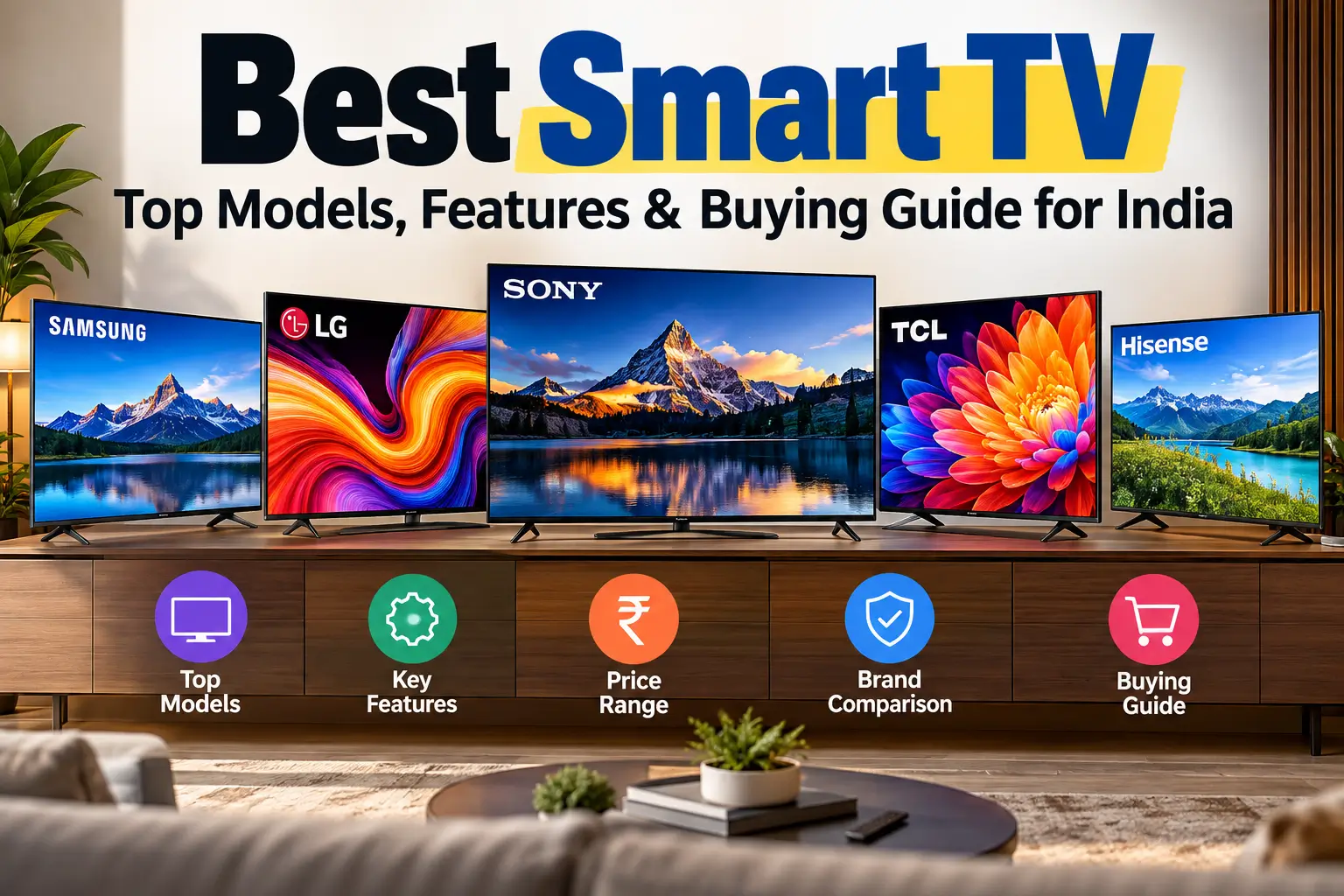
Buying the best smart TV in India in 2026 is no longer simply a choice between Samsung, LG or Sony.
Today’s market includes conventional LED TVs, QLED models, Mini LED and QD-Mini LED televisions, OLED panels and increasingly sophisticated AI-powered processing. Screen sizes have also expanded dramatically, with 75-, 85-, 98-, 100- and even 115-inch televisions appearing in Indian lineups.
At the same time, prices can change sharply during online sales. Amazon’s Great Indian Festival 2026 is scheduled to begin for all customers on October 8, with discounts and bank offers across televisions and other electronics.
So there is no single television that is objectively best for everybody.
For most buyers, the best smart TV is the one that gets the important things right for their room, viewing habits and budget.
After looking at current 2026 offerings from Samsung, LG, Sony, TCL and Xiaomi, here is how we would approach the market.
Quick answer: Which is the best smart TV in India?
If money is not the only consideration, premium OLED remains one of the strongest choices for movie and TV-series enthusiasts, because its self-emissive pixels can deliver extremely deep blacks and excellent contrast.
For buyers who want a combination of high brightness, HDR performance and large-screen value, modern Mini LED televisions deserve serious consideration.
For a more balanced purchase, Samsung’s 2026 Neo QLED range, LG’s QNED Mini LED range, Sony’s BRAVIA Mini LED televisions, TCL’s QD-Mini LED models and Xiaomi’s new FX Mini LED series offer different approaches to the same problem.
Our practical recommendations
| Buyer type | TV technology/model to consider | Why |
|---|---|---|
| Best premium OLED experience | Samsung S95H OLED | High-end OLED, glare-reduction technology and strong gaming features |
| Premium OLED alternative | LG OLED evo G6 | Flagship OLED picture technology and 165Hz gaming capability |
| Premium Sony experience | Sony BRAVIA 8 II / higher BRAVIA models | Strong processing, cinematic presentation and Google TV |
| Best bright-room direction | Samsung Neo QLED QN80H | Mini LED backlighting, high brightness and 144Hz |
| Best value Mini LED | Xiaomi TV FX Mini LED | QD Mini LED at substantially lower current prices |
| Large-screen Mini LED option | TCL QD-Mini LED range | Strong focus on large screens, local dimming and high refresh rates |
| Best mainstream choice | A good 55-inch 4K QLED/Mini LED | Better balance of price, picture quality and size |
These aren’t rankings in which the first TV is automatically the best purchase. They are different answers to different buying problems.
OLED vs Mini LED vs QLED: which should you buy?
This is arguably more important than the brand name.
OLED
OLED pixels produce their own light. That allows an OLED television to turn individual pixels off for extremely dark scenes.
Best for:
- Movies
- Netflix and streaming
- Dark-room viewing
- Premium picture quality
- Gamers wanting excellent response and contrast
The major trade-off is that OLED isn’t necessarily the best choice for every extremely bright room or every buyer who wants a very large screen at the lowest possible cost.
Samsung’s 2026 S95H, for example, is a premium OLED with OLED HDR Pro, Glare Free technology and gaming features including a 165Hz mode. The 65-inch model is currently listed by Samsung India at ₹2,35,990, although TV prices and offers can change.
Mini LED
Mini LED still uses an LCD panel but employs a much more sophisticated backlight containing many small LEDs and local-dimming zones.
The result can be very high brightness with considerably better contrast than ordinary edge-lit LED televisions.
Best for:
- Bright living rooms
- Sports
- HDR
- Large screens
- Mixed family viewing
- Buyers worried about OLED’s trade-offs
TCL’s current Indian Mini LED portfolio includes models with hundreds or thousands of local-dimming zones depending on the television, while its C755, for example, lists up to 1,344 zones on 65-inch-and-larger models, HDR brightness up to 1,600 nits and 144Hz VRR.
QLED
QLED is generally an LCD/LED television using quantum-dot technology to improve colour performance.
It isn’t automatically equivalent to OLED.
A QLED with a basic LED backlight can be very different from a QLED combined with Mini LED local dimming.
That’s why simply seeing the word “QLED” on a box isn’t enough.
1. Samsung S95H OLED — premium choice for picture quality
Samsung’s 2026 S95H is one of the company’s flagship OLED televisions.
It combines OLED HDR Pro with Glare Free technology, Samsung Vision AI features and a gaming-oriented 165Hz capability. Samsung lists the S95H in 55-, 65-, 77- and 83-inch sizes.
The 65-inch version is currently listed at ₹2,35,990 on Samsung India’s website, against an MRP of ₹2,64,900. That is a current listed price rather than a guaranteed street price.
Why consider it?
- Excellent black levels
- OLED contrast
- Glare Free screen technology
- High refresh-rate gaming
- Premium design
- Strong smart-TV ecosystem
Who should buy it?
Someone who watches a lot of movies and premium streaming content and is prepared to spend significantly more for picture quality.
Who shouldn’t?
A buyer primarily interested in getting the largest possible screen for the least money.
2. LG OLED evo G6 — premium OLED for home cinema and gaming
LG’s 2026 OLED evo G6 represents another high-end approach.
The television uses LG’s Hyper Radiant Color technology and Alpha 11 AI Processor 4K Gen3. LG also advertises Reflection Free Premium technology, Perfect Black and Perfect Color, Dolby Vision and Dolby Atmos, while gaming support reaches up to 165Hz with G-SYNC and FreeSync Premium.
The G6 is therefore aimed at buyers who want an expensive television to function as a home-cinema and gaming display, rather than simply a large streaming screen.
LG’s 2026 OLED evo range extends to enormous sizes, including 83 and 97 inches.
Best for
- Movie enthusiasts
- Premium gaming
- High-end living rooms
- Buyers who value LG’s webOS ecosystem
- People who want a very large OLED
3. Samsung Neo QLED QN80H — a better fit for many bright Indian living rooms
Here’s an important point that gets lost in OLED-vs-QLED debates:
Your room matters.
If your television faces windows, receives substantial daylight or is used heavily for cricket and other sports, a high-brightness Mini LED television can make more practical sense.
Samsung’s 2026 QN80H is a Neo QLED Mini LED television with Motion Xcelerator 144Hz. The 55-inch model is currently listed at ₹95,990 on Samsung India’s website, against an MRP of ₹1,09,900.
Samsung’s 2026 India television range includes 72 models across Micro RGB, OLED, Neo QLED, The Frame, Mini LED and UHD categories, showing how broad the company’s current lineup has become.
Best for
- Bright rooms
- Sports
- Mixed family viewing
- Gaming
- Buyers who want Mini LED rather than OLED
4. Sony BRAVIA — for buyers who prioritise processing and cinema
Sony’s current Indian BRAVIA portfolio is particularly interesting because it covers several technologies rather than pushing one display type.
The company currently lists OLED, Mini LED and RGB LED televisions in India.
Its higher-end range includes the BRAVIA 8 II OLED, BRAVIA 7/7 II Mini LED televisions and BRAVIA 9/9 II models. Google TV is used across many of these models.
The BRAVIA 7 II, for example, uses Sony’s True RGB technology and XR processing, while the BRAVIA 8 II is an OLED model designed around deep blacks and Sony’s Acoustic Surface Audio+ technology.
Why Sony remains relevant
Sony’s appeal isn’t just a specification sheet.
Its television strategy puts substantial emphasis on image processing, cinematic presentation, sound integration and PlayStation-related features.
Best for
- Movie and TV enthusiasts
- Sony ecosystem buyers
- PlayStation owners
- Buyers who value processing over headline specifications
5. TCL QD-Mini LED — a serious large-screen alternative
TCL deserves more attention in a modern Indian TV buying guide because its strategy is different from traditional premium brands.
It pushes Mini LED and QD-Mini LED technology across multiple screen sizes.
The company’s Indian C755 series, for example, offers QD-Mini LED, local dimming, Dolby Vision, Dolby Atmos, 144Hz VRR and AMD FreeSync Premium Pro.
TCL’s newer Indian portfolio includes models such as the C6K, C6KS, Q6C, Q6CS, C7K and C72K, with different combinations of Mini LED, QLED and local-dimming capabilities.
Best for
- Large-screen buyers
- Sports
- Gaming
- Bright rooms
- Buyers wanting Mini LED without automatically moving into flagship-brand pricing
6. Xiaomi TV FX Mini LED — one of the most interesting value propositions
Xiaomi’s 2026 FX Mini LED series is particularly interesting because Mini LED is no longer confined to extremely expensive televisions.
Xiaomi currently lists the FX Mini LED in 43-, 55-, 65- and 75-inch sizes. The company describes the series as using QD Mini LED, 4K resolution, HDR10+, Filmmaker Mode and its Vivid Picture Engine 2.
Its current official Indian store pricing is:
- 43-inch: ₹32,999
- 55-inch: ₹44,999
- 65-inch: ₹64,999
- 75-inch: ₹84,999
These are current listed prices and can change during sales.
The 55-, 65- and 75-inch versions support DLG 120Hz, along with ALLM and MEMC. The series also uses Fire TV and supports Alexa voice control and AirPlay 2.
Why this matters
For a buyer with a budget around ₹45,000–₹65,000, the question is no longer necessarily:
“Can I afford Mini LED?”
It may instead be:
“Is Mini LED a better use of my budget than spending the same money on a conventional LED or QLED TV?”
That is a much more useful buying question.
What size smart TV should you buy?
Screen size should be chosen according to viewing distance, not simply according to the maximum size your budget allows.
A larger TV can be more immersive, but an enormous screen in a small room may dominate the space.
As a practical starting point:
| Viewing distance | Sensible starting sizes |
|---|---|
| Around 5–6 ft | 43–55 inch |
| Around 6–8 ft | 55–65 inch |
| Around 8–10 ft | 65–75 inch |
| Around 10–12 ft | 75–85 inch |
| 12 ft+ | 85 inch and above can make sense |
These are guidelines rather than strict rules.
The quality of the content also matters. A good 4K source can make a large screen much more enjoyable than low-quality compressed video.
Is 4K still worth buying in 2026?
Yes, for most buyers.
4K televisions have become mainstream enough that buying a new premium or mid-range TV with only Full HD resolution generally makes little sense.
The more important question is what sits behind the 4K resolution:
- Panel technology
- Brightness
- Local dimming
- HDR support
- Motion handling
- Processing
- Viewing angles
- Reflection handling
- Refresh rate
- HDMI connectivity
- Operating system
Two televisions can both be marketed as “4K Smart TVs” while providing dramatically different picture quality.
60Hz vs 120Hz vs 144Hz: does refresh rate matter?
It depends on what you watch.
For normal movies and television programmes, you don’t necessarily need an extremely high refresh rate.
For sports and gaming, higher refresh rates can be much more valuable.
If you own a PS5, Xbox Series X/S or gaming PC, look for:
- HDMI 2.1
- 4K at 120Hz
- VRR
- ALLM
- FreeSync or G-SYNC compatibility where relevant
- Low input lag
Samsung’s current premium models advertise refresh rates as high as 165Hz, while TCL and LG also offer 144Hz or higher capabilities on selected models.
Don’t buy a TV simply because the box says 144Hz. Check which HDMI inputs support the feature and under what resolution and gaming conditions.
What about Dolby Vision?
Dolby Vision is a dynamic HDR format designed to provide scene-by-scene or frame-level HDR optimisation.
It can be useful if the streaming services and content you watch actually provide Dolby Vision.
However, its absence doesn’t automatically make a television bad.
Samsung, for example, has historically taken a different HDR approach, while TCL’s selected Indian models explicitly list Dolby Vision and HDR10+.
So don’t choose a TV solely on the presence or absence of one logo.
Look at the complete picture pipeline.
The biggest mistake: buying the TV with the longest specification sheet
A television can advertise:
- AI
- 144Hz
- 4K
- QLED
- Dolby Audio
- HDR
- voice control
- gaming mode
- multiple processors
and still produce mediocre real-world results.
The most important hierarchy is usually:
Panel/display quality → contrast and brightness → processing → motion → HDR performance → viewing environment → gaming features → smart platform → audio.
This is not an absolute ranking, but it is a better way to think about TV quality than counting features.
Best smart TV by use case
Best for movies
Premium OLED
Consider Samsung S95H or LG OLED evo G6.
The priority should be contrast, black levels, HDR performance and processing rather than simply screen size.
Best for bright rooms
Mini LED
Samsung Neo QLED, TCL QD-Mini LED and LG QNED Mini LED are worth considering.
Best for gaming
OLED or high-end Mini LED with 120Hz/144Hz+ support
Check HDMI 2.1, VRR and ALLM before buying.
Best value
Xiaomi FX Mini LED
Its current official pricing makes the 55-inch and 65-inch versions particularly interesting for buyers looking to enter Mini LED without spending premium-OLED money.
Best for very large screens
TCL / Samsung / LG Mini LED ranges
TCL currently lists extremely large QD-Mini LED televisions, while Samsung and LG also offer 100-inch-plus models.
Best for Sony/PlayStation ecosystem
Sony BRAVIA
Sony specifically positions its higher-end BRAVIA models around PlayStation gaming and cinematic viewing.
How much should you spend?
Rather than setting rigid price brackets, use this framework.
Around ₹30,000–₹45,000
Prioritise:
- 4K
- decent panel quality
- reliable software
- good warranty/service
- sufficient brightness
You don’t necessarily need OLED.
Xiaomi’s current FX Mini LED range makes this segment particularly interesting because the 43-inch and 55-inch models are listed at ₹32,999 and ₹44,999 respectively.
Around ₹45,000–₹75,000
This is where the market becomes particularly competitive.
Look at:
- Mini LED
- QLED
- better 55/65-inch models
- 120Hz/144Hz options
- HDMI 2.1 if gaming
The Xiaomi FX Mini LED 65 is currently listed at ₹64,999.
Around ₹75,000–₹1.5 lakh
You can start considering more sophisticated Mini LED and premium OLED options depending on screen size and sale pricing.
₹1.5 lakh+
This is where you should be looking at picture quality rather than feature count.
OLED becomes particularly compelling, while flagship Mini LED can be preferable for very bright rooms or very large screens.
Should you buy a TV during India’s 2026 festive sales?
Possibly—but don’t let the discount percentage make the decision for you.
Amazon’s Great Indian Festival 2026 is scheduled to start on October 8 for all customers, with discounts and bank offers on electronics.
The important thing is to compare:
sale price + bank discount + exchange benefit + warranty + installation + return/replacement policy
against the normal selling price.
A television marked “40% off” isn’t automatically a better deal if the underlying model is weaker than a competing TV at a similar final price.
What to check before buying a smart TV
Use this checklist before placing the order.
Display
- 4K resolution
- OLED, Mini LED, QLED or conventional LED?
- Native refresh rate
- HDR formats
- Local dimming where applicable
- Reflection handling
- Viewing angles
Gaming
- HDMI 2.1
- 4K 120Hz or higher
- VRR
- ALLM
- FreeSync/G-SYNC if required
Smart features
- Google TV, webOS, Tizen or Fire TV
- Apps you actually use
- Voice control
- Software update support
- Casting/AirPlay requirements
Ownership
- Panel warranty
- Installation
- Service availability
- Replacement policy
- Wall-mount compatibility
- Power consumption
Don’t ignore the sound
Modern televisions can have excellent displays while still producing only average sound.
If you’re spending ₹1 lakh or more on a TV, budget for audio separately if movies and music are important to you.
Look for:
- HDMI eARC
- Dolby Atmos support
- adequate speaker output
- compatibility with your preferred soundbar
Samsung, Sony, LG and other manufacturers also have proprietary TV-to-soundbar integration features, but these should be treated as bonuses rather than reasons to buy a weaker TV.
OLED or Mini LED: the simple decision
If you’re still confused, use this shortcut:
Choose OLED if:
- Movies are your priority.
- You watch mostly at night.
- You care about black levels and contrast.
- You’re comfortable paying more.
Choose Mini LED if:
- Your room is bright.
- You watch lots of sports.
- You want a very large screen.
- You want high HDR brightness.
- You want strong picture quality without moving to flagship OLED pricing.
Choose conventional QLED/LED if:
- Your budget is limited.
- You mainly watch cable/DTH/YouTube.
- You don’t need premium HDR.
- You’d rather spend the difference on a larger screen or sound system.
Our final verdict
There is no honest way to name one television as the best smart TV in India for everyone.
For premium picture quality, Samsung S95H and LG OLED evo G6 are among the televisions worth examining.
For bright rooms and buyers who prefer Mini LED, Samsung Neo QLED, TCL QD-Mini LED and LG QNED Mini LED are compelling alternatives.
For buyers focused on value, Xiaomi’s FX Mini LED series is one of the more interesting developments in the 2026 Indian market, particularly because its current official pricing puts Mini LED within reach of buyers who previously would have been shopping conventional LED or QLED televisions.
And for Sony loyalists, the current BRAVIA range remains relevant for buyers who value Sony’s processing, Google TV and cinema-oriented approach.
The best TV isn’t necessarily the one with the highest price, most AI features or biggest screen. It’s the one whose strengths match how you actually watch television.
FAQ
Which is the best smart TV in India in 2026?
There isn’t one universal winner. Premium OLED models such as Samsung S95H and LG OLED evo G6 are strong choices for movie-focused buyers, while Mini LED models can make more sense for bright rooms, sports and large-screen viewing.
Is OLED better than Mini LED?
Not universally. OLED generally has an advantage in pixel-level black control and dark-room contrast. Mini LED can deliver extremely high brightness and is often a better fit for bright rooms and large screens.
Is QLED better than LED?
Usually, QLED can offer better colour performance than basic LED TVs, but the result depends heavily on the underlying panel and backlight. A good Mini LED TV can be substantially better than a basic QLED.
Is 120Hz necessary for a smart TV?
No, not for everyone. It becomes much more valuable for sports and gaming. Console and PC gamers should pay particular attention to 120Hz/144Hz support, VRR, ALLM and HDMI 2.1.
What is the best TV size for a living room?
It depends on viewing distance. For many Indian living rooms, 55-65 inches is a sensible starting point, while 75 inches or larger can be worthwhile at greater viewing distances.
Is a 4K TV worth buying in 2026?
Yes. 4K has become the mainstream resolution for new mid-range and premium televisions. Panel quality, HDR, processing and brightness are now more important differentiators than simply choosing 4K.
Which TV is best for gaming?
Look for OLED or a high-quality Mini LED with 120Hz/144Hz+, HDMI 2.1, VRR and ALLM. Samsung’s premium OLEDs, LG’s OLED evo models and selected TCL Mini LED models are particularly worth investigating.
Is Mini LED worth buying?
For many buyers, yes. Mini LED can provide substantially better contrast and brightness than basic LED televisions while avoiding some of the price and use-case limitations associated with premium OLED.