Google has officially opened pre-orders for Googlebook, a new category of premium laptops built around Gemini Intelligence and designed to work closely with Android phones. The first Googlebook devices come from Acer, ASUS, Dell, HP and Lenovo, with US prices starting at $899. Pre-orders opened on September 21, 2026.
For Indian users, however, there is an important limitation: Google has not announced an India launch date or Indian pricing yet. The first announced markets are the US, Canada, the UK, Ireland, France, Germany and Australia.
The bigger story is what Googlebook represents. Rather than simply refreshing the Chromebook, Google is combining Android’s technology stack with desktop foundations from ChromeOS and putting Gemini at the centre of the experience.
Quick answer: What is Googlebook?
Googlebook is Google’s new premium laptop platform designed around Gemini Intelligence and deeper integration with Android phones.
Google describes it as a new category that brings together Android technology, ChromeOS desktop foundations, Google Play applications and Gemini-powered assistance.
Unlike traditional Chromebooks, Googlebook is positioned as a higher-end computing platform. The first devices start with 16GB of RAM and 512GB of storage, while processors include Intel Core Ultra 5 and Qualcomm Snapdragon X Elite options.
Googlebook price
The Googlebook range starts at $899 in the US.
Google’s launch lineup includes different models from Acer, ASUS, Dell, HP and Lenovo, with prices reaching $1,299 for some configurations.
The starting price does not translate into an official Indian price. Google has not published Indian pricing, so converting $899 directly into rupees would only provide a currency conversion, not an actual India retail price.
That distinction matters because taxes, duties, retailer margins, configuration differences and local distribution can change the final price.
Googlebook models and specifications
Google’s first-generation Googlebook lineup is built by five hardware partners.
| Model | Processor | Display | RAM | Storage | Battery claim |
|---|---|---|---|---|---|
| Acer Googlebook 14 | Intel Core Ultra 5 325 | 14-inch 2.8K OLED | 16GB | 512GB | Up to 16 hours |
| ASUS Googlebook | Intel Core Ultra 5 | Up to 2.8K OLED | 16GB | 512GB | Model-dependent |
| Dell XPS Googlebook | Snapdragon X Elite | 13.4-inch 2560×1600 LCD | 16GB | 512GB | Up to 18 hours |
| HP Googlebook 14 | Snapdragon X Elite | Up to 2.8K OLED | 16GB | 512GB | Model-dependent |
| Lenovo Googlebook 15 | Intel Core Ultra 5 | 15.3-inch 2.8K OLED | 16GB | 512GB | Up to 13 hours |
Google’s comparison information confirms 16GB RAM and 512GB storage across the listed lineup, while display, processor, battery and form factor vary by model.
For example, the Acer Googlebook 14 uses an Intel Core Ultra 5 325 processor, a 14-inch 2.8K OLED touchscreen, 16GB LPDDR5X memory and a 512GB PCIe Gen 4 SSD. Its NPU is rated at up to 47 TOPS and Google lists battery life of up to 16 hours.
The Dell XPS Googlebook uses Qualcomm’s Snapdragon X Elite, 16GB RAM and 512GB storage. Its 13.4-inch touchscreen has a 2560×1600 resolution and variable refresh rate up to 120Hz, with Google listing up to 18 hours of battery life.
Gemini is at the centre of Googlebook
Gemini is not being treated as a separate chatbot that users simply open in a browser.
Googlebook is designed around Gemini Intelligence, which Google says can assist with tasks across the laptop environment.
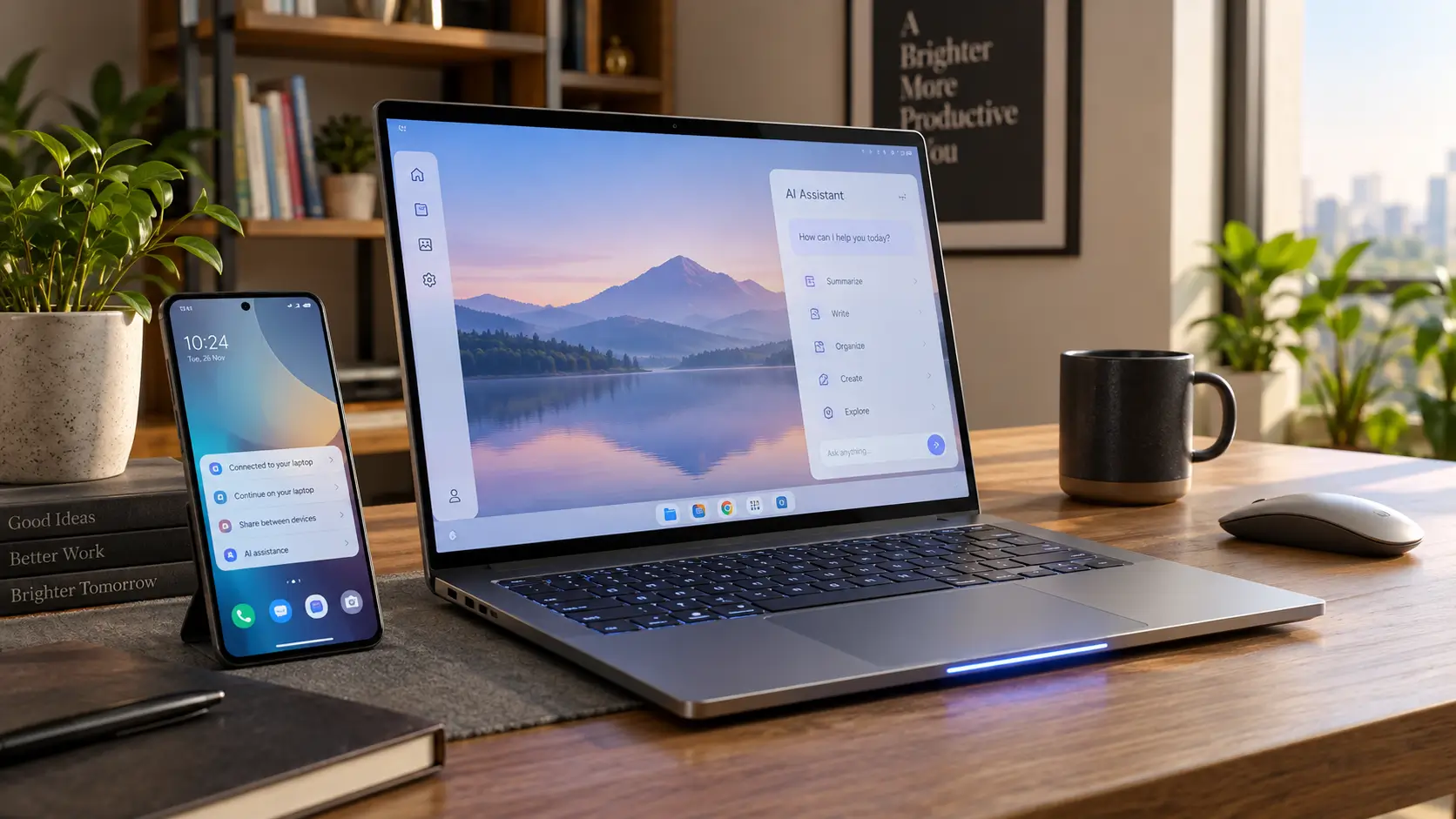
One of the headline features is Magic Pointer. Moving the pointer in a particular way activates Gemini so users can ask questions or perform actions based on what is displayed on the screen.
Another feature is Rambler, a voice-dictation system designed to turn spoken thoughts into more structured writing. Google says it can help organise notes, action items and other spoken material.
Google also promotes custom desktop widgets that can be generated from natural-language instructions.
The broader goal is clear: Google wants AI to be part of the computer’s normal workflow rather than an application users have to launch separately.
Googlebook is designed to work with Android phones
This may ultimately be more important than the AI features.
Googlebook is designed to work closely with Android phones, allowing users to continue tasks between their phone and laptop.
Google highlights several capabilities:
- Continue On: continue a task started on an Android phone.
- Files: access files and photos from the phone through the laptop.
- Cast My Apps: interact with phone applications from a Googlebook window.
- Phone settings and other information can be carried into the laptop experience during setup.
Google says Googlebook compatibility is designed for Android phones running Android 17 or later.
That makes Google’s Android strategy particularly relevant to Indian consumers, where Android represents a large part of the smartphone market.
Googlebook vs Chromebook: What’s the difference?
Googlebook is not simply another Chromebook name.
Chromebooks are built around ChromeOS and have traditionally focused on straightforward computing, web applications, cloud services and relatively accessible hardware.
Googlebook is positioned at a higher level.
| Feature | Googlebook | Chromebook |
|---|---|---|
| Positioning | Premium laptop category | Broad laptop category |
| Software foundation | Android technology + ChromeOS desktop foundations | ChromeOS |
| Gemini | Deeply integrated | Available through supported Google services |
| Android integration | Central design goal | Existing connectivity varies |
| Hardware | Premium specifications | Wide range |
| RAM baseline | 16GB | Varies widely |
| Storage | 512GB standard in Googlebook lineup | Varies |
| Android phone workflows | Deep integration | More conventional connectivity |
Google itself describes the distinction as deeper cross-device synergy in Googlebook, including phone files, applications and task continuation.
What apps can Googlebook run?
Googlebook combines the web with applications from Google Play.
Google lists applications such as Adobe Photoshop, Adobe Lightroom and CapCut, while Microsoft 365 applications can be used to open, edit and save Word, Excel and PowerPoint files.
Google also promotes gaming support, including Android games and cloud gaming through GeForce NOW.
This is important because Google’s challenge is not simply making a laptop with good hardware. The platform needs to handle the applications people expect from a premium computer.
Security is another major part of Googlebook
Googlebook devices include the Google Titan C2 security module.
Google says the platform uses a security architecture derived from ChromeOS, with protections designed around the device’s boot process, personal data and credentials.
Individual models also offer features such as fingerprint readers, while some include additional authentication or camera privacy hardware.
How much battery life does Googlebook have?
Battery life varies by model.
Google’s official comparison lists:
- Lenovo Googlebook: up to 13 hours
- XPS Googlebook: up to 18 hours
- Acer Googlebook: up to 16 hours
These are manufacturer claims rather than independent Everyday Post testing.
That distinction is important because actual battery life depends on brightness, applications, processor workload, wireless connectivity and other factors.
When will Googlebook launch?
Pre-orders opened on September 21, 2026.
Google says the first devices will reach stores on:
- October 4: United States
- October 5: Canada, UK, Ireland, France, Germany and Australia
Is Googlebook coming to India?
India availability has not been announced yet.
India does not appear in Google’s current list of Googlebook launch markets. Google has also not published an Indian price or confirmed an India release date.
Therefore, Indian buyers should not treat online rupee conversions of the $899 US starting price as an official Googlebook India price.
The situation can change if Google expands the product to additional markets, so this section should be updated when an official India announcement is made.
What Indian buyers should know
For an Indian Android user, Googlebook’s biggest potential attraction is not simply its processor or OLED display.
The more interesting proposition is ecosystem integration.
Someone who already uses an Android phone may be able to move files, continue tasks and access phone applications without treating the smartphone and laptop as completely separate devices.
At the same time, Googlebook’s premium positioning means buyers will need to compare it with established Windows laptops and MacBooks once the products become available locally.
Without an official Indian launch price and without independent long-term testing, it would be premature to make a definitive value-for-money judgement for Indian buyers.
What remains unknown
Several India-specific questions remain unanswered:
- When will Googlebook launch in India?
- What will the Indian starting price be?
- Which models will reach India?
- Which configurations will be sold?
- Which bundled subscriptions will be available in India?
- What will local warranty and support look like?
Until Google publishes those details, they should be treated as unknown rather than estimated facts.
Bottom line
Googlebook is Google’s attempt to rethink the laptop around Gemini AI, Android integration and premium hardware.
The first generation starts at $899 in the US and brings together Acer, ASUS, Dell, HP and Lenovo hardware. The platform combines Android technology with ChromeOS desktop foundations, while features such as Magic Pointer, Rambler and phone-to-laptop continuity are intended to make AI and Android integration part of everyday computing.
For Indian readers, the most important fact is straightforward: Googlebook is not officially available in India yet, and Google has not announced Indian pricing or a launch date.
This makes Googlebook an important product to watch, but Indian buyers should wait for official local availability and pricing before treating the US specifications and price as an India purchase proposition.
FAQ
What is Googlebook?
Googlebook is Google’s new category of premium laptops combining Android technology with desktop foundations from ChromeOS and built around Gemini Intelligence.
How much does Googlebook cost?
Googlebook starts at $899 in the US. Individual models can cost more.
Is Googlebook available in India?
No India launch has been announced as of September 22, 2026. India is not among Google’s current launch markets.
What is the difference between Googlebook and Chromebook?
Googlebook is positioned as a premium laptop category combining Android technology with ChromeOS desktop foundations, while Chromebooks run ChromeOS and cover a much wider range of hardware.
Does Googlebook work with Android phones?
Yes. Googlebook is designed to integrate with Android phones, including phone file access, app interaction and task continuation. Google says compatibility is designed for Android 17 or later.
How much RAM and storage does Googlebook have?
The Googlebook lineup has 16GB RAM and 512GB storage as its standard configuration, according to Google’s comparison information.
What processors does Googlebook use?
The first Googlebook lineup uses Intel Core Ultra 5 processors and Qualcomm Snapdragon X Elite processors, depending on the model.
Does Googlebook have Gemini AI?
Yes. Gemini Intelligence is a central part of Googlebook, including features such as Magic Pointer and Rambler.
DISCLAIMER
Product information disclaimer: Googlebook pricing, availability, specifications, bundled services and launch markets can change. The India launch date and Indian pricing had not been announced by Google as of September 22, 2026. Verify current information with Google or an authorised retailer before making a purchase.