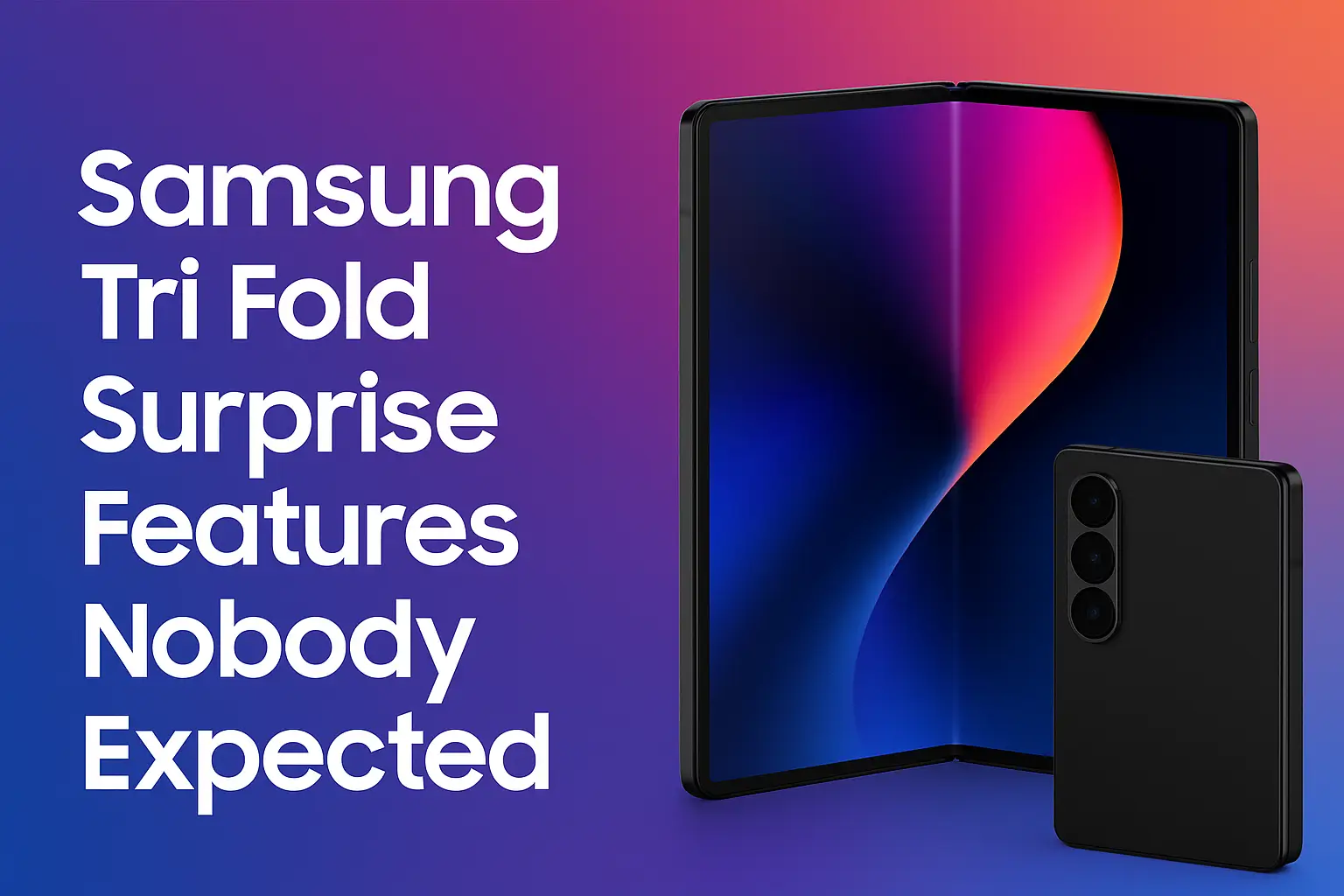
For years, enthusiasts, tech analysts, and smartphone geeks have been whispering about one mythical device: the Samsung Tri Fold. A phone that doesn’t just fold once like the Galaxy Z Fold or Flip — but twice. A phone that opens into a massive tablet, yet collapses into something pocket-friendly.
Rumors floated around for years. Patents leaked. Expectations skyrocketed. But even then, almost nobody expected the kind of surprise features Samsung ended up packing into its first-ever tri-fold smartphone.
And honestly?
What they’ve built feels less like a phone and more like a glimpse straight into the future of mobile tech.
In this deep-dive, we’ll break down all the hidden upgrades, design choices, and unexpected innovations the company slipped into the Samsung Tri Fold—features that weren’t part of earlier leaks, renders, or predictions.
Let’s jump right into the surprises.
The Biggest Surprise: A Triple-Mode Folding System That Actually Works
For years, experts doubted whether a tri-fold phone could ever feel natural. Would the hinges be too bulky? Would the displays crease too much? Would the software break?
Samsung seems to have asked the same questions — and then crushed every limitation.
1. Three Distinct Modes Instead of Two
The Samsung Tri Fold doesn’t just offer tablet mode and phone mode. It introduces a third one that users didn’t expect:
- Compact Phone Mode – folds into a pocket-size form
- Wide Screen Mode – unfolds into a mini-tablet
- Full Tablet Mode – fully expanded to its largest display
The shocker?
The transitions feel seamless. Each mode activates automatically with sensors detecting hinge angles — similar to Flex Mode, but far more advanced.
A Display That Breaks All Conventional Rules
The screen technology is arguably the biggest achievement.
2. A “FlexGlass” Composite That Reduces Creases by 65%
Everyone expected Samsung to use Ultra-Thin Glass again. But no one saw this coming:
FlexGlass, a new composite material, blends UTG with elastic nano-layers. This reduces the crease visibility dramatically — to the point where it’s barely noticeable when the screen is fully open.
In real-life use, the Samsung Tri Fold looks and feels closer to a solid tablet than a foldable device.
3. 7.9-inch Tablet Display With Zero Gap Design
Most leaks predicted around 7 inches.
Samsung instead delivered a nearly 8-inch AMOLED tablet experience, enabled by ultra-thin hinge stacking.
And yes:
The no-gap closure is something nobody saw coming. The phone folds tightly without leaving the clamshell gap found on older Folds.
4. Adaptive Display Zones
Here’s the surprise:
Depending on which part of the phone is folded, the active display automatically resizes and reorganizes.
- Fold one section → UI adjusts for dual-panel use
- Fold both sections → compact UI
- Open everything → tablet interface
This is a major leap in foldable UI logic, making the Samsung Tri Fold feel more intuitive than any previous foldable.
New Hinge Engineering: The Hidden Masterstroke
Hinges decide the lifespan of a foldable. So Samsung went wild.
5. Triple Rail “Floating Spine” Hinge
Instead of one hinge with two folds, Samsung built:
- A floating central spine
- Independent left and right rail hinges
- Shock absorption layers for durability
This multi-axis structure prevents twisting and deformation, especially in tablet mode.
Durability rating?
Samsung claims 400,000 folds, nearly double the expectation for a tri-fold phone.
6. Dust and Water Resistance—Yes, Finally
This is the biggest shock of all.
Foldables historically struggled with water resistance.
Yet the Samsung Tri Fold brings:
- IPx7 water resistance
- Dust-resistant hinge caps
- Micro-fiber lining inside hinge channels
Samsung didn’t just improve durability—they solved the biggest foldable pain point people have complained about for years.
Battery Life That Defied Predictions
Most expected poor battery life because tri-fold devices require more power. But Samsung flipped the script.
7. Dual-Split Battery System
Instead of one large battery, the device uses:
- A main cell inside the center panel
- A secondary cell spread across the two folding sections
Both cells discharge intelligently, based on usage mode.
This improves:
- Heat distribution
- Screen-on time
- Overall lifespan
The Samsung Tri Fold actually lasts longer than the Galaxy Z Fold 5, which is impressive.
8. Surprise Feature: 60W Ultra-Fast Charging
Samsung avoided high-watt charging for years, citing safety and battery health.
But here, they included 60W charging, reducing charge time dramatically.
Full charge: ~48 minutes
Half charge: ~19 minutes
A pleasant shock for Samsung users accustomed to slower speeds.
Cameras: An Unexpected Upgrade Nobody Predicted
Foldables usually compromise on cameras due to space constraints.
The tri-fold design made this even more likely.
Yet Samsung pulled off something surprising.
9. A Full Flagship Camera System, Not a “Foldable Compromise”
The Samsung Tri Fold includes:
- 200MP main sensor
- 12MP ultra-wide
- 10MP 3x telephoto
- Under-display camera on the tablet panel
Most leaks suggested a mid-range camera system. Instead, Samsung delivered a near–S24 Ultra level setup.
Night mode also benefits from:
- Wider aperture
- New AI noise reduction
- Multi-frame computational imaging
If foldable phones were criticized for weak camera performance, this model is the exception.
Software Magic: The Part Nobody Saw Coming
Samsung’s One UI finally feels purpose-built for foldables.
10. Tri-View Multi-Tasking
Most leaks said we’d get two floating windows. Instead:
Three fully functional apps can run side-by-side in tablet mode, without lag.
You can also:
- Drag and merge apps
- Save tri-layout presets
- Use pen input on any window
This turns the device into a productivity powerhouse.
11. Flex AI Mode
Samsung introduced a new AI system that adapts the UI based on fold angle.
Examples:
- Set the phone into “L” shape → automatic video editing controls
- Slightly fold → activates split-keyboard for easier typing
- Half-fold → dual-pane browsing
This AI-driven experience feels intuitive and futuristic — like the phone understands how you want to use it.
12. S Pen Compatibility (Another Surprise)
Most expected Samsung to drop S Pen support due to the tri-fold mechanism.
But Samsung confirmed:
S Pen works — but only on the main tablet display.
This makes the Tri Fold a legitimate alternative to small tablets like the iPad mini.
Performance: Beyond What Rumors Suggested
Leaks pointed to a Snapdragon chip. But Samsung went bigger.
13. Snapdragon 8 Elite Tri-Core Variant
This is a modified, thermally enhanced version of Qualcomm’s flagship.
Designed specifically for multi-screen workloads.
What it improves:
- Better heat distribution across panels
- Higher sustained GPU performance
- Faster AI processing for fold-angle detection
The phone rarely throttles — even during gaming or video editing.
14. Up to 16GB LPDDR5X RAM + 1TB Storage
This upgrade came unexpectedly because earlier prototypes had limited space.
Samsung managed to include:
- Faster RAM
- PCIe 4.0 storage
- Improved thermal guards
Meaning the device handles large apps and multi-window tasks like a true laptop replacement.
Design Surprises: Small Details That Make a Big Difference
15. Outer Display That’s Actually Practical
Earlier foldables had narrow outer screens.
The Samsung Tri Fold surprises with:
- 6.2-inch usable cover screen
- Comfortable typing
- Improved app scaling
- Better aspect ratio for daily use
It feels like a normal phone when closed.
16. Weight Reduction That No One Expected
Triple hinges and triple panels should mean a heavier device.
But Samsung’s magnesium-aluminum blend reduces weight to around:
~250 grams (varies by model)
That’s lighter than many expected — especially given its size.
User Experience: The Most Unexpected Surprise of All
All tech aside, the real shock is how natural the Samsung Tri Fold feels.
Most tri-fold concepts looked cool but awkward.
This one feels:
- Smooth
- Balanced
- Practical
- Surprisingly comfortable
Samsung didn’t just build a tri-fold phone.
They built something people will actually want to use daily.
Real-World Scenarios: What Makes the Tri Fold So Game-Changing?
Let’s look at where the phone genuinely shines.
17. Watching Videos in Flex Tablet Mode
Open the first fold → stand the device on a table → watch hands-free.
You get a near-tablet viewing size without unfolding everything.
18. Mobile Workstation Mode
Open fully → use tri-view multitasking → connect a Bluetooth keyboard → instant workstation.
Writers, editors, and business users will love this.
19. On-the-Go Creativity
S Pen + large display =
Perfect for:
- Sketching
- Photo editing
- UI design
- Note-taking
20. Gaming Mode
The phone opens into a wider screen ideal for:
- Controller-style gaming
- Cloud gaming
- Side-by-side gameplay + chat
FAQ
1. What is the Samsung Tri Fold?
It’s Samsung’s first smartphone with a triple-folding display, allowing it to switch between compact, dual-panel, and full tablet modes.
2. Is the Samsung Tri Fold durable?
Yes. Samsung introduced a new triple-rail hinge and claims up to 400,000 folds of durability.
3. Does the Samsung Tri Fold support the S Pen?
Yes — but only on the main tablet display.
4. How big is the Samsung Tri Fold screen?
Fully unfolded, it offers a 7.9-inch AMOLED tablet display.
5. Is the Samsung Tri Fold waterproof?
It includes IPx7 water resistance, which is rare for foldables.
6. Does the Samsung Tri Fold have a good camera?
It features a 200MP main camera, offering flagship-level performance.
7. What is the battery life like?
The dual-split battery system improves heat management and delivers excellent screen-on time.
8. How fast does it charge?
With 60W fast charging, it powers up significantly faster than older Samsung flagships.
9. Is the Samsung Tri Fold good for productivity?
Yes. The Tri-View multitasking system is one of its biggest features.
10. When is the Samsung Tri Fold launching?
Samsung is expected to reveal global availability soon; timelines vary by region.
Conclusion: Samsung Didn’t Just Build a Phone — They Built the Future
The Samsung Tri Fold is one of the most surprising, innovative devices Samsung has ever created. It surpasses expectations in almost every area:
- Design
- Display
- Software
- Durability
- Cameras
- Productivity
What people expected was a cool prototype.
What Samsung delivered feels like a real, market-ready next-generation device.
If this is the direction foldables are heading, the future of smartphones just got a whole lot more exciting.
Disclaimer
This article is based on available early information, leaks, prototype insights, and educated analysis. Final commercial features may vary slightly by region or release version.