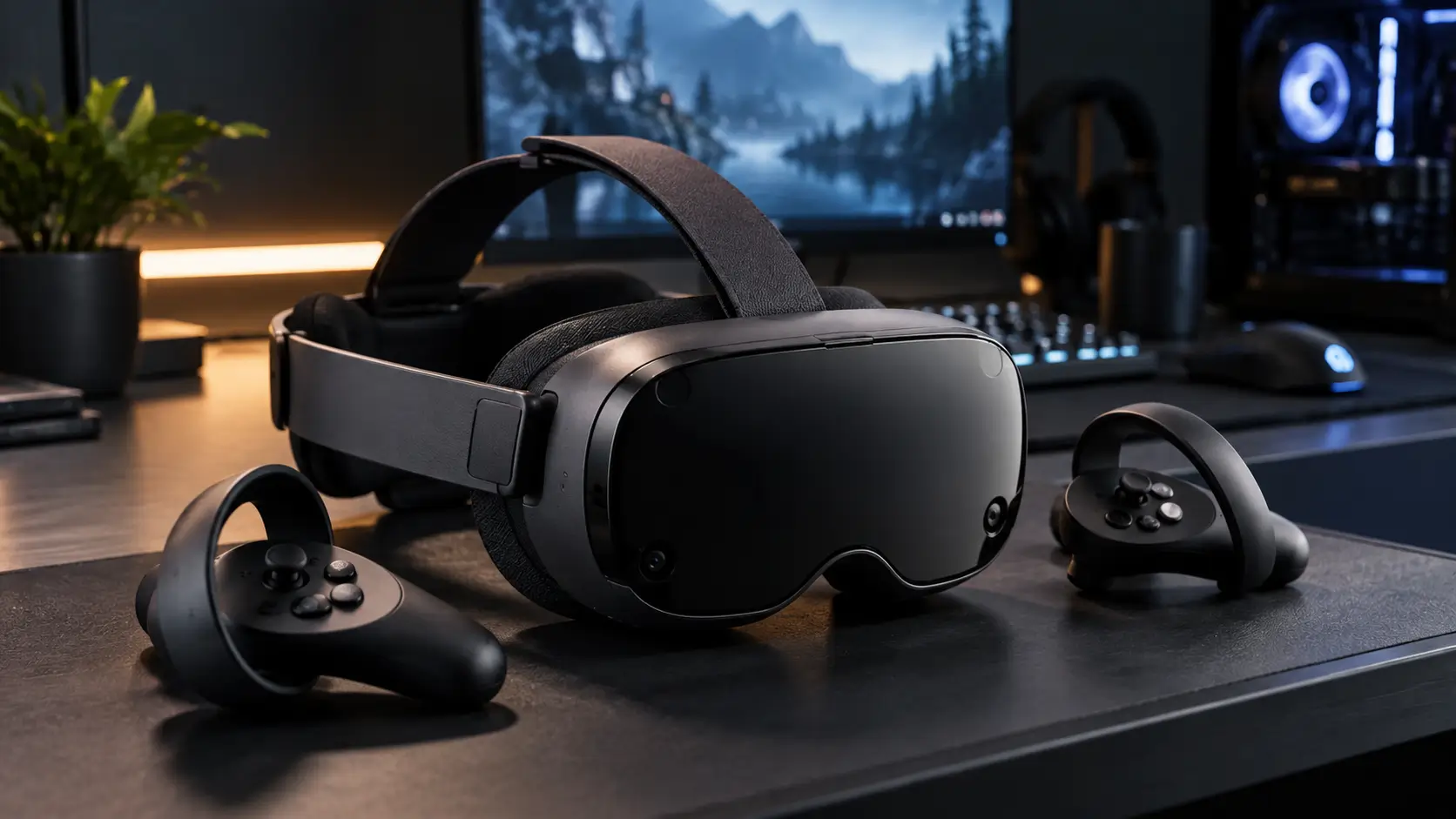
Valve’s Steam Frame has finally moved from a long-awaited hardware project to a real product. The wireless VR headset is designed to play Steam games through low-latency wireless streaming from a PC while also running selected VR and non-VR games locally through SteamOS.
The launch price is considerably higher than early expectations. The Steam Frame starts at $1,059 for 256GB, while the 1TB model starts at $1,299. Valve is also including two wireless controllers and a copy of Half-Life: Alyx. The first batch uses a reservation lottery rather than a conventional first-come, first-served sale.
For Indian buyers, there is another important issue: Steam Frame does not have an official India launch listed among its initial markets. That means Indian availability is primarily an import question for now, rather than a conventional India retail launch.
Quick answer
Steam Frame is Valve’s new wireless VR headset built around SteamOS, Qualcomm’s Snapdragon 8 Gen 3 and 16GB of LPDDR5X memory.
Its main purpose is wireless PC VR streaming, but it can also run compatible games locally without a gaming PC. Valve supports SteamVR and OpenXR, while its ARM-based hardware uses software technologies including Proton and FEX to make some PC games possible on the device.
The headset has dual 2160×2160 LCD displays, pancake optics, eye tracking, inside-out tracking and Wi-Fi 7. A dedicated Wi-Fi 6E adapter is supplied for the low-latency connection between the headset and a gaming PC.
What is Steam Frame?
Steam Frame is best understood as a wireless Steam gaming computer worn like a VR headset.
It is not simply a replacement for the Valve Index.
The Index depended heavily on a wired connection to a PC and external tracking infrastructure. Steam Frame removes much of that setup by combining the display, tracking, computing hardware, battery and wireless connectivity into one device.
Valve’s Steamworks documentation describes it as a standalone VR headset designed primarily for low-latency streaming of a player’s Steam library from a PC, while also supporting standalone VR and non-VR experiences.
That distinction is important.
The device can run games by itself, but Valve’s architecture is clearly built around the idea that a powerful gaming PC remains useful.
Steam Frame price
Valve’s US pricing is:
| Model | Price |
|---|---|
| Steam Frame 256GB | $1,059 |
| Steam Frame 1TB | $1,299 |
The 1TB model therefore costs $240 more than the base configuration.
The higher price is partly connected to the current memory and storage market. Valve developers have said that component costs affected the final price and that the company had originally wanted the headset to be more affordable.
The important point for buyers is that $1,059 is the official US starting price, not an Indian retail price.
Taxes, import duties, shipping, retailer margins and currency conversion can all change the eventual cost for an Indian buyer.
Steam Frame release date
Valve announced the commercial launch on September 14, 2026.
For the first US reservation batch, buyers can register their interest through September 17 at 10 AM Pacific Time. Valve then randomises the list, with selected customers receiving purchase opportunities.
The first purchase invitations are expected on September 18.
KOMODO, Valve’s hardware distribution partner in parts of Asia, has separately started selling Steam Frame in Japan, Taiwan and Hong Kong. KOMODO says South Korean availability will be announced separately.
This means the product is no longer merely scheduled for release. It has entered its commercial rollout.
Steam Frame specifications
The important hardware specifications are:
| Specification | Steam Frame |
|---|---|
| Processor | Qualcomm Snapdragon 8 Gen 3 |
| RAM | 16GB LPDDR5X |
| Storage | 256GB / 1TB |
| Expansion | microSD |
| Display | 2160 × 2160 per eye |
| Panel | LCD |
| Optics | Pancake |
| Refresh rate | 72–120Hz |
| Experimental refresh rate | 144Hz |
| Field of view | Up to 110° horizontal |
| Tracking | 6DoF inside-out tracking |
| Eye tracking | Yes |
| Wireless | Wi-Fi 7 |
| PC streaming adapter | Wi-Fi 6E |
| Operating system | SteamOS |
| Battery | 21.6Wh |
| Weight | About 440g with headstrap |
The displays use LCD rather than micro-OLED technology. Valve has chosen the LCD approach as part of its balance between image quality, performance, weight and cost.
The headset uses pancake optics and provides up to a 110-degree horizontal field of view.
Why the Snapdragon 8 Gen 3 matters
Steam Frame is unusual because it uses an ARM-based mobile processor rather than the kind of desktop-class processor normally associated with PC gaming.
The Snapdragon 8 Gen 3 provides the local computing foundation.
Steam Frame combines it with 16GB of LPDDR5X memory, allowing the headset to run supported standalone software.
However, the processor should not be interpreted as equivalent to a desktop gaming CPU and GPU.
For demanding PC games, Valve’s preferred approach is still wireless streaming from a gaming computer.
That is why Steam Frame’s networking hardware is almost as important as its processor.
How PC streaming works
Steam Frame includes a dedicated wireless adapter designed to create a low-latency connection between the headset and a PC.
The headset itself has Wi-Fi 7, while the included PC adapter uses a 6GHz connection.
This creates a dedicated link rather than forcing all VR streaming traffic through the normal Wi-Fi connection used by other household devices.
That matters because VR is particularly sensitive to latency.
A normal flat-screen game can tolerate a small amount of input or display delay without becoming unusable. VR is much less forgiving because the image needs to respond closely to head movement.
Valve therefore designed Steam Frame around a direct wireless connection.
Foveated streaming
One of the more interesting features is foveated streaming.
Steam Frame uses eye tracking to determine where the player is looking.
The system can then prioritise higher-quality image data in the user’s central field of view while reducing the amount of data allocated to peripheral areas.
The basic principle is straightforward:
Send the most detail where the player is actually looking.
This can reduce the bandwidth required to stream high-resolution VR imagery.
It is particularly relevant because Steam Frame’s displays provide 2160×2160 resolution for each eye.
Can Steam Frame play games without a PC?
Yes, but there is an important qualification.
Steam Frame supports standalone gaming, including compatible VR and non-VR games.
Valve’s software stack allows ARM64 applications to run natively, while selected Windows games can use compatibility and emulation technologies.
However, standalone performance is not identical to running the same game on a powerful desktop PC.
Independent testing has found that the headset is strongest when used for wireless PC streaming, while standalone games can lose performance because of the additional software translation involved in running x86 Windows games on ARM hardware.
That makes the Steam Frame more accurately a hybrid gaming device than a complete replacement for a gaming PC.
Half-Life: Alyx runs natively
One of the most significant technical demonstrations is Half-Life: Alyx.
Valve has ported the game to run natively on Steam Frame’s ARM64 hardware, while the headset can also stream the game from a PC.
The headset includes Half-Life: Alyx with the purchase.
This is significant because Half-Life: Alyx remains one of the most demanding and technically important PC VR games.
Getting it to run on a Snapdragon-based standalone device demonstrates what Valve believes is possible with careful optimisation.
It does not mean every PC VR game will run natively.
Compatibility remains game-specific.
Steam Frame controllers
Steam Frame comes with two wireless controllers.
The controllers use six-degree-of-freedom tracking and include:
- analog triggers
- grip controls
- haptic feedback
- capacitive finger sensing
- thumbsticks
- Steam controls
- conventional gaming buttons
- a D-pad on the left controller
Their design is closer to modern standalone VR controllers than the older Valve Index controllers.
Each controller uses a replaceable AA battery.
This means users do not need to charge the controllers in the same way as a rechargeable built-in-battery gamepad.
Display and tracking
The headset uses two LCD displays, each providing 2160×2160 resolution.
The refresh rate can operate between 72Hz and 120Hz, with a 144Hz mode currently described as experimental.
Steam Frame also uses inside-out tracking, meaning users do not need external base stations around the room.
The system uses outward-facing cameras for tracking and monochrome passthrough.
That last point is important.
Steam Frame does not provide built-in full-colour passthrough in the base hardware.
Valve is instead offering compatibility with an optional Arcturus Vision Camera that can add colour passthrough and spatial-video capture.
Battery life
Steam Frame uses a 21.6Wh battery positioned toward the back of the headstrap.
Moving some of the battery weight backward helps balance the front-heavy optical and computing hardware.
Battery life depends heavily on what the headset is doing.
Independent testing has found substantially shorter endurance during demanding standalone VR gaming than during lighter or streamed workloads.
This is therefore not a headset that should be evaluated using one universal battery-life number.
Standalone VR, streamed PC gaming, display refresh rate and workload all affect endurance.
Is Steam Frame available in India?
This is where Indian buyers need to be careful.
There is no official India launch identified for Steam Frame.
Valve’s 2025 announcement indicated that the new Steam hardware family would follow the company’s existing Steam Deck-style regional strategy, covering markets such as the US, Canada, UK, European Union and Australia, along with selected Asian markets handled by KOMODO.
India was not included in that initial regional rollout.
The situation is therefore different from an ordinary smartphone launch in India.
Indian buyers may eventually find imported units through third-party sellers, but an imported device is not the same thing as official Indian retail availability.
What could Steam Frame cost in India?
There is currently no official Indian price.
The US base price is $1,059, but simply converting that number into rupees would not produce a reliable Indian retail price.
An imported Steam Frame can involve:
- international shipping
- customs duties
- GST
- retailer margins
- warranty limitations
- currency conversion costs
Anyone publishing a precise “Steam Frame India price” without an official Indian listing should therefore make it clear that the figure is an estimate.
For now, the only safe statement is:
Official India price: not announced.
Steam Frame vs a conventional VR headset
Steam Frame’s strongest differentiator is its relationship with Steam.
A conventional standalone VR headset may prioritise its own application ecosystem.
Steam Frame is instead designed around access to a large PC gaming library through wireless streaming while also adding standalone capability.
That makes it particularly interesting for PC gamers who already own a capable gaming computer.
The equation changes if someone does not own a gaming PC.
In that situation, Steam Frame’s standalone capabilities become much more important, and the $1,059 starting price becomes harder to justify against less expensive standalone VR options.
Who should consider Steam Frame?
Steam Frame makes the most sense for:
- PC gamers who already own a capable gaming desktop
- Steam users with large PC game libraries
- VR enthusiasts who want wireless PC VR
- users who value lightweight hardware
- enthusiasts interested in SteamOS and experimental gaming hardware
- buyers willing to pay a premium for Valve’s ecosystem
Who should probably skip it?
It is harder to justify for:
- casual VR users
- first-time VR buyers on a tight budget
- people without a gaming PC
- buyers primarily interested in mixed-reality colour passthrough
- users who want very long standalone battery life
- Indian buyers expecting official local warranty and retail support
The high starting price is the biggest limitation.
Is Steam Frame worth buying?
There is no universal answer.
For someone who already owns a powerful gaming PC and wants a wireless Steam VR experience, Steam Frame is a much more interesting proposition than its standalone specifications might suggest.
For someone buying their first VR headset, the calculation is different.
The device costs more than mainstream standalone alternatives, and its strongest advantage is its integration with PC gaming.
That means the Steam Frame should not be judged as simply another VR headset.
Its real proposition is:
wireless PC VR + SteamOS standalone gaming + a lightweight Valve-designed hardware platform.
For Indian buyers, the lack of official local availability makes the decision more complicated because imported hardware can carry additional costs and support risks.
Bottom line
Steam Frame is Valve’s most ambitious VR hardware release since the Index, but it is not trying to follow exactly the same path as the Meta Quest family.
Its defining idea is wireless access to PC VR and the Steam library, combined with enough local computing power to run selected games without a PC.
The hardware is substantial: Snapdragon 8 Gen 3, 16GB RAM, 2160×2160 LCD displays per eye, pancake optics, eye tracking, Wi-Fi 7 and a dedicated Wi-Fi 6E PC adapter.
The trade-offs are equally important.
The base model starts at $1,059, standalone performance is more limited than PC streaming, battery life depends heavily on workload, and India does not currently have an official launch channel.
For PC gaming enthusiasts who specifically want wireless Steam VR, Steam Frame is a distinctive product.
For everyone else, the price makes it a niche proposition rather than an obvious mainstream VR recommendation.
FAQ
What is Steam Frame?
Steam Frame is Valve’s wireless SteamOS-based VR headset designed primarily for low-latency PC game streaming while also supporting selected standalone VR and non-VR games.
How much does Steam Frame cost?
Steam Frame starts at $1,059 for 256GB in the US, while the 1TB version starts at $1,299.
Does Steam Frame need a gaming PC?
No. Steam Frame can run compatible games locally, but Valve designed it primarily around wireless PC streaming, and demanding games generally benefit from a gaming PC.
What processor does Steam Frame use?
Steam Frame uses Qualcomm’s Snapdragon 8 Gen 3 with 16GB of LPDDR5X memory.
What is Steam Frame’s display resolution?
Steam Frame has dual LCD displays with 2160×2160 resolution per eye and supports refresh rates up to 120Hz normally, with a 144Hz experimental mode.
Is Steam Frame available in India?
There is currently no official India launch listed. Valve’s initial Steam hardware rollout covers selected Western and Asian markets, but India is not included in the identified launch regions.
Does Steam Frame include Half-Life: Alyx?
Yes. Valve includes Half-Life: Alyx with Steam Frame, and the game has been ported to run natively on the headset as well as through PC streaming.
Is Steam Frame standalone or PC VR?
It is both. Steam Frame can run compatible software locally but is designed primarily as a wireless PC-VR streaming device.
DISCLAIMER
Prices, regional availability, import costs, accessories, software compatibility and game support can change. The US price should not be treated as an Indian retail price. Indian buyers should verify official regional availability, warranty coverage and final import costs before purchasing.