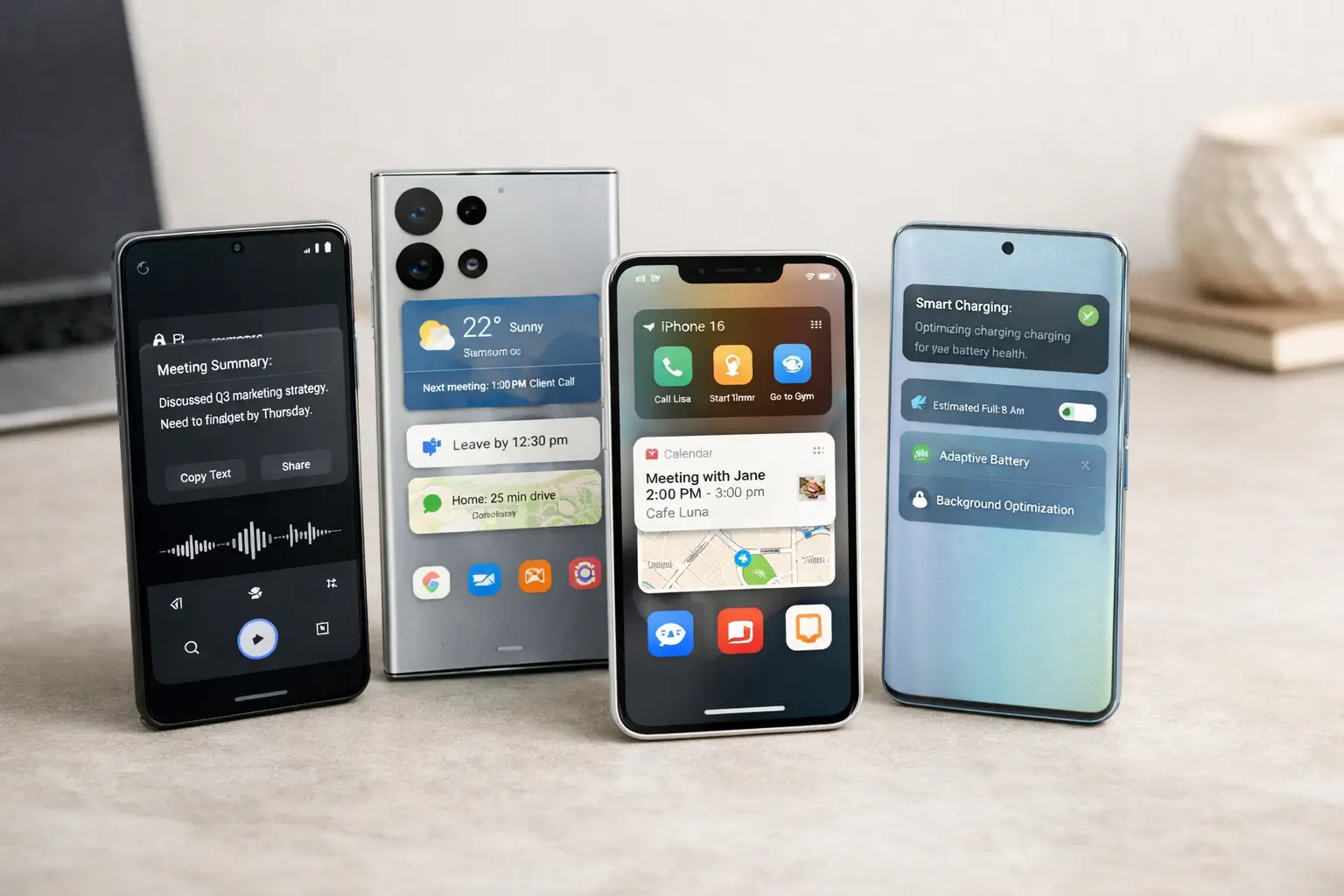
Smartphones today are no longer defined solely by megapixels or raw benchmark scores. The real evolution is in how devices think, adapt to your habits, and make everyday tasks—like messaging, navigation, productivity, and battery life—feel effortlessly smarter. With advances in AI on phone systems, a new generation of mobile devices is delivering context-aware assistance, on-device personalization, and proactive features that reshape daily usage.
Here we profile nine standout AI phones across price tiers and use cases—each designed not just for performance, but for practical, intelligent experiences in real life.
1. Samsung Galaxy S24 Ultra 5G
One of the most capable Android flagships, the S24 Ultra blends premium hardware with advanced AI features. Samsung’s AI ecosystem includes system-wide tools that assist with translation, writing, multitasking, and contextual suggestions—for example, AI Select for smart text manipulation and generative editing across apps.
Stand-out AI capabilities
- On-device text and image editing
- Intelligent task suggestions across apps
- Advanced voice and image recognition
Samsung’s focus on cohesive AI experience highlights how an AI phone can feel smarter without being intrusive.
2. Apple iPhone 16 128GB White
Apple’s latest mainstream model brings “Apple Intelligence” into a broader audience. Powered by its in-house Neural Engine, the iPhone 16 supports features like predictive typing, enhanced dictation, and personalized suggestions throughout iOS. It also benefits from tight privacy controls, with on-device AI ensuring sensitive interactions stay local.
Why it matters
- Smooth on-device contextual recommendations
- Intelligent voice processing
- Tight app integration with personalized suggestions
Even without flagship pricing, the iPhone 16 delivers genuinely helpful AI behaviors in everyday tasks.
3. Vivo X200 FE
The Vivo X200 FE represents a compelling balance of performance, price, and AI functionality. While not always headline-grabbing in benchmarks, it integrates smart adaptive systems that learn and adjust to your usage patterns—optimizing battery life, managing app behavior, and tailoring notifications based on your routines.
Key intelligence features
- Adaptive battery learning
- Usage-aware performance scaling
- Smart notification grouping
These everyday “little changes” combine into a noticeably smoother experience over time.
4. Oneplus Nord CE5 5G
A strong mid-range contender, the Nord CE5 5G includes practical AI features that enhance usability without demanding premium prices. Its software uses predictive suggestions for apps and multitasking, and adaptive battery techniques to prolong real-world performance.
Useful AI highlights
- Smart app suggestions
- Battery optimization
- Lightweight on-device learning
For everyday users seeking intelligent behavior over raw power, this phone punches above its price.
5. Google Pixel 10 Series (Multiple Models)
Though not represented here with a specific product listing, the Google Pixel 10 lineup is widely recognized for deep on-device AI integration. With the new Tensor G5 chip and Gemini enhancements, these models anticipate user needs—like surfacing relevant information based on calendar events and context—and support AI-driven transcription and summarization.
Pixel AI strengths
- Android-wide AI suggestions (Gemini-based)
- Real-time transcription and summary tools
- Context-aware task surfaces
Google’s intelligent insights feel natural, helping the phone act as an assistant, not just a tool.
6. Samsung Galaxy S25 Series
Building on the legacy of its predecessors, the Galaxy S25 lineup integrates AI deeply across system behavior, from battery management to cross-app intelligence. Samsung’s vision for this series is a smartphone that anticipates user needs and surface-level tasks proactively, without overwhelming the user with prompts.
Smart features to know
- Proactive task management
- Local intelligence for privacy
- System-wide AI assistance
Even the base S25 benefits from a layered AI ecosystem shared across the series.
7. Google Pixel 9 Pro and XL
Still a strong choice in the AI phone space, the Pixel 9 Pro family offers deep learning-powered features like Magic Editor and enhanced speech processing. While newer models have appeared, these remain excellent examples of AI used for real productivity—like summarizing voice memos or smart composition tools in the recorder.
Why this matters
- Intelligent editing tools
- Speech and voice insights
- Long-term software support
Google’s iterative improvements show how AI can enhance everyday tasks across the system.
8. Foldables with AI Enhancements
Devices like the Samsung Galaxy Z Flip7 and other AI-ready foldables incorporate AI to improve multitasking and notifications across large screens. These devices blur the line between phone and mini-computer, with AI-assisted workflows that make split-screen and pop-up actions feel smoother and more intuitive.
Smart adaptability
- Screen-aware app suggestions
- Contextual UI adjustments
- Enhanced productivity layouts
Foldables are turning digital intelligence into a physical advantage.
9. Emerging AI Phones Across Price Ranges
Beyond flagship models, dozens of devices now include practical AI features—such as adaptive battery, smart text prediction, voice assistants, and more. These include phones across sub-₹30,000 and mid-range categories, widening access to intelligent features.
Examples from the segment
- Phones with adaptive battery and UI learning
- Mid-tier models receiving AI updates
- Budget tiers gaining voice-based intelligence
Even entry-level AI phones can improve everyday interactions without overwhelming complexity.
What Makes These AI Phones Different
Across this selection, AI on phone is defined not by marketing labels, but by how the device:
- Adapts to your habits over time
- Anticipates needs before you ask
- Optimizes resources like battery and apps
- Assists contextually without interrupting
This shift—from raw specs to meaningful intelligence—is the real transformation in modern smartphones.
FAQ: AI Phones Explained
What makes an AI phone different from others?
AI phones use on-device intelligence to enhance user experience through context-aware features, learning user habits and optimizing system behavior.
Do AI features work offline?
Many core AI features like text prediction, adaptive battery, and voice recognition work offline, improving speed and privacy.
Are more expensive phones always better for AI?
Not necessarily. Mid-range models increasingly include AI features that improve usability and efficiency, even if their hardware isn’t flagship level.
Does AI drain battery more quickly?
AI-driven optimization often saves battery by reducing unnecessary background activity.
Can AI on phone protect my privacy?
Yes—processing data locally means personal interactions are less exposed to cloud servers.
Is AI the main reason to upgrade a phone?
AI features are compelling, but combined with battery life, software support, and usability they form part of a holistic upgrade decision.
Conclusion
The latest generation of AI phones proves that meaningful intelligence is now a core differentiator in everyday mobile experiences. From adaptive systems that learn your routines to contextual assistance that feels proactive rather than intrusive, AI on phone is reshaping what users expect.
Whether you choose a premium flagship with comprehensive intelligence tools or a mid-range model with smart usability features, there is an AI phone designed to improve the way you interact with technology every day.
Disclaimer
This article is for informational purposes only. Features and capabilities may vary by device, software version, and region. Readers should verify specifications with official sources before making decisions.