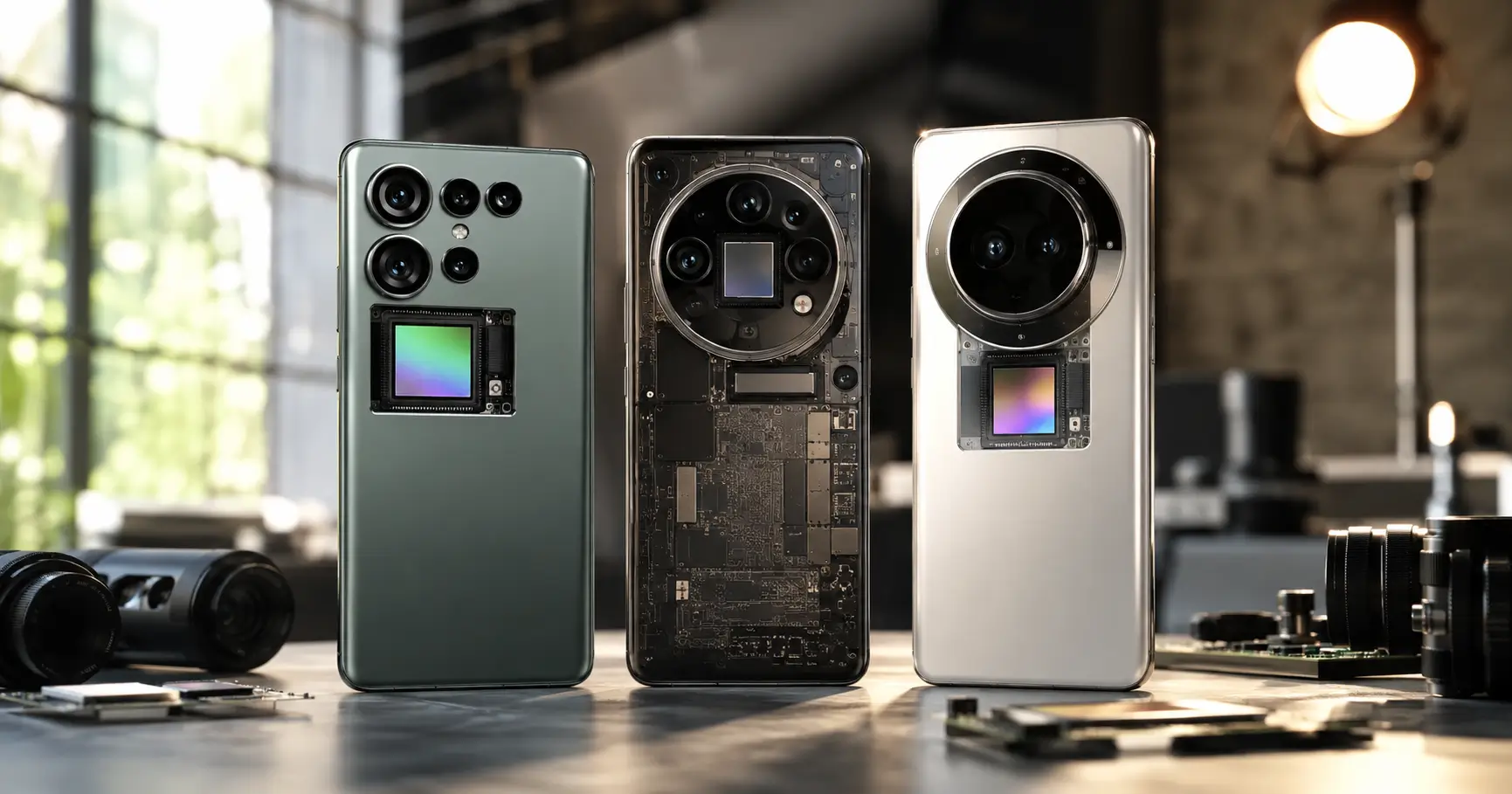
The biggest camera number on a smartphone is not necessarily the one that matters most.
A 200MP camera can look impressive on a specification sheet, but a phone with a larger sensor, better optics and stronger image processing can produce a better photograph with fewer megapixels. That is why choosing the best camera sensor phones requires looking beyond resolution.
In 2026, smartphone camera hardware has become remarkably sophisticated. Large 1-inch-class sensors, 200MP telephoto sensors, stacked CMOS designs, advanced HDR and computational photography are appearing across premium devices. Xiaomi, Vivo, OPPO, Samsung, Google and Apple are taking very different approaches.
So which phones actually have the most impressive camera hardware, and what should you look for before buying one?
What makes a smartphone camera sensor good?
A camera sensor converts incoming light into an electronic image.
Its performance depends on several factors, including physical sensor size, pixel architecture, pixel size, dynamic range, autofocus technology, readout speed and sensitivity.
But the sensor is only one part of the camera.
A useful way to think about smartphone photography is:
Sensor + lens + stabilization + ISP + computational photography = final image.
That explains why two phones with similar 50MP or 200MP sensors can produce very different photographs.
The five specifications that matter most
When comparing camera sensor phones, prioritize:
- Sensor size
- Pixel architecture
- Lens quality and aperture
- OIS and autofocus
- Image processing
Megapixel count comes after these factors.
Best camera sensor phones in 2026
The following phones stand out because their camera systems combine strong sensor hardware with sophisticated optics and processing.
| Phone | Camera hardware highlight | Best for |
|---|---|---|
| Vivo X300 Ultra | 200MP 1/1.12-inch main sensor + large telephoto | Photography and portraits |
| OPPO Find X9 Ultra | 200MP 1/1.12-inch main + 10× optical telephoto | Zoom and versatility |
| Xiaomi 17 Ultra | 50MP 1-inch main + 200MP 1/1.4-inch telephoto | Large-sensor photography |
| Samsung Galaxy S26 Ultra | 200MP main + multiple telephoto cameras | All-round versatility |
| Google Pixel 10 Pro XL | 50MP 1/1.3-inch main + computational photography | Point-and-shoot photography |
| iPhone 17 Pro Max | Triple 48MP Pro Fusion system | Video and consistency |
These aren’t interchangeable winners. Each uses a different imaging philosophy.
1. Vivo X300 Ultra: one of the strongest sensor setups
The Vivo X300 Ultra is one of the most interesting examples of how smartphone camera hardware is evolving.
Its main camera uses a 200MP Sony LYTIA 901 sensor with a 1/1.12-inch format, while its 85mm-class telephoto uses a 200MP 1/1.4-inch sensor. Vivo also pairs the system with ZEISS optics and OIS.
That is significant because large sensors are no longer restricted to the primary wide camera.
Vivo has effectively treated multiple focal lengths as serious cameras rather than making the telephoto an afterthought.
Why it stands out
- Large main sensor
- Large high-resolution telephoto
- OIS across the main camera system
- ZEISS optical design
- Multiple useful focal lengths
- Strong portrait potential
For photography enthusiasts, this is one of the most complete sensor configurations currently available.
2. OPPO Find X9 Ultra: built for extreme zoom
The OPPO Find X9 Ultra takes a different approach.
Its main camera uses a 200MP 1/1.12-inch Sony sensor with an f/1.5 aperture, while its 3× portrait telephoto uses a 200MP 1/1.28-inch sensor. The phone also introduces a 50MP 10× optical-zoom telephoto with a 1/2.75-inch sensor.
The interesting part is not simply the 200MP number.
OPPO has invested heavily in the optical system, including a quintuple-prism periscope structure designed to achieve 10× optical zoom within a smartphone body.
This makes the Find X9 Ultra particularly interesting for:
- Concert photography
- Wildlife
- Travel
- Sports
- Distant subjects
- Portrait photography
It demonstrates an important trend: camera quality is increasingly about focal-length coverage as much as sensor resolution.
3. Xiaomi 17 Ultra: the 1-inch sensor approach
Xiaomi has gone in another direction with the Xiaomi 17 Ultra.
Its primary Leica camera uses a 50MP 1-inch sensor, while its telephoto camera uses a 200MP 1/1.4-inch sensor with continuous optical zoom from 75mm to 100mm. Xiaomi also highlights a LOFIC hardware HDR system and 4K 120fps recording.
The 1-inch main sensor is particularly important.
A physically larger sensor can collect more light than a much smaller sensor when other variables are comparable. That can help with noise, dynamic range and image quality in difficult lighting.
Why the Xiaomi approach matters
The company is effectively combining:
Large sensor + Leica optics + hardware HDR + high-resolution telephoto + continuous optical zoom.
That makes the 17 Ultra one of the most sensor-focused camera phones of the current generation.
4. Samsung Galaxy S26 Ultra: the versatile choice
Samsung’s Galaxy S26 Ultra uses a 200MP main camera alongside 50MP ultra-wide and telephoto cameras and a 10MP 3× telephoto. Samsung lists an f/1.4 aperture for the main camera and f/2.9 for its 50MP telephoto.
The strength here is versatility.
You aren’t buying the S26 Ultra solely for its main sensor.
You get multiple focal lengths for landscapes, portraits and distant subjects, plus Samsung’s ProVisual Engine and optical stabilization across key cameras.
Who should choose it?
The S26 Ultra makes sense for people who regularly photograph different subjects.
It is particularly attractive if you want one phone that can handle:
- Everyday photography
- Night photography
- Portraits
- Landscapes
- Zoom
- Social media
- Video
Its camera system is less about having one gigantic sensor and more about creating a complete multi-camera platform.
5. Google Pixel 10 Pro XL: computational photography matters
The Google Pixel 10 Pro XL provides an important counterargument to the idea that the biggest sensor automatically wins.
Google specifies a 50MP wide camera with a 1/1.3-inch sensor, plus a 48MP ultrawide and 48MP 5× telephoto. The system also includes optical and electronic stabilization, laser autofocus and Google’s computational photography features.
This is a useful real-world lesson.
Google’s camera strategy relies heavily on combining sensor information with algorithms.
Features such as Night Sight, HDR processing, computational zoom and portrait processing can substantially influence the final photograph.
The result is that a phone does not necessarily need the largest sensor to produce excellent everyday images.
6. iPhone 17 Pro Max: the complete imaging pipeline
Apple’s iPhone 17 Pro Max takes yet another approach.
Apple specifies a 48MP Pro Fusion camera system, including 48MP main, 48MP ultra-wide and 48MP telephoto cameras. The system includes sensor-shift stabilization, 100% Focus Pixels, Smart HDR 5, Photonic Engine, Deep Fusion and a tetraprism telephoto design.
Apple does not market the iPhone primarily around huge sensor numbers.
Instead, it emphasizes consistency across the entire imaging pipeline.
That becomes particularly important for video.
For creators who shoot social content, interviews, travel videos or professional-looking clips, consistent exposure, stabilization, autofocus and color can matter more than having the largest possible sensor.
Sensor size vs megapixels: which matters more?
This is probably the most important question in the entire topic.
Larger sensor
A larger sensor generally provides more physical area for capturing light.
When the optical system and processing are comparable, this can provide advantages in:
- Low-light performance
- Noise control
- Dynamic range
- Subject separation
- Tonal information
More megapixels
Higher resolution can provide:
- More detail in good lighting
- Greater cropping flexibility
- High-resolution output
- More data for some computational techniques
- Potential benefits for digital zoom
But megapixels alone do not guarantee better photographs.
A badly processed 200MP image can look worse than a well-processed 50MP image.
Why pixel size still matters
Pixel size describes the physical size of individual pixels on the sensor.
Larger pixels can collect more photons individually, while modern high-resolution sensors often compensate through pixel binning.
For example, Samsung’s ISOCELL HP2 can combine pixels using Tetra²pixel technology, allowing its 200MP sensor to operate in lower-resolution modes with larger effective pixels.
This is why comparing “200MP versus 50MP” without understanding sensor architecture can be misleading.
The sensor may behave differently depending on lighting conditions and capture mode.
What is pixel binning?
Pixel binning combines information from neighboring pixels to create an output with lower resolution but potentially better light sensitivity and noise performance.
A simplified example:
200MP → 50MP → 12.5MP
does not necessarily mean the 12.5MP photograph is worse.
In low light, combining pixel information can produce a cleaner image.
This is one reason modern smartphone cameras often use high-resolution sensors while saving everyday photographs at much lower resolutions.
The telephoto sensor revolution
One of the biggest developments in smartphone photography is the improvement of telephoto sensors.
Historically, manufacturers often used relatively small sensors behind zoom cameras.
That created obvious weaknesses in low light.
Modern flagships are changing that.
Samsung’s ISOCELL HP9, for example, was introduced as a 200MP telephoto image sensor in a 1/1.4-inch optical format. Samsung’s technology combines 16 pixels into larger effective pixels for improved low-light performance and supports in-sensor zoom.
This matters because telephoto cameras can now become useful beyond bright daylight.
Portraits, indoor photography and evening zoom shots all benefit from better telephoto hardware.
What makes a good camera sensor phone?
If you are comparing phones, use this checklist instead of simply sorting by megapixels.
1. Check sensor size
Look for larger formats when low-light photography is important.
A 1-inch-class main sensor is particularly interesting for users who prioritize natural detail and night photography.
2. Check stabilization
OIS is highly valuable.
It helps compensate for hand movement during longer exposures and can also contribute to more stable video.
3. Check the aperture
A wider aperture allows more light to reach the sensor.
But don’t evaluate aperture independently. Lens quality and optical design matter too.
4. Check autofocus
Fast, accurate autofocus matters enormously for:
- Children
- Pets
- Sports
- Street photography
- Video
- Portraits
5. Examine the telephoto camera
If you frequently use zoom, the telephoto sensor may matter more to you than the main camera.
This is where phones such as the Vivo X300 Ultra and OPPO Find X9 Ultra become especially interesting.
Common mistakes when choosing a camera phone
Mistake 1: Buying based on megapixels
A 200MP camera is not automatically better than a 50MP camera.
Sensor size, optics and processing can matter more.
Mistake 2: Ignoring the telephoto sensor
If you love portraits or travel photography, a high-quality telephoto can transform your experience.
Mistake 3: Looking only at daylight samples
Almost every premium phone can produce impressive daylight images.
Low light is where differences become easier to see.
Mistake 4: Ignoring video
A camera phone should be evaluated for stabilization, autofocus, exposure consistency and audio—not just still photographs.
Mistake 5: Comparing sensor names instead of phones
A Sony sensor does not automatically make a phone better than an OmniVision or Samsung sensor.
The implementation matters.
Myths vs facts
Myth: The phone with the biggest sensor always wins
Fact: Larger sensors provide important physical advantages, but optics and processing can change the final result.
Myth: 200MP is better than 50MP
Fact: Resolution and image quality are different measurements.
Myth: Sony sensors are always better
Fact: Sony, Samsung and OmniVision make many different sensors with different strengths.
Myth: AI photography replaces good hardware
Fact: Computational photography can improve results, but it cannot completely eliminate the physical limitations of optics and sensor hardware.
How to choose the right camera sensor phone
Use this simple process before buying.
- Define your photography style.
- Decide whether you prioritize low light, portraits, zoom, landscapes or video.
- Check the main sensor size.
- Examine the telephoto sensor if zoom matters.
- Confirm OIS and autofocus capabilities.
- Look at real-world camera samples.
- Compare video stabilization.
- Check software support and camera updates.
- Compare the complete phone, not just its camera specification.
- Buy according to your actual shooting habits.
The bottom line
There is no single camera sensor that is perfect for everyone.
The Vivo X300 Ultra emphasizes large sensors across multiple focal lengths. OPPO’s Find X9 Ultra pushes optical zoom and large sensors. Xiaomi combines a 1-inch main sensor with a huge telephoto sensor. Samsung emphasizes versatility, Google leans heavily into computational photography, and Apple focuses on consistency across the complete camera pipeline.
That is why the best camera sensor phones are not necessarily the phones with the biggest numbers.
The better question is:
Which phone has the right sensor, optics and processing for the photographs you actually take?
For low-light photography, prioritize sensor size and stabilization.
For zoom, prioritize telephoto sensor size and optical reach.
For video, look at stabilization, autofocus, exposure consistency and processing.
And for everyday point-and-shoot photography, the complete imaging pipeline may matter more than any individual sensor specification.
Key takeaways
- Sensor size matters more than megapixels alone.
- Large sensors can provide important low-light and dynamic-range advantages.
- 200MP sensors can be valuable, particularly for cropping and advanced zoom systems.
- Pixel binning can improve sensitivity in difficult lighting.
- OIS and autofocus are critical parts of a good camera system.
- Large telephoto sensors are becoming increasingly important.
- Computational photography can dramatically influence final image quality.
- The best camera phone depends on how you shoot, not simply which sensor has the largest specification.
FAQ
Which phone has the best camera sensor in 2026?
There is no universal winner, but the Vivo X300 Ultra, OPPO Find X9 Ultra and Xiaomi 17 Ultra currently stand out for unusually large and sophisticated sensor hardware. Their approaches differ, so the best choice depends on whether you prioritize main-camera quality, portraits, low light or zoom.
Is a larger camera sensor better?
Generally, a larger sensor can provide advantages in light collection, noise control and dynamic range when other parts of the camera system are comparable. However, lens quality, stabilization and image processing also strongly affect the final result.
Is 200MP better than 50MP for a smartphone camera?
Not automatically. A 200MP sensor can provide more resolution and cropping flexibility, but a well-designed 50MP sensor can produce better images depending on sensor size, optics, processing and lighting conditions.
Which phones have a 1-inch camera sensor?
The Xiaomi 17 Ultra is one current example, using a 50MP 1-inch main sensor. Xiaomi pairs it with a 200MP 1/1.4-inch telephoto sensor.
Are Sony camera sensors better than Samsung sensors?
Neither manufacturer is universally better. Sony and Samsung produce multiple sensor generations with different sizes, architectures and purposes. The phone’s implementation—including optics, OIS, ISP and software—can be just as important as the sensor manufacturer.
What should I look for in a camera phone?
Prioritize sensor size, lens quality, OIS, autofocus, telephoto capability and image processing. Megapixel count should be considered alongside these factors rather than used as the primary buying criterion.
Conclusion
The smartphone camera race has moved well beyond the old “more megapixels = better camera” argument.
Today’s strongest camera phones are combining large sensors, advanced pixel architectures, sophisticated optics, OIS, fast autofocus, powerful image processors and computational photography.
The Vivo X300 Ultra pushes large sensors across multiple focal lengths. OPPO is taking telephoto photography to another level with a 10× optical system. Xiaomi combines a 1-inch main sensor with a large 200MP telephoto, while Samsung, Google and Apple demonstrate how much can be achieved through different combinations of hardware and software.
The biggest takeaway is simple: don’t buy a camera phone because of one number.
Look at the entire imaging system.
If you prioritize night photography, start with sensor size and OIS.
If you shoot portraits or distant subjects, pay close attention to the telephoto sensor and optical zoom.
If you create videos, prioritize stabilization, autofocus, exposure consistency and processing.
And if you want effortless everyday photography, remember that software can be just as important as the sensor itself.
The best camera sensor is ultimately the one that works best for the way you photograph.
Disclaimer
Disclaimer: Camera specifications, sensor configurations, pricing and availability can vary by market, storage variant, software version and manufacturer updates. This article is intended for informational purposes and does not represent a universal laboratory ranking of smartphone cameras. Manufacturer specifications describe hardware capabilities, while real-world image quality can vary substantially depending on optics, stabilization, image processing, lighting and shooting technique. Readers should verify current specifications and pricing before making a purchase.