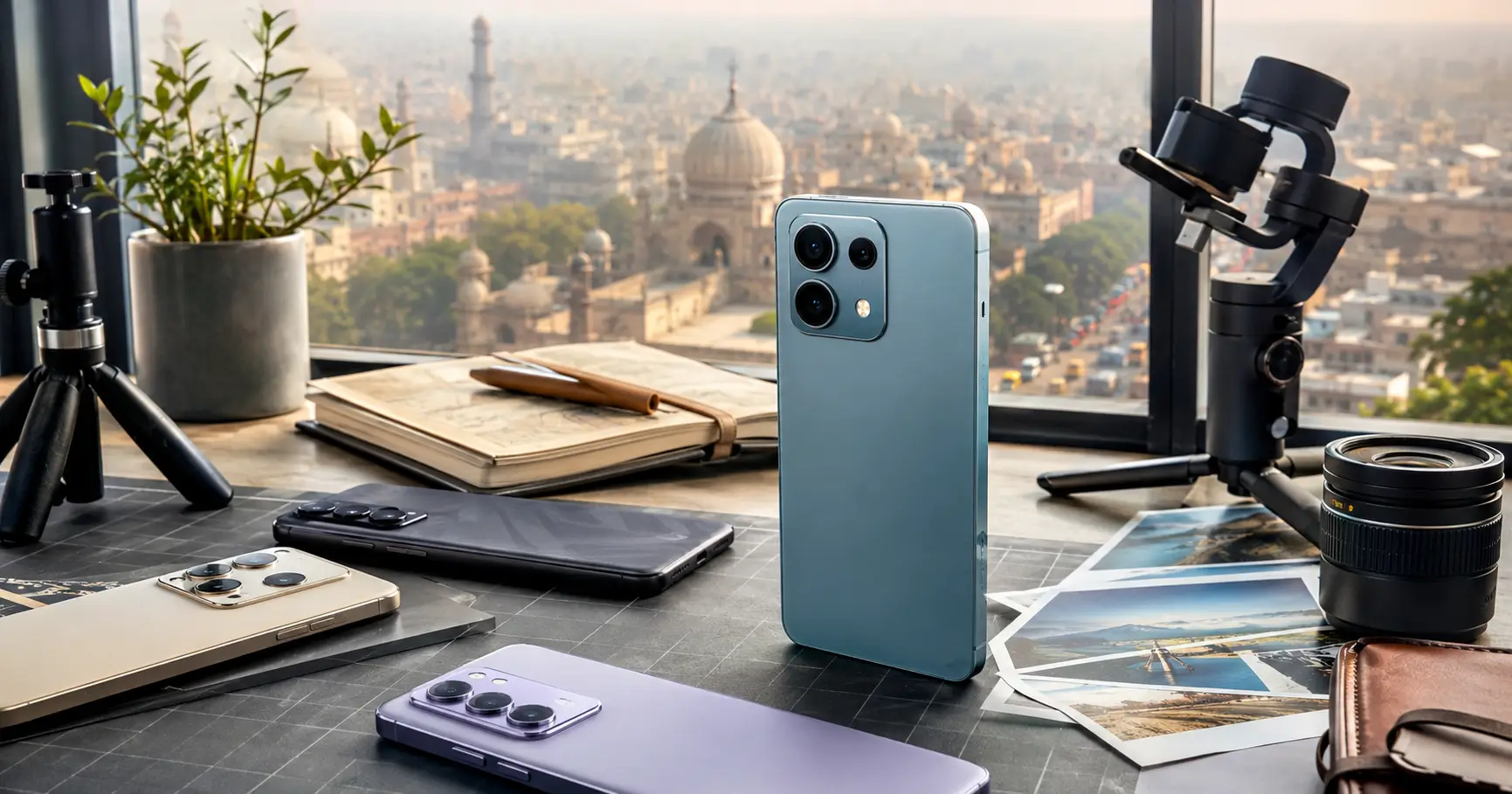
Finding the best camera phone under ₹25,000 is no longer about picking the phone with the biggest megapixel number.
At this price, you can now find phones with OIS, large sensors, ultrawide cameras, 4K recording, better night modes and surprisingly capable selfie cameras. The real challenge is figuring out which camera system performs consistently outside a specification sheet.
For August 2026, the Moto G96 5G is one of the strongest overall camera-focused choices, while phones such as the Motorola Edge 60 Fusion, Nothing Phone (3a), iQOO Z10R and Redmi Note 15 5G make compelling cases for different types of photographers. Current prices and availability can change quickly, so verify the final price before purchasing.
Quick comparison
| Phone | Camera strength | Best for |
|---|---|---|
| Moto G96 5G | 50MP OIS + 8MP ultrawide | Best overall camera value |
| Motorola Edge 60 Fusion | 50MP OIS + 13MP ultrawide | Photography + ultrawide |
| Nothing Phone (3a) | 50MP OIS + 50MP telephoto + ultrawide | Zoom & portraits |
| iQOO Z10R | 50MP Sony OIS + 32MP 4K selfie | Selfies & vlogging |
| Redmi Note 15 5G | 108MP OIS + 8MP ultrawide | Detail & daylight |
| realme P4 | 50MP + 8MP ultrawide | All-round everyday photography |
| Samsung Galaxy M56 5G | 50MP OIS triple camera | Samsung software & portraits |
Prices fluctuate. Some models can move above or below ₹25,000 depending on configuration, discounts and availability.
Which is the best camera phone under ₹25,000?
1. Moto G96 5G — Best overall camera value
The Moto G96 5G is arguably the most balanced starting point for someone whose first priority is camera quality.
Its main camera uses a 50MP Sony Lytia 700C sensor with OIS, Quad PDAF and an f/1.8 aperture. It is paired with an 8MP ultrawide camera with a 118.6-degree field of view. The phone can also record rear-camera video at up to 4K 30fps.
The combination matters more than the megapixel number.
OIS helps reduce camera shake, particularly when shooting handheld in dim environments. PDAF helps the camera lock focus quickly, while the ultrawide gives you another useful perspective for landscapes, architecture and group photos.
Motorola’s India listing currently shows the phone below ₹20,000 for certain configurations, although its availability can fluctuate.
Best for: everyday photography, portraits, travel and social-media photos.
Watch out for: Motorola’s update policy is not as strong as some competitors, with the official specifications listing one OS upgrade and three years of security maintenance releases.
2. Motorola Edge 60 Fusion — Best ultrawide camera
If you frequently photograph buildings, landscapes, groups or travel scenes, the Motorola Edge 60 Fusion becomes particularly interesting.
Its camera system combines a 50MP Sony Lytia 700C main camera with OIS and a 13MP ultrawide camera offering a 120-degree field of view. The ultrawide also supports autofocus and macro photography.
That ultrawide camera is important because many budget phones add secondary cameras that are technically present but not particularly useful.
The Edge 60 Fusion also supports 4K video from its rear main and ultrawide cameras, while the 32MP front camera supports 4K recording.
Motorola’s own India listing has shown configurations around ₹23,000, although stock and configuration-specific pricing vary.
Best for: landscapes, travel, group photography and creators who use the ultrawide camera.
Watch out for: check the actual selling price before buying because some configurations can be listed substantially higher.
3. Nothing Phone (3a) — Best for zoom and portraits
Here’s where the competition gets interesting.
The Nothing Phone (3a) uses a 50MP OIS primary camera, 50MP telephoto camera and 8MP ultrawide camera. Its dedicated telephoto provides 2x optical zoom, making it particularly useful for portraits and subjects that are slightly farther away.
This is a major advantage over phones that rely entirely on digital cropping.
Imagine photographing a person outdoors. Instead of moving extremely close or using aggressive digital zoom, the telephoto lens lets you frame the subject more naturally.
It also supports 4K video and offers up to a 30x zoom range, although the quality at extreme digital zoom levels should not be confused with true optical zoom.
Best for: portraits, people, travel and casual zoom photography.
Watch out for: don’t judge the camera solely by the “30x” number. The useful range is much closer to its optical and lossless zoom capabilities.
4. iQOO Z10R — Best for selfies and video creators
For someone who spends as much time with the front camera as the rear camera, the iQOO Z10R deserves serious attention.
It has a 50MP Sony IMX882 OIS rear camera capable of 4K video and a 32MP front camera with 4K recording. That front-camera capability is unusually useful for creators, vloggers and people who record themselves frequently.
The phone also combines its camera hardware with a 6.77-inch AMOLED display, Dimensity 7400 processor and 5,700mAh battery.
Its official store has listed the 8GB/128GB model at ₹22,999, although retail prices can change.
Best for: selfies, Instagram videos, YouTube Shorts and vlogging.
Watch out for: the secondary rear camera is only a 2MP bokeh camera, so this isn’t the most versatile rear-camera system.
5. Redmi Note 15 5G — Best for high-resolution photography
The Redmi Note 15 5G takes a different approach.
Its primary camera is a 108MP sensor with OIS, a 1/1.67-inch sensor size and an f/1.7 aperture. It is paired with an 8MP ultrawide camera and supports 4K recording.
But here’s the important lesson: 108MP does not automatically mean better photos than 50MP.
Higher resolution can be useful for cropping and capturing fine detail, but sensor size, lens quality, stabilization, dynamic range and image processing all influence the final photograph.
For daylight photography, however, the Redmi’s high-resolution main sensor makes it a compelling choice for users who enjoy cropping images or photographing detailed subjects.
Best for: daylight photography, detailed shots and users who like high-resolution images.
Watch out for: don’t buy it solely because the camera says 108MP.
6. realme P4 — Strong all-round camera package
The realme P4 combines a 50MP main camera with an 8MP ultrawide camera and AI-assisted photography features. The company positions the phone around different photography scenarios, including travel and portraits.
Its appeal is broader than the camera alone.
The phone also brings a large 7,000mAh battery, 80W charging and a 144Hz AMOLED display, making it attractive to users who want photography alongside long battery life and entertainment features.
Best for: everyday photography, travel and users who prioritize battery life.
Watch out for: camera versatility is not the same as having a dedicated telephoto camera.
7. Samsung Galaxy M56 5G — Best for Samsung’s camera experience
The Samsung Galaxy M56 5G uses a 50MP OIS triple-camera system with an 8MP ultrawide and 2MP macro camera.
Samsung also lists a 12MP front camera with 4K HDR video recording, Nightography features and 2x portrait shooting.
The camera system is designed to deliver consistent results rather than simply maximizing specifications.
However, this model is an important example of why you should check the price on the day you purchase. Recent listings have placed it around or above the ₹25,000 boundary, meaning it should be considered only when a discount brings your chosen configuration within budget.
Best for: Samsung fans, portraits and people who prefer Samsung’s software ecosystem.
Why megapixels are not the most important camera feature
A common smartphone-buying mistake is to assume:
108MP > 50MP > 12MP
Camera quality does not work that way.
A camera’s output depends on several components working together:
- Sensor size
- Pixel size
- Lens aperture
- Optical stabilization
- Autofocus system
- Image signal processing
- HDR processing
- Noise reduction
- Computational photography
- Video stabilization
For example, the Moto G96 combines a 50MP Sony Lytia sensor with OIS, while the Redmi Note 15 uses a 108MP OIS sensor. Both approaches can produce excellent results, but they target different strengths.
The lesson: never choose a camera phone by megapixels alone.
What should you look for in a camera phone under ₹25,000?
1. OIS should be high on your checklist
Optical Image Stabilization physically compensates for small movements while shooting.
It is particularly helpful for:
- Night photography
- Indoor photography
- Handheld video
- Moving around while filming
- Longer exposures
A 50MP camera with OIS can therefore be more useful than a higher-resolution camera without stabilization.
2. Look at the ultrawide camera
If you photograph landscapes, buildings or groups, an ultrawide camera can be more useful than a low-quality macro sensor.
The Edge 60 Fusion, for example, uses a 13MP 120-degree ultrawide with autofocus, while the Moto G96 has an 8MP 118.6-degree ultrawide.
3. Check whether the phone has a real telephoto camera
A dedicated telephoto lens is different from digital zoom.
The Nothing Phone (3a), for example, has a 50MP telephoto camera with 2x optical zoom.
If you frequently photograph people, pets, events or distant objects, this can be a major advantage.
4. Don’t ignore video
If you’re buying a phone for Instagram Reels, YouTube Shorts or travel videos, check:
- 4K recording
- Stabilization
- Front-camera video resolution
- Autofocus
- Audio quality
- Exposure consistency
- Low-light video
The iQOO Z10R is particularly interesting for creators because both its rear and front cameras support 4K recording.
A simple buying guide
Choose the Moto G96 5G if:
You want the best overall camera value and a strong main camera without spending the entire ₹25,000 budget.
Choose the Edge 60 Fusion if:
You care about ultrawide photography, travel and a more premium overall package.
Choose the Nothing Phone (3a) if:
You want optical zoom and better portrait flexibility.
Choose the iQOO Z10R if:
You shoot selfies, vlogs and front-camera videos frequently.
Choose the Redmi Note 15 5G if:
You prefer high-resolution daylight photography and cropping.
Choose the realme P4 if:
You want a balanced phone with a big battery and capable cameras.
Choose the Galaxy M56 5G if:
You prefer Samsung’s software and camera processing, provided you find it within budget.
Common mistakes buyers make
Mistake 1: Buying based on megapixels
More megapixels do not guarantee better photos.
Mistake 2: Ignoring OIS
If you shoot indoors or at night, stabilization can make a noticeable difference.
Mistake 3: Looking only at the main camera
A good ultrawide or telephoto can dramatically expand what you can photograph.
Mistake 4: Ignoring front-camera video
This matters if you create Reels, Shorts or vlogs.
Mistake 5: Forgetting software support
A camera phone is a long-term purchase. Software and security updates matter almost as much as hardware.
Myths vs facts
| Myth | Reality |
|---|---|
| 108MP always beats 50MP | False. Sensor and processing matter. |
| More cameras mean better photography | False. Camera quality matters more than camera count. |
| Digital zoom is the same as optical zoom | False. Optical zoom uses dedicated optics. |
| OIS is only useful for video | False. It can also help handheld still photography. |
| AI photography is always better | False. Processing can improve images but may also make colours or details look unnatural. |
The biggest camera upgrade under ₹25,000
The biggest change in this segment isn’t simply higher megapixel counts.
It is better computational photography combined with better hardware.
Today’s sub-₹25,000 phones can combine OIS, large sensors, HDR processing, night modes and AI-assisted image processing in ways that were previously associated with more expensive devices.
That’s why two phones with seemingly similar 50MP cameras can produce noticeably different photographs.
The specifications tell you what the hardware can do.
The processing tells you what the photograph actually looks like.
FAQ
What is the best camera phone under ₹25,000 in 2026?
The Moto G96 5G is one of the strongest overall choices because it combines a 50MP Sony Lytia 700C main camera, OIS, an 8MP ultrawide and 4K video recording at a sub-₹25,000 price point.
Which is the best camera phone under ₹25,000 for portraits?
The Nothing Phone (3a) is a strong option because it has a dedicated 50MP telephoto camera with 2x optical zoom, alongside its 50MP OIS main camera.
Is a 108MP camera better than a 50MP camera?
Not necessarily. Image quality also depends on sensor size, lens quality, OIS, autofocus, dynamic range and computational photography. A well-tuned 50MP camera can outperform a poorly processed 108MP camera.
Which camera phone under ₹25,000 is best for selfies?
The iQOO Z10R is particularly attractive for selfie-focused users because its 32MP front camera supports 4K video recording.
Is OIS important in a camera phone?
Yes. OIS can reduce the effects of hand movement, making it particularly useful for handheld photography and video, especially in lower-light conditions.
What should I check before buying a camera phone under ₹25,000?
Prioritize the main sensor, OIS, ultrawide quality, telephoto availability, video stabilization, front-camera video, image processing and software support rather than choosing based solely on megapixel count.
Conclusion
The search for the best camera phone under ₹25,000 has become much harder—and that is actually good news for buyers.
You no longer have to spend flagship money to get OIS, high-quality sensors, ultrawide photography, 4K video and useful computational photography.
If you want the best overall balance, the Moto G96 5G is a strong starting point. If zoom and portraits matter most, the Nothing Phone (3a) has a major advantage with its dedicated telephoto camera. For selfies and creator-focused video, the iQOO Z10R stands out, while the Redmi Note 15 5G is worth considering if high-resolution daylight photography is your priority.
The most important takeaway is simple:
Don’t buy a camera phone because it has the biggest megapixel number. Buy it because its complete camera system matches the way you actually take photos and videos.
Before placing your order, compare the current price, storage variant, software support and camera performance. A phone that is technically the “best” may not be the best choice for your photography style—and that’s the distinction that can save you ₹25,000 worth of buyer’s remorse.
Disclaimer
Disclaimer: Smartphone prices, specifications, offers and availability can change without notice and may vary between retailers, storage configurations and regions. The recommendations in this article are editorial opinions based on publicly available specifications, current market information and the intended use cases of each device. Always verify the latest price, warranty, configuration and specifications with the manufacturer or authorized retailer before purchasing.