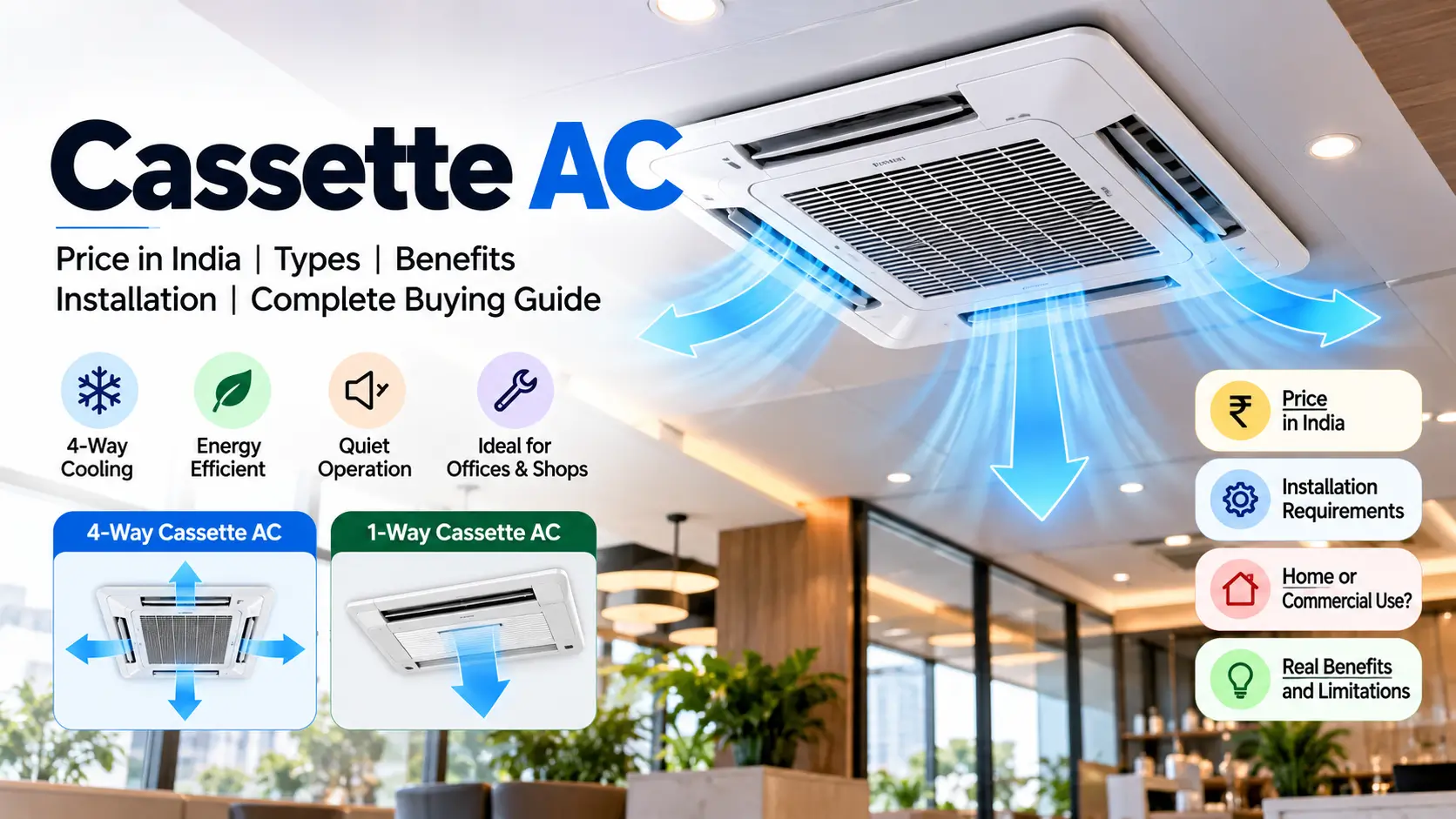
A cassette AC is an air-conditioning system designed to sit in or against a ceiling, with the indoor unit distributing conditioned air across the room rather than blowing it primarily from one wall.
That design makes cassette air conditioners particularly useful in offices, shops, restaurants, clinics, showrooms, hotels and other open spaces. They can also work in some homes, but only when the ceiling and installation conditions are suitable.
Unlike a conventional wall-mounted split AC, a cassette system changes the way air enters the room. A four-way model can discharge air in multiple directions, helping spread cooling more evenly across an open area. Manufacturers such as Daikin, LG, Panasonic, Blue Star and Carrier currently offer cassette systems in India, with configurations ranging from compact 1-way units to larger multi-directional commercial systems.
But there is an important catch: a cassette AC is not automatically a better AC than a split AC.
The right choice depends on the room, ceiling, cooling load, operating hours, installation budget and how evenly you need air distributed.
What is a cassette AC?
A cassette AC is essentially a ceiling-mounted air-conditioning system in which the indoor unit is installed within the ceiling space or integrated with a false ceiling.
The visible part is usually a relatively flat ceiling panel. Depending on the model, air can be discharged through one, four or other airflow configurations.
A typical four-way cassette sends conditioned air toward different sides of the room. This is particularly useful in relatively open layouts where a wall-mounted split AC could leave parts of the room farther from the air outlet.
The basic system still has the familiar air-conditioning components:
- Indoor evaporator unit
- Outdoor condensing unit
- Compressor
- Refrigerant piping
- Drainage system
- Electrical connections
- Air filter
- Controller or remote
The major difference is where the indoor unit is installed and how it distributes air.
For example, Blue Star describes its cassette systems as ceiling-mounted units designed for offices, retail outlets, premium residential spaces and other commercial environments, while Carrier positions its four-way inverter cassette systems for light-commercial applications such as retail stores, offices and hotels.
How does a cassette AC work?
The cooling cycle is broadly similar to other split-type air conditioners.
The indoor unit draws warm room air, passes it over the evaporator coil and returns cooled air to the room. Refrigerant carries heat from the indoor unit to the outdoor unit, where the heat is rejected.
What changes is the air distribution strategy.
With a wall-mounted split AC:
Indoor unit → mostly forward/downward airflow → room
With a four-way cassette:
Ceiling-mounted indoor unit → multiple airflow directions → room
That difference becomes important in large or open spaces.
A cassette unit positioned reasonably centrally can distribute air toward several sections of the room. Some current models also provide independent louvre control, adjustable swing modes and high-ceiling operating modes.
1-way vs 4-way cassette AC
Not every cassette AC blows air in four directions.
1-way cassette AC
A 1-way cassette directs air predominantly toward one side.
This can make sense when the unit is installed close to a wall or at the edge of a room.
It can also be useful when the building layout makes four-direction airflow unnecessary.
Current 1-way products from LG and Carrier are designed around more focused airflow and slimmer ceiling installation requirements. Carrier, for example, lists a 1-way inverter cassette with a low ceiling-space requirement of about 132 mm for its specified model.
4-way cassette AC
A 4-way cassette distributes air in multiple directions simultaneously.
This is the more familiar cassette configuration and is particularly useful for:
- Open offices
- Retail shops
- Restaurants
- Showrooms
- Conference rooms
- Clinics
- Hospitality spaces
Blue Star’s current four-way cassette range, for example, spans 1.5TR, 2TR, 3TR and 4TR configurations.
Which is better?
Neither is universally better.
A 4-way cassette is generally more suitable when the room benefits from multidirectional cooling.
A 1-way model can be more appropriate where the unit has to sit toward one side of the room or where the ceiling structure is restrictive.
What does 360-degree airflow mean?
You will often see manufacturers describe cassette ACs using terms such as 360-degree airflow.
This should not be interpreted as the AC literally throwing an identical stream of air in every possible direction.
In practical terms, it refers to the ability of a suitable ceiling cassette design to distribute air around the unit through multiple outlets.
Blue Star describes its four-way systems as providing 360-degree airflow, while Daikin offers cassette systems using different multi-air-swing and radial airflow designs.
The real benefit is more uniform air distribution, provided the unit is correctly positioned and sized for the space.
Cassette AC price in India
There is no single standard price for a cassette AC because the category covers a wide range of capacities, efficiency levels, brands and commercial configurations.
As a current market reference, a 2-ton Godrej cassette AC listing was around ₹73,999 in September 2026, while current market listings and dealer prices for 2-ton cassette systems can vary substantially by brand and configuration.
A current 2-ton Blue Star dealer listing in the Punjab/Mohali market, for example, shows a price around ₹85,000, illustrating why buyers should not treat a single online price as the universal market price.
The final project cost can also be considerably higher than the equipment price because installation may involve:
- False-ceiling modification
- Refrigerant piping
- Drain piping
- Electrical work
- Supports/hangers
- Condensate pump requirements
- Ceiling access
- Outdoor-unit installation
- Additional copper piping
- Civil or interior work
The correct way to compare cassette AC prices is therefore to compare the complete installed system, not just the indoor/outdoor unit price.
Why cassette AC installation is different
This is probably the most important thing buyers overlook.
A cassette AC is not simply mounted on a wall.
The indoor unit needs to be properly supported above or within the ceiling, while refrigerant pipes and condensate drainage need to be routed correctly.
The ceiling also needs enough space for the particular indoor unit.
For example, one current 2TR LG cassette specification lists an indoor-unit body measuring 840 × 246 × 840 mm, with a 950 × 25 mm panel. A 1.5TR LG model has a different body height, demonstrating why the actual model’s installation dimensions must be checked before construction work begins.
This means you should involve the AC installer before finalising the false ceiling.
The service-access issue
A hidden indoor unit still needs servicing.
Filters, drainage components, electrical connections and other components must remain accessible.
Modern designs can make maintenance easier. LG, for example, describes detachable panels and an auto-elevation grille on selected systems to simplify filter cleaning and service access.
A beautiful false ceiling is not useful if the technician has to dismantle a large section of it every time the AC requires service.
What about water drainage?
Every air conditioner that cools humid air produces condensate.
With a cassette AC, that water has to be removed safely from the ceiling-mounted indoor unit.
Some models use an integrated drain pump.
Blue Star’s current four-way cassette range includes an in-built drain pump, while Carrier also specifies condensate-pump systems on its cassette products.
This matters because poor drainage can result in water leakage around the ceiling.
When getting quotations, ask the installer:
- Where will the condensate water go?
- Is a drain pump required?
- Where will the inspection/access point be?
- How will the drainage line be supported?
- What happens if the drain gets blocked?
These questions can prevent expensive ceiling damage later.
How much cooling capacity do you need?
Cassette ACs are commonly described using TR, or ton of refrigeration.
You may encounter models such as:
- 1.5TR
- 2TR
- 3TR
- 4TR
But choosing capacity purely by floor area is risky.
The actual cooling load also depends on:
- Ceiling height
- Number of occupants
- Windows and glass area
- Sun exposure
- Lighting
- Computers and equipment
- Kitchen or cooking heat
- Door opening frequency
- Insulation
- Building orientation
- Local climate
- Operating hours
A 300-square-foot office with several computers and large west-facing windows can have a very different cooling requirement from a 300-square-foot shaded room.
A practical rule
Use floor area as a starting point, not as the final calculation.
For a commercial installation, ask the installer or HVAC professional for a cooling-load assessment before selecting the capacity.
Over-sizing is not automatically better. An excessively large system can increase upfront cost and may not operate in the manner you expect.
Under-sizing can cause the AC to run continuously while struggling to maintain the desired temperature.
Cassette AC vs split AC
| Factor | Cassette AC | Wall-mounted split AC |
|---|---|---|
| Indoor unit location | Ceiling | Wall |
| Air distribution | Multi-directional on many models | Primarily one direction |
| False ceiling | Usually important/required for concealed installation | Not required |
| Wall space | Frees wall space | Uses wall space |
| Large open areas | Often well suited | May need multiple units |
| Installation complexity | Higher | Generally simpler |
| Maintenance access | Requires planning | Usually easier |
| Appearance | Very discreet | More visible |
| Typical applications | Offices, shops, restaurants, showrooms | Homes, bedrooms, smaller rooms |
| Upfront project cost | Often higher | Usually lower |
The comparison is not really about one technology being universally superior.
It is about matching the air-distribution method to the building.
If you have a normal bedroom with no false ceiling, a cassette AC may add unnecessary complexity.
If you have an open showroom with a large unobstructed ceiling, the cassette approach can make much more sense.
Advantages of cassette AC
1. Better use of ceiling space
The indoor unit does not occupy a wall.
That can be useful in shops where wall space is needed for displays, branding or furniture.
2. More even airflow
A properly positioned four-way cassette can distribute air across several directions.
3. Cleaner interior appearance
Only the ceiling panel is prominently visible.
This is one reason cassette systems are popular in modern commercial interiors.
4. Suitable for open spaces
Offices, restaurants and showrooms can benefit from the airflow pattern.
5. Multiple capacity options
Current Indian ranges include systems from approximately 1.5TR to 4TR and beyond depending on manufacturer and product family.
6. Inverter options are widely available
Modern inverter cassette ACs can vary compressor operation according to cooling demand rather than relying only on repeated full-power on/off cycles.
Blue Star, Carrier, LG and Panasonic all currently offer inverter cassette configurations in India.
Disadvantages of cassette AC
1. Higher installation complexity
This is the biggest disadvantage.
Ceiling work, drainage and service access need to be planned properly.
2. Higher total project cost
Even if the AC’s sticker price appears reasonable, installation and ceiling work can change the final cost.
3. False-ceiling dependency
Many four-way cassette installations require suitable ceiling space.
4. Maintenance needs planning
The unit is overhead, so service access matters.
5. Not ideal for every room
A small bedroom does not necessarily benefit from a commercial-style ceiling system.
6. Incorrect positioning can reduce the benefit
The fact that a cassette has four outlets does not guarantee uniform cooling.
Furniture, partitions, ceiling height and room geometry can interfere with airflow.
Does a cassette AC consume more electricity?
There is no simple answer that applies to every cassette AC.
Electricity consumption depends on:
- Cooling capacity
- Inverter or fixed-speed operation
- ISEER/efficiency
- Outdoor temperature
- Indoor heat load
- Set temperature
- Operating hours
- Maintenance
- Room insulation
- Occupancy
India’s Bureau of Energy Efficiency includes RAC cassette, floor-standing tower, ceiling and corner ACs in its standards-and-labeling framework. BEE uses ISEER as an important efficiency measure for applicable air conditioners.
This means buyers should not compare ACs merely by saying “2-ton AC versus 2-ton AC.”
Look at the actual model’s:
- BEE star rating
- ISEER
- Rated power input
- Cooling capacity
- Operating range
For example, Panasonic’s current 18,000-BTU-class cassette specification lists an ISEER of 4.20 and a rated power input of 1,625W for that particular model. That figure applies to that model and should not be generalized to every cassette AC.
Should you buy an inverter cassette AC?
For spaces that run AC for long periods, an inverter model deserves serious consideration.
An inverter compressor can vary its operating speed according to cooling demand.
This can help avoid the repeated full-on/full-off behaviour associated with conventional fixed-speed systems.
For example, current Blue Star four-way inverter cassettes use inverter compressor technology and Carrier’s current four-way inverter range specifies inverter operation and ISEER values up to 4.32 on its stated model range.
However, never assume “inverter” automatically means the lowest electricity bill.
Actual consumption depends on the entire system and the building.
Which rooms are best for a cassette AC?
Offices
A strong use case because employees can occupy different parts of an open floor.
Retail shops and showrooms
The ceiling installation keeps display walls relatively free.
Restaurants
A ceiling-mounted system can distribute cooling without taking up valuable wall space.
Clinics
The unobtrusive ceiling design can work well where wall space is limited.
Hotels and hospitality
Premium interiors often benefit from concealed or discreet HVAC installations.
Large residential rooms
Possible, but only when the ceiling and room layout justify the installation.
Manufacturers explicitly market current cassette systems across offices, retail, restaurants, hospitality and selected residential environments.
Is a cassette AC good for home?
Sometimes—but not automatically.
For a conventional bedroom, a wall-mounted split AC is usually the simpler solution.
A cassette AC becomes more interesting for a home when you have:
- A large living room
- An open-plan floor
- A suitable false ceiling
- A need to keep walls free
- Aesthetic reasons for ceiling integration
- A relatively large cooling load
If the room is small and the ceiling is low, installing a cassette system may create more complexity than benefit.
What should you check before buying?
Use this checklist before paying an advance.
Ceiling checklist
- Is there enough ceiling depth?
- Is the false ceiling strong enough?
- Is there enough service access?
- Can the indoor unit be positioned centrally?
- Where will the drain line go?
AC checklist
- Cooling capacity
- Inverter or fixed speed
- BEE star rating
- ISEER
- Refrigerant
- Airflow pattern
- Indoor noise
- Operating temperature range
- Warranty
- Service network
Installation checklist
- Copper-pipe length included?
- Drain-pump installation included?
- Drain pipe included?
- Electrical work included?
- Outdoor stand included?
- False-ceiling work included?
- Additional refrigerant cost?
- Core drilling or civil work?
- Service access panel?
- Installation warranty?
The last group can significantly change your final bill.
What are some leading cassette AC brands in India?
There is no single brand that is best for every project.
Major manufacturers with current Indian cassette offerings include:
The important point is not to select a brand first and capacity second.
Select the required cooling capacity and installation configuration first, then compare suitable models from brands with good service availability in your area.
Cassette AC buying decision: a simple framework
Choose a cassette AC when:
You have a large/open space + suitable ceiling + need multidirectional cooling.
Choose a 1-way cassette when:
You need ceiling integration but the airflow should be directed primarily toward one side.
Choose a conventional split AC when:
You have a normal bedroom or small room and want simpler installation and maintenance.
Consider a VRF system when:
You are planning multiple indoor units across a larger commercial building and need centralized HVAC control.
A cassette indoor unit can also be part of a VRF system rather than an independent split arrangement. Carrier’s current VRF systems, for example, can connect cassette and other indoor-unit types to a common outdoor system.
Final verdict: Is a cassette AC worth it?
A cassette AC is worth considering when air distribution and interior layout matter as much as raw cooling capacity.
Its biggest advantage is not simply that it can cool strongly. The real advantage is that the indoor unit can disappear into the ceiling while distributing conditioned air across a wider area.
That makes it particularly attractive for offices, restaurants, showrooms, clinics, hotels and large open rooms.
But it is also more installation-dependent than a conventional split AC.
If you are installing one, do not begin by asking:
“Which is the best cassette AC?”
Start with:
“What is my actual cooling load, what ceiling space do I have, where will the drainage go, and how will the unit be serviced?”
Once those questions are answered, choosing between a 1-way or 4-way configuration, inverter technology, capacity and brands becomes much easier.
For most ordinary bedrooms, a split AC remains the simpler solution. For an open commercial space where wall-mounted units would create uneven cooling or interfere with the interior, a properly designed cassette system can be a much better fit.
FAQ
What is a cassette AC?
A cassette AC is a ceiling-mounted air-conditioning system in which the indoor unit is installed in or against the ceiling and distributes conditioned air through one or more outlets.
Is cassette AC better than split AC?
Not universally. Cassette ACs are better suited to open spaces where multidirectional airflow and ceiling installation are useful. For ordinary bedrooms and smaller rooms, a wall-mounted split AC is often simpler.
What is a 4-way cassette AC?
A 4-way cassette AC distributes conditioned air through multiple directions from a ceiling-mounted indoor unit. It is commonly used in offices, shops, restaurants, showrooms and other open spaces.
What is the price of a 2-ton cassette AC in India?
Current 2026 listings show substantial variation. Examples include roughly ₹69,000–₹85,000 for some 2-ton models, but the actual equipment price depends on brand, efficiency, configuration, seller and availability. Installation can add considerably to the project cost.
Can a cassette AC be installed at home?
Yes, provided the room and ceiling are suitable. Large living rooms and open-plan spaces are more natural candidates than small bedrooms.
Does a cassette AC need a false ceiling?
Many cassette installations are designed to sit within ceiling space, particularly conventional four-way systems. However, exact installation requirements vary by model, so the manufacturer’s installation dimensions should be checked before constructing the ceiling.
Is cassette AC expensive to maintain?
Maintenance can be more installation-dependent than with a wall-mounted split AC because the indoor unit is overhead. Proper service access and drainage planning can make routine maintenance much easier.
Is inverter cassette AC better?
For spaces that operate the AC for long periods, an inverter cassette can be attractive because its compressor can vary output with cooling demand. But actual electricity consumption depends on the specific model and building conditions, so compare ISEER, rated power and real operating requirements rather than relying on the word “inverter” alone.