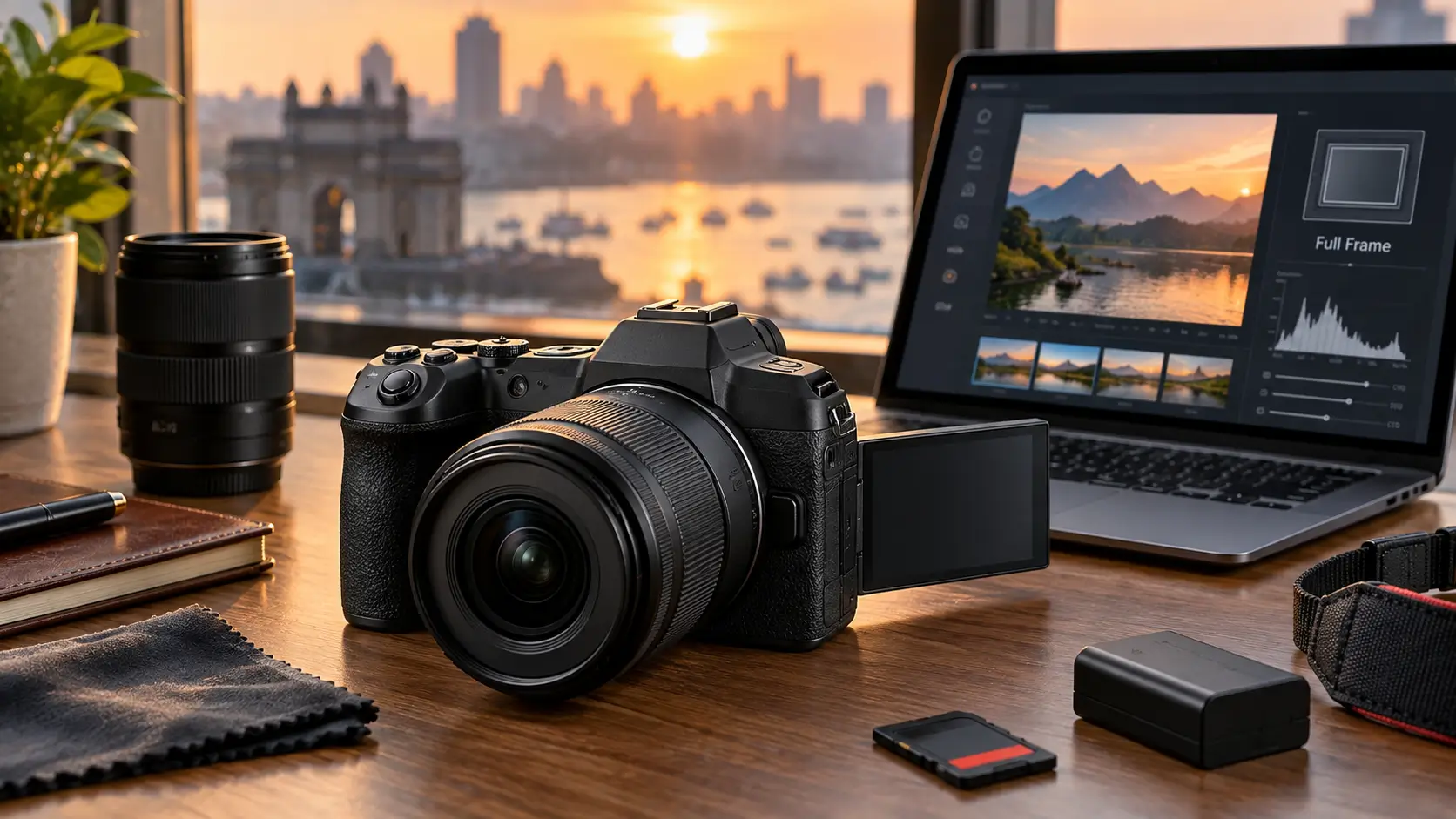
The Canon EOS R8 remains available in India in 2026, but the buying decision has changed after Canon introduced the newer EOS R8 Mark II.
The original EOS R8 is a compact full-frame mirrorless camera with a 24.2MP sensor, DIGIC X processor, Dual Pixel CMOS AF II autofocus, up to 40fps electronic-shutter shooting and 6K-oversampled 4K 60p video. Its lightweight 461g body is one of its biggest advantages.
As of September 17, 2026, Canon India lists the EOS R8 body at ₹1,14,990, compared with an MRP of ₹1,42,995. The camera remains an interesting option for photographers and creators who want a lightweight full-frame body without moving into Canon’s more expensive R6 series.
However, the EOS R8 has one important limitation: it does not have in-body image stabilization. That matters more now because the newly launched EOS R8 Mark II adds 5-axis IBIS and other improvements.
Quick answer
The Canon EOS R8 is a lightweight 24.2MP full-frame mirrorless camera designed for photographers and creators who want strong autofocus, fast burst shooting and capable 4K video without carrying a larger body.
Its biggest strengths are its low weight, full-frame sensor, autofocus system, 40fps electronic shooting and 4K 60p video.
Its main compromises are the lack of in-body stabilization, relatively small battery and single memory-card slot.
For buyers in 2026, the current price is the key factor. If the original R8 is available at a substantial discount, it can still make sense. If the price difference with newer alternatives becomes smaller, the EOS R8 Mark II deserves closer consideration.
Canon EOS R8 price in India
Canon India currently lists the EOS R8 body at ₹1,14,990, including taxes.
The listed MRP is ₹1,42,995.
Prices can change, particularly during retailer promotions and camera-industry sales, so buyers should check the current price immediately before purchasing.
The RF 24-50mm F4.5-6.3 IS STM is also designed as a compact starter lens for Canon’s full-frame RF system. Canon India lists the lens separately with an MRP of ₹31,995.
Canon EOS R8 specifications
| Feature | Canon EOS R8 |
|---|---|
| Sensor | 24.2MP full-frame CMOS |
| Processor | DIGIC X |
| Autofocus | Dual Pixel CMOS AF II |
| Electronic burst | Up to 40fps |
| Video | 4K 60p, 6K oversampled |
| Slow motion | Full HD up to 180p |
| Log recording | Canon Log 3 |
| EVF | 2.36-million-dot OLED |
| Screen | 3-inch vari-angle touchscreen |
| Memory | Single UHS-II SD card |
| Stabilization | No IBIS |
| Connectivity | Wi-Fi, Bluetooth, USB-C |
| Battery | LP-E17 |
| Weight | Approx. 461g |
| Lens mount | Canon RF |
24.2MP full-frame sensor
The EOS R8 uses a 24.2MP full-frame CMOS sensor.
For many photographers, 24.2MP is a practical resolution rather than a limitation. It provides enough detail for everyday photography, portraits, travel, events and many professional workflows without producing excessively large files.
The full-frame format also gives photographers a different field of view and depth-of-field relationship compared with APS-C cameras using the same focal length.
For someone moving from an APS-C camera to full frame, this is one of the most important reasons to consider the R8.
Lightweight design is a major advantage
One of the most distinctive characteristics of the EOS R8 is its weight.
Canon lists the camera at approximately 461g, including the battery and memory card.
That makes the R8 particularly interesting for travel photographers and creators who want full-frame image quality without carrying a heavier professional body.
The trade-off is that the lighter body comes with fewer physical controls and less stabilization capability than some more expensive Canon cameras.
Autofocus and 40fps shooting
The EOS R8 uses Canon’s Dual Pixel CMOS AF II system and provides subject-detection capabilities for people, animals and vehicles.
Its headline shooting figure is up to 40fps with the electronic shutter.
That number sounds more relevant to sports and wildlife photographers than everyday users, but fast electronic shooting can also be useful for capturing unpredictable movement, children, pets and events.
However, a high maximum burst rate does not automatically make the camera a professional sports body. Storage speed, rolling-shutter behaviour, battery capacity, autofocus conditions and lens choice all matter.
4K video is one of its strongest features
The EOS R8 can record 4K video at up to 60p using a 6K oversampling process.
It also supports Full HD recording at up to 180p and Canon Log 3.
That makes the R8 more than a still-photography camera. It can serve creators who need both photographs and video.
The camera also includes microphone and headphone connections, which are important for creators who want to monitor or improve their audio setup.
The biggest limitation: no IBIS
The most important compromise is the absence of in-body image stabilization.
The camera can use optical stabilization provided by compatible lenses and electronic stabilization for video, but the sensor itself is not stabilized.
This is particularly relevant when shooting handheld with non-stabilized lenses or in low-light conditions.
The issue becomes even more obvious when comparing the original R8 with the new R8 Mark II, because Canon has added five-axis in-body stabilization to the newer model.
For buyers who frequently shoot handheld video, low-light scenes or stabilized still photography, this difference deserves serious consideration.
Battery and storage
The EOS R8 uses the LP-E17 battery and has a single SD memory-card slot.
The small battery is one of the compromises associated with the camera’s compact body.
Photographers planning long events, travel days or extensive video sessions should therefore budget for spare batteries or suitable power-management options.
The single-card design is also worth considering for professional event photographers who prefer automatic backup recording to two cards.
Canon EOS R8 vs EOS R8 Mark II
The biggest 2026 question is whether the original R8 remains attractive after the Mark II launch.
| Feature | EOS R8 | EOS R8 Mark II |
|---|---|---|
| Sensor | 24.2MP full frame | 24.2MP full frame |
| IBIS | No | Yes |
| Electronic burst | Up to 40fps | Up to 40fps |
| Pre-continuous shooting | No | Yes |
| Autofocus | Dual Pixel CMOS AF II | Updated Dual Pixel CMOS AF II system |
| Video | 4K 60p | 4K 60p |
| Weight | Approx. 461g | Approx. 546g |
| Battery | LP-E17 | LP-E17 |
| Card slots | 1 SD | 1 SD |
| India body price | ₹1,14,990 listed by Canon India | ₹1,78,995 launch price |
The most significant difference is therefore not resolution or maximum burst rate.
It is the additional stabilization, newer controls and updated features in the Mark II.
The original R8 is also substantially cheaper at Canon India’s current listed price.
Who should consider the Canon EOS R8?
The EOS R8 makes the most sense for buyers who prioritize:
- a lightweight full-frame body
- Canon’s RF lens ecosystem
- strong autofocus
- 24.2MP resolution
- 4K 60p video
- fast electronic shooting
- travel-friendly dimensions
- a lower purchase price than newer full-frame Canon models
It can also make sense for photographers who already own compatible RF lenses and want an affordable full-frame body.
Who should think twice?
The EOS R8 deserves more caution if you:
- frequently shoot handheld video
- rely heavily on stabilization
- photograph long events
- need dual memory-card recording
- want extensive physical controls
- expect professional-body ergonomics
- are comparing it with the latest generation of full-frame cameras
The lack of IBIS is particularly important.
Is the Canon EOS R8 still worth buying in 2026?
The answer depends heavily on the actual purchase price.
At Canon India’s current listed body price of ₹1,14,990, the original R8 occupies a substantially lower price position than the newly launched R8 Mark II.
That makes the older camera easier to justify for buyers who value its compact full-frame design and do not need sensor stabilization.
The R8 Mark II, meanwhile, adds 5-axis IBIS, pre-continuous shooting and updated controls. Its Indian launch price is ₹1,78,995 for the body.
Therefore, buyers should not compare the two cameras solely on megapixels. Both use 24.2MP full-frame sensors and both can shoot up to 40fps electronically.
The more useful question is whether the newer camera’s additional features are worth the higher price for your particular photography or video workflow.
What about the RF 24-50mm lens?
The RF 24-50mm F4.5-6.3 IS STM is a compact full-frame zoom designed for the RF system.
It covers a useful everyday range from wide-angle 24mm to short telephoto 50mm.
Canon lists up to seven stops of image stabilization for the lens when paired with a compatible camera.
That makes the lens particularly relevant to the original R8 because the camera itself does not have IBIS.
The relatively slow f/4.5-6.3 aperture is its main trade-off. Buyers interested in stronger low-light performance or more pronounced background blur may eventually want a faster RF lens.
Bottom line
The Canon EOS R8 remains a capable full-frame mirrorless camera in 2026.
Its 24.2MP sensor, strong autofocus, 40fps electronic shooting and 4K 60p video still provide a useful combination, while its approximately 461g weight makes it particularly appealing for travel and everyday photography.
The main issue is timing.
Canon has now launched the EOS R8 Mark II, which adds in-body stabilization and other improvements. That makes the original R8 most interesting when its lower price creates a meaningful gap.
For buyers who want a lightweight full-frame Canon and can take advantage of the current lower price, the R8 remains relevant. Buyers who place a high value on IBIS, newer controls and additional features should compare the newer R8 Mark II before purchasing.
The important point is that the EOS R8 has not suddenly become obsolete. Instead, its value in 2026 depends much more heavily on price versus features than it did when the camera first launched.
FAQ
What is the Canon EOS R8 price in India in 2026?
Canon India currently lists the EOS R8 body at ₹1,14,990, while its listed MRP is ₹1,42,995. Prices can change.
Is the Canon EOS R8 a full-frame camera?
Yes. The EOS R8 uses a 24.2MP full-frame CMOS sensor.
Does the Canon EOS R8 have IBIS?
No. The original EOS R8 does not have in-body image stabilization. It can use compatible lens stabilization and digital movie stabilization.
Can the Canon EOS R8 shoot 40fps?
Yes. Canon specifies up to 40fps continuous shooting using the electronic shutter under supported conditions.
Can the Canon EOS R8 record 4K 60p?
Yes. It can record 4K 60p using 6K oversampling.
Is Canon EOS R8 still worth buying in 2026?
It can be relevant for buyers prioritizing a lightweight full-frame body and lower price, but the newly launched EOS R8 Mark II adds IBIS and other improvements. The decision should therefore be based on the actual price difference and required features.
What is the Canon EOS R8 Mark II price in India?
The EOS R8 Mark II launched in India at ₹1,78,995 for the body, according to current Indian launch reports.
DISCLAIMER
Product disclaimer: Prices, availability, specifications, promotions and warranty offers can change. Verify the current price and terms with Canon India or an authorized retailer before purchasing.