Buying an electric car in India with a budget of ₹10 lakh is possible, but choosing the right model requires more than comparing starting prices. You need to consider the exact variant, driving range, charging options, seating space and the total amount you will pay after registration, insurance and other charges.
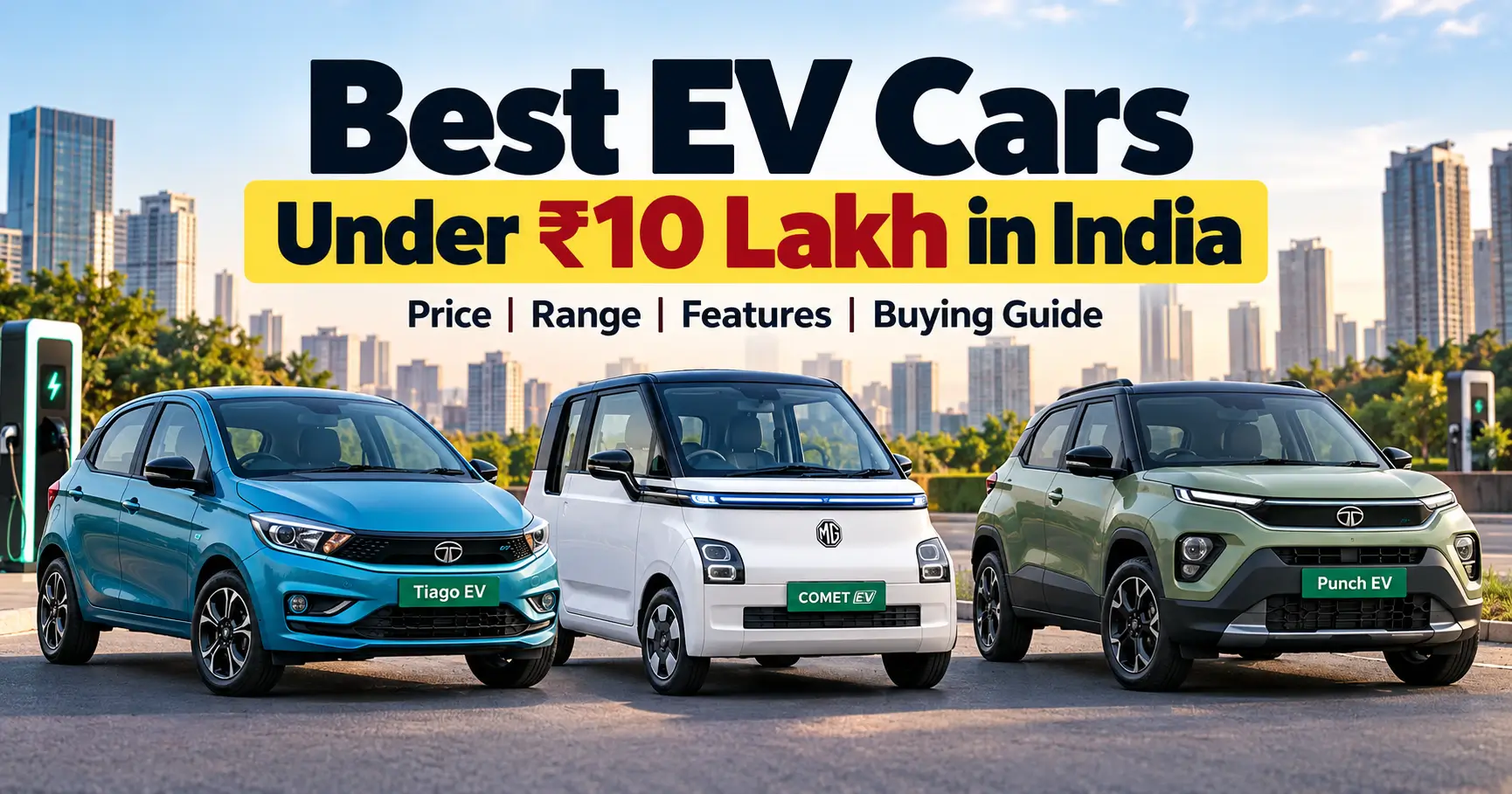
The Tata Tiago EV and MG Comet EV are two of the main electric cars to consider in this price range. Some entry-level variants of other electric cars may also qualify, depending on current pricing and offers. However, not every variant of an eligible model will cost less than ₹10 lakh.
If you want a conventional hatchback for everyday use, start by comparing the Tiago EV with the Comet EV. If you prefer an SUV-style vehicle, check whether the specific entry-level variant you want fits your budget.
Best EV Cars Under ₹10 Lakh in India
The following shortlist focuses on the models most relevant to budget-conscious buyers. Prices and eligibility should be confirmed for the exact variant and city before booking.
| Electric car | Best suited for | What to consider |
|---|---|---|
| Tata Tiago EV | Everyday commuting and small-family use | Variant-wise range, charging and on-road price |
| MG Comet EV | Compact city driving and easy parking | Four-seat layout, boot space and charging limitations |
| Tata Punch EV, entry variant if eligible | Buyers who prefer an SUV-style electric car | Current entry-variant price and total on-road cost |
The Tiago EV and Comet EV are established options in this category. The Punch EV should be included only when its specific variant meets the chosen price limit. Automotive listings show that its broader price range extends beyond ₹10 lakh.
1. Tata Tiago EV: A Practical Electric Hatchback
The Tata Tiago EV is worth considering if you want an electric car that feels closer to a conventional family hatchback. Its five-seat layout makes it more versatile than a smaller four-seat city car for buyers who regularly travel with family members.
Tata’s official website provides a location-based price tool, which buyers can use to check the relevant configuration and pricing details. The manufacturer’s indexed listing has shown an introductory price point of ₹6.99 lakh, although the final price depends on the current model, variant and applicable charges.
What makes the Tiago EV worth considering?
- A conventional hatchback body style.
- Five-seat capacity.
- A choice of configurations, subject to current availability.
- Potential suitability for daily commuting and routine family journeys.
What should you check before buying?
Do not assume that every Tiago EV variant falls below ₹10 lakh. Compare the battery configuration, claimed range, charging equipment and included features of the exact variant you intend to purchase.
Ask the dealer whether the quoted price includes any current offers and request a written on-road quotation. If you plan to travel beyond the city, confirm the charging options available on your preferred variant.
Who should consider it? Buyers looking for a versatile electric hatchback for commuting, errands and regular family use.
2. MG Comet EV: A Compact Electric Car for City Driving
The MG Comet EV takes a different approach. It is a compact, four-seat electric car designed around urban mobility, manoeuvrability and convenient parking.
According to MG Motor India’s official model page, the Comet EV has a claimed ARAI-certified range of 230 km and a 17.4 kWh battery. The manufacturer also states that the vehicle does not support DC fast charging. These specifications should be checked against the current brochure and variant before purchase. Source: MG Motor India.
What makes the Comet EV worth considering?
- A compact footprint for crowded city streets.
- Four-seat configuration.
- A claimed range suitable for evaluating short and predictable daily journeys.
- Connected-car and infotainment features on selected variants.
What are its limitations?
The Comet EV’s small size is useful in the city, but it may not suit every family. Check rear-seat access, passenger comfort and luggage capacity in person.
Its lack of DC fast charging is particularly important if you expect to make frequent long-distance journeys. Before buying, establish whether your usual routes and charging arrangements are compatible with AC charging.
Who should consider it? Urban commuters, couples and households seeking a compact electric car for regular city travel.
3. Tata Punch EV: Check the Entry Variant
The Tata Punch EV is an option for buyers who prefer an SUV-style body and a higher seating position. However, it should not automatically be described as an electric car available entirely under ₹10 lakh.
Current automotive listings show a wider Punch EV price range, including variants above this budget. Source: Autocar India.
Before including it in your shortlist, ask an authorised dealer for the current entry-variant price in your city. Check the battery configuration, claimed range, standard equipment and final on-road price.
A model that starts near your budget may exceed it once you select a different battery, a higher trim or optional equipment.
Who should consider it? Buyers who prefer an SUV-style EV and are willing to compare the entry-level configuration carefully.
Tata Tiago EV vs MG Comet EV: Which Is Better?
These two cars address different needs. The better choice depends on how many people you carry, where you drive and how you plan to recharge.
| Buying consideration | Tata Tiago EV | MG Comet EV |
|---|---|---|
| Body style | Conventional hatchback | Compact city car |
| Seating | Five | Four |
| Main appeal | Everyday versatility | Urban manoeuvrability |
| Charging | Check the selected variant’s equipment | AC charging; no DC fast charging according to MG |
| Best use case | Commuting and routine family journeys | Short, predictable city journeys |
| Main trade-off | Variant price and range must be checked | Space and long-distance charging limitations |
Specifications and equipment can vary by variant and model year. Verify them using the manufacturers’ latest documentation before making a final comparison.
Which one should you choose?
Choose the Tiago EV if you need five seats and want a more conventional hatchback format. Consider the Comet EV if you usually travel alone or with one or two other people and value compact dimensions for city use.
Neither choice is universally better. Your typical journey, charging access and passenger requirements matter more than a single specification.
What Does ₹10 Lakh Actually Buy?
One of the most common mistakes when comparing electric cars is treating an advertised ex-showroom price as the final purchase cost.
The ex-showroom price generally excludes expenses such as registration-related charges and insurance. Depending on the city, applicable taxes, offers and selected configuration, the on-road amount can be higher.
Before booking, request a written quotation containing:
- Ex-showroom price of the exact variant.
- Registration and applicable statutory charges.
- Insurance premium and coverage.
- Charger and installation costs, where applicable.
- Accessories or other optional items.
- Discounts, eligibility conditions and offer expiry dates.
- Final on-road amount.
If ₹10 lakh is your absolute limit, do not choose a car solely because its advertised starting price appears comfortably below the budget.
Understand Battery-as-a-Service Before Choosing an EV
Some EV offers use a Battery-as-a-Service (BaaS) arrangement. Under this model, the initial vehicle price can be lower because battery use is charged separately, often on a per-kilometre basis.
MG Motor India’s Comet EV page has advertised a BaaS option starting at ₹4.99 lakh, plus ₹3.20 per kilometre, subject to the manufacturer’s terms. The conventional vehicle price and BaaS price are not directly comparable without accounting for the battery-use charge. Source: MG Motor India.
For example, at a hypothetical 1,000 km of driving per month, a charge of ₹3.20 per kilometre would equal ₹3,200 per month, or ₹38,400 over 12 months. This is an arithmetic illustration, not a complete ownership-cost estimate.
Before selecting BaaS, check the contractual terms, minimum commitments if any, applicable fees, battery coverage and the cost at your expected annual mileage. Compare the arrangement with the conventional purchase price over the period you expect to own the car.
How Much Does It Cost to Run an Electric Car?
Electricity can cost less than petrol per kilometre, but the actual saving depends on energy consumption, charging tariffs, charging losses and how much you drive.
A useful starting calculation is:
Home-charging cost per kilometre = electricity cost per kWh × electricity consumed per kilometre.
For example, if an EV consumes 0.15 kWh per kilometre and your effective electricity rate is ₹8 per kWh, the estimated electricity cost is ₹1.20 per kilometre. This is an illustrative calculation; actual consumption and tariffs vary.
Your total ownership cost should also account for insurance, tyres, servicing, financing, charging installation and any battery-use charges.
Do not compare electricity cost alone with petrol cost and assume that it represents the entire saving.
What to Check Before Buying an Electric Car
1. Your daily driving distance
Estimate how many kilometres you travel on an ordinary day and how often you make longer journeys. A car with sufficient range for your daily commute may not be suitable for frequent highway trips.
2. Home-charging access
Check whether you can install a compatible charger safely at your parking location. Apartment residents should confirm permission, electrical capacity and installation arrangements before committing to an EV.
3. Real-world driving range
Manufacturer-claimed range is not a guarantee of the distance you will achieve in every situation. Air-conditioning, traffic, speed, load, weather and driving style can affect consumption.
Keep a practical buffer instead of planning every journey around the maximum claimed range.
4. Charging compatibility
Confirm the connector, charging power, charging time and available equipment for your chosen variant. Do not assume that every EV supports DC fast charging.
5. Battery warranty
Read the warranty terms carefully. Check the coverage period, kilometre limit, exclusions, ownership conditions and the procedure for handling battery-related issues.
6. Service and support
Find the authorised service centre closest to your home and check whether it supports the exact EV model. Also investigate roadside assistance and the availability of public charging on routes you regularly use.
7. A proper test drive
Test the vehicle with the number of passengers you normally carry. Check visibility, seat comfort, boot space, braking, ride comfort and ease of entry and exit.
Frequently Asked Questions
Which is the best EV car under ₹10 lakh in India?
The Tata Tiago EV is a strong starting point for buyers who need a conventional five-seat electric hatchback. The MG Comet EV is worth considering for compact city driving. The right choice depends on the current variant price, charging needs, passenger requirements and final on-road budget.
Is there an electric car under ₹10 lakh for a family?
The Tata Tiago EV is worth evaluating because it has five seats and a conventional hatchback format. Check passenger comfort, luggage capacity and the final price of the selected variant before buying.
Is the MG Comet EV suitable for highway driving?
It can be used for journeys that fit its range and charging limitations, but its compact size and lack of DC fast charging make it less convenient for frequent long-distance travel. Plan the route and charging stops carefully.
Is the advertised EV range the same as real-world range?
No. The claimed figure is obtained under a specified testing procedure. Real-world range varies with driving conditions, speed, air-conditioning use, load, temperature and driving style.
Does an electric car cost less to maintain?
An EV does not need conventional engine oil changes, but it still requires maintenance. Tyres, brakes, suspension, air-conditioning, software-related checks and other components may require servicing. Actual costs vary by vehicle and usage.
Should I choose a BaaS electric car?
BaaS can lower the initial purchase price, but it adds a separate battery-use cost. Compare the complete cost over your expected ownership period rather than choosing the lowest advertised starting price.
What should I do before booking an EV?
Obtain a written on-road quotation, check the current variant specifications and warranty, arrange a test drive, confirm charging access and calculate the total cost of ownership.
Final Verdict
For a budget of ₹10 lakh, start with the Tata Tiago EV if you need a versatile five-seat electric hatchback. Consider the MG Comet EV if your journeys are mainly within the city and you value compact dimensions. If you prefer an SUV-style electric car, check the exact entry-level Tata Punch EV variant and its current on-road price.
The smartest purchase is not necessarily the EV with the lowest advertised price or the highest claimed range. It is the car that fits your budget after all charges, covers your regular journeys comfortably and can be charged conveniently.
Before booking, verify the latest price and specification sheet with the manufacturer or an authorised dealer. Prices, variants, offers and availability can change, and your final decision should be based on the quotation for your location.