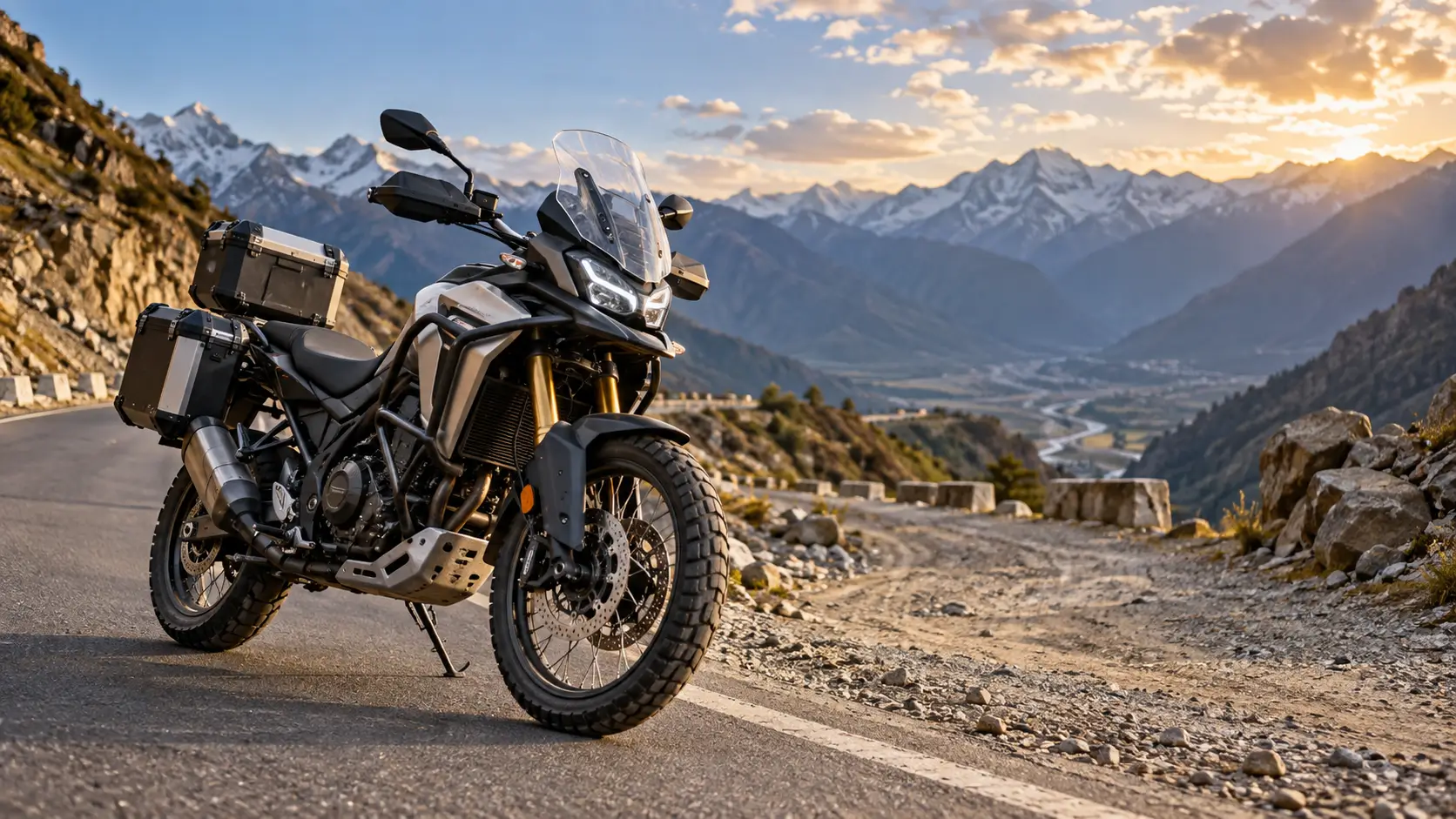
Adventure bikes have become a much broader category in India. The segment now includes relatively accessible motorcycles such as the Hero Xpulse 210 and Suzuki V-Strom SX, mid-size machines such as the TVS Apache RTX and Royal Enfield Himalayan 440, and more performance-focused motorcycles such as the Himalayan 450 and KTM 390 Adventure range.
But choosing an adventure bike is not simply about finding the biggest engine or the longest specification sheet.
The more important question is: where and how will you actually ride it?
A motorcycle used mainly for city commuting and occasional weekend trips needs different characteristics from one intended for long highway journeys or demanding off-road riding. Weight, seat height, suspension travel, wheel size, ground clearance and electronics can matter just as much as engine capacity.
Quick answer: What should you look for?
For Indian buyers, start with five things:
- Your riding environment — city, highway, mountains or trails.
- Weight and seat height — particularly if you frequently ride in traffic or stop on uneven surfaces.
- Suspension and wheel size — important for broken roads and off-road riding.
- Engine character — more power is useful for highways, but it also adds weight and cost.
- Service and ownership practicality — a motorcycle should fit your budget and usage, not just your aspirations.
What is an adventure bike?
An adventure bike is a motorcycle designed to combine road-going ability with some degree of off-road capability.
Typical characteristics include an upright riding position, increased ground clearance, long-travel suspension and a chassis designed to handle poor surfaces better than a conventional street motorcycle.
However, not every adventure bike is designed for the same kind of terrain.
Some are primarily adventure tourers. They are comfortable on highways and broken roads but are not intended for aggressive trail riding.
Others are much more off-road focused, with larger front wheels, longer suspension travel, lower overall weight and equipment designed around standing riding and loose surfaces.
That distinction matters when buying.
Adventure bike vs adventure tourer
The terms are sometimes used interchangeably, but there is a practical difference.
A touring-oriented adventure motorcycle generally prioritizes highway comfort, luggage carrying, wind protection and long-distance stability.
A more off-road-focused motorcycle gives greater importance to suspension travel, wheel configuration, ground clearance, chassis control and low-speed manoeuvrability.
For example, the KTM 390 Adventure R has a 21-inch front and 18-inch rear wheel setup and 230mm of suspension travel, specifications that point toward more serious off-road capability.
By comparison, the Suzuki V-Strom SX uses a 19-inch front wheel and is positioned as a sports adventure tourer, making it more naturally suited to road touring and lighter adventure use.
Engine size is not everything
A common mistake is assuming that a larger engine automatically means a better adventure motorcycle.
It does not.
A 200–300cc motorcycle can be easier to manage on narrow trails, in traffic and at low speeds. A larger motorcycle can provide stronger highway performance and easier overtaking, particularly with luggage or a passenger.
The Hero Xpulse 210, for example, uses a 210cc liquid-cooled engine producing 24.6 PS, while the TVS Apache RTX uses a 299.1cc engine producing 36 PS.
At the other end, the Royal Enfield Himalayan 450 produces 40.02 PS from its 452cc engine.
The appropriate engine therefore depends on how much highway and long-distance riding you actually do.
Weight matters more than many buyers expect
Adventure motorcycles are often physically large.
That can be useful at speed, but weight becomes noticeable when moving the motorcycle around a parking area, navigating traffic or recovering it after a low-speed tip-over.
This is particularly important for riders who intend to ride off-road alone.
A specification sheet cannot tell you exactly how a motorcycle will feel to every rider, but it can provide an important starting point. The Suzuki V-Strom SX, for example, has a listed kerb mass of 167kg, while the TVS Apache RTX is listed at 180kg.
Do not choose a motorcycle solely because it has more equipment. Consider whether you can comfortably manoeuvre it.
Seat height is another critical factor
Adventure motorcycles tend to have relatively tall riding positions, although not all of them are equally tall.
The Hero Xpulse 210 is listed with an 830mm seat height. The Suzuki V-Strom SX is also listed at 835mm.
The Royal Enfield Himalayan 440 is notable for its 800mm seat height, while the Himalayan 450 offers a standard seat range beginning at 825mm.
Seat height is especially important for shorter riders because being able to confidently place a foot down can make slow-speed riding easier.
Do not judge seat height only from numbers, however. Seat width, suspension sag, rider weight and riding position also influence how accessible a motorcycle feels.
Suspension and wheel size
For Indian roads, suspension is not just an off-road feature.
Longer suspension travel can help a motorcycle cope with potholes, broken surfaces and uneven roads.
Wheel size also influences how a motorcycle behaves over rough terrain.
A larger 21-inch front wheel is common on more off-road-oriented adventure motorcycles. The Himalayan 450 and KTM 390 Adventure R are examples.
The TVS Apache RTX uses a 19-inch front wheel and 17-inch rear wheel, placing it in a different part of the adventure-touring spectrum.
There is no universally superior wheel size. The correct setup depends on the type of riding you expect to do.
Adventure bikes worth considering in India
The current Indian market provides several useful reference points.
Hero Xpulse 210
The Xpulse 210 is a relatively accessible entry into the adventure category. Hero lists a 210cc liquid-cooled engine, 24.6 PS, a 21-inch front wheel and 210mm of front suspension travel.
It is worth considering for riders who want a motorcycle that can handle city riding, touring and rougher surfaces without moving immediately into the larger-displacement category.
Suzuki V-Strom SX
The V-Strom SX uses a 249cc single-cylinder engine producing 26.5 PS and 22.2 Nm.
Its 19-inch front wheel, 167kg kerb mass and road-oriented adventure-touring design make it a relevant option for riders who expect substantial road use with occasional exploration beyond smooth tarmac.
TVS Apache RTX
The Apache RTX brings TVS into the modern adventure-touring segment with a 299.1cc liquid-cooled engine producing 36 PS and 28.5 Nm.
It also offers features such as multiple riding modes, switchable ABS and, on applicable variants, traction control, cruise control and a bi-directional quickshifter.
This makes it particularly interesting for riders who value technology alongside touring and mixed-road capability.
Royal Enfield Himalayan 440
The Himalayan 440 takes a different approach. Royal Enfield lists a 443cc engine producing 25.4 bhp and 34 Nm.
Its 800mm seat height, 220mm ground clearance and 21-inch front wheel make its specification particularly relevant to riders who want an adventure motorcycle with an accessible seat and strong rough-road credentials.
Royal Enfield Himalayan 450
The Himalayan 450 is the more powerful option in Royal Enfield’s Himalayan family.
It uses a 452cc liquid-cooled engine producing 40.02 PS and 40 Nm. Royal Enfield lists 200mm of front and rear wheel travel, 230mm of ground clearance and a 17-litre fuel tank.
It is therefore a more substantial motorcycle for riders who expect long-distance touring combined with serious rough-road and off-road capability.
KTM 390 Adventure range
KTM’s Indian Adventure range has expanded beyond a single motorcycle.
The company currently lists the 390 Adventure, 390 Adventure X, 390 Adventure S and 390 Adventure R alongside the 250 Adventure.
The 390 Adventure R is particularly focused on off-road use, with a 398.7cc engine, 46 PS, 21/18-inch wheels and 230mm suspension travel.
This makes the R version fundamentally different in emphasis from an adventure motorcycle intended primarily for road touring.
Which adventure bike type is right for you?
Mostly city riding with occasional weekend trips
Do not automatically buy the largest motorcycle you can afford.
A lighter motorcycle can be easier to manage in traffic and parking areas. The Xpulse 210 and V-Strom SX are examples of motorcycles worth investigating in this use case.
Long highway touring
If most of your riding involves highways, long distances and luggage, engine performance, fuel capacity, stability and riding comfort become increasingly important.
The Himalayan 450, Apache RTX and KTM Adventure models are relevant examples, but the final choice should depend on your budget and preferred riding style.
Frequent broken roads and mountain routes
Ground clearance, suspension travel, wheel size and low-speed control become more important.
This is where motorcycles such as the Himalayan 440, Himalayan 450 and Xpulse 210 become particularly relevant.
Serious off-road riding
If technical trails are a major part of your riding rather than an occasional activity, prioritize suspension, wheel configuration, weight, chassis control and electronic aids.
The KTM 390 Adventure R is an example of a motorcycle designed with a stronger off-road emphasis.
What Indian buyers should check before buying
Before paying a booking amount, check:
- Actual seat height and whether you can manage it comfortably
- Kerb weight rather than just engine capacity
- Front and rear suspension travel
- Front wheel size
- Ground clearance
- ABS configuration
- Availability of replacement tyres
- Luggage options
- Service network in your area
- Warranty terms
- Insurance and registration costs
- Spare-parts availability
- Intended passenger and luggage load
Most importantly, check the motorcycle in person.
A specification sheet can tell you that two bikes have similar seat heights, but it cannot fully tell you which one will feel easier to balance.
Common mistakes to avoid
Buying for an imaginary adventure
If 90% of your riding is city commuting, buying a large off-road-focused motorcycle may not be the most practical decision.
Focusing only on engine size
A bigger engine brings performance, but it can also mean additional weight, cost and complexity.
Ignoring seat height
A motorcycle that looks perfect on paper can become frustrating if you cannot confidently manage it at low speeds.
Treating ground clearance as the whole story
Ground clearance is useful, but suspension, wheel size, chassis geometry and tyres also affect rough-road capability.
Comparing only prices
Two motorcycles with similar prices can have very different purposes. Compare them according to the riding you actually intend to do.
Bottom line
The best adventure bike in India is not necessarily the most powerful or the most expensive.
For a buyer who spends most of the week commuting, a lighter and more manageable motorcycle may make more sense. For long-distance touring, engine performance and comfort become more important. For serious off-road riding, suspension, wheels, weight and chassis design deserve greater priority.
The current Indian market gives buyers a wide range of choices, from the Hero Xpulse 210 and Suzuki V-Strom SX to the TVS Apache RTX, Royal Enfield Himalayan 440 and Himalayan 450, and KTM’s 390 Adventure family.
The smartest approach is to decide where you will ride first and then choose the motorcycle around that use case.
FAQ
What is an adventure bike?
An adventure bike is a motorcycle designed to combine road riding with some degree of off-road capability, typically using upright ergonomics, increased ground clearance and long-travel suspension.
Which adventure bikes are available in India?
Current examples include the Hero Xpulse 210, Suzuki V-Strom SX, TVS Apache RTX, Royal Enfield Himalayan 440, Royal Enfield Himalayan 450 and several KTM Adventure models.
Are adventure bikes good for daily commuting?
Some are. Lighter and less aggressively off-road-focused models can work well for commuting, but larger adventure motorcycles can be physically demanding in dense traffic.
Is a 200cc adventure bike enough for touring?
A 200–210cc adventure motorcycle can be sufficient for touring, particularly at moderate speeds, but riders who frequently carry luggage or spend long periods on highways may prefer stronger engine performance.
Is the Himalayan 450 suitable for off-road riding?
Yes. Royal Enfield lists 200mm front and rear suspension travel, 230mm ground clearance and a 21-inch front wheel, giving it specifications suited to off-road and rough-road use.
Is a KTM 390 Adventure R designed for serious off-road riding?
The 390 Adventure R has a 21-inch front wheel, 18-inch rear wheel and 230mm suspension travel, along with rally-oriented design elements, making it more off-road focused than many road-oriented adventure tourers.
What is more important: engine size or weight?
Neither is universally more important. Engine size matters for performance and highway riding, while weight strongly affects low-speed handling, manoeuvrability and off-road control.
What should I check before buying an adventure bike?
Check seat height, kerb weight, suspension travel, wheel size, ground clearance, ABS, service support, luggage capability and the motorcycle’s suitability for your actual riding conditions.
DISCLAIMER
Prices, specifications, availability and equipment can change by variant, location and model year. Verify the latest details, on-road price and available equipment with the manufacturer or an authorized dealer before purchasing.