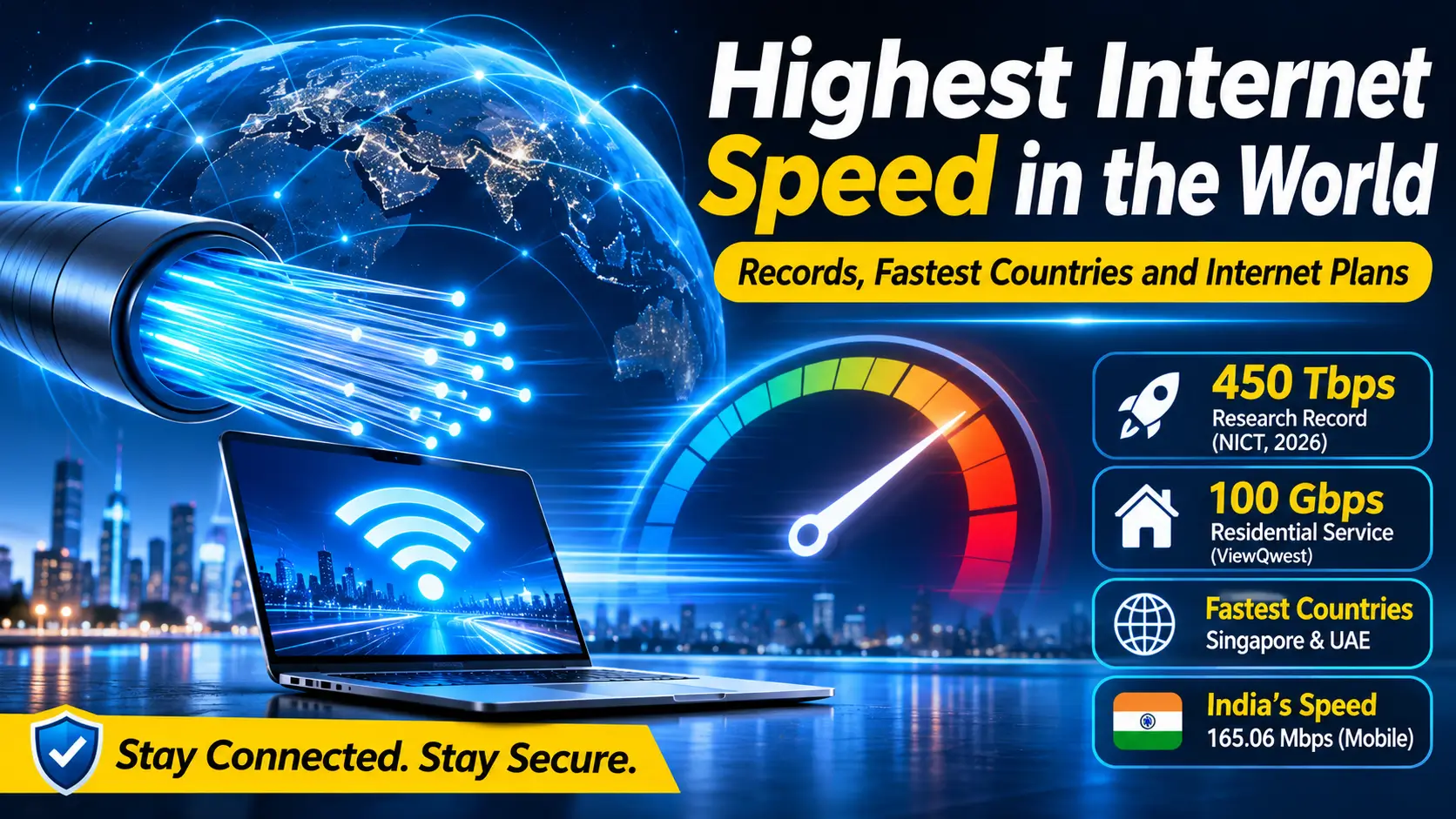
The highest internet speed ever achieved depends on what is being measured. Optical-fibre researchers have demonstrated data transmission at hundreds of terabits per second, while the fastest residential broadband services available to consumers operate at speeds measured in gigabits per second.
These figures describe different technologies and use cases. A laboratory or network transmission record does not mean an ordinary household can subscribe to the same speed.
As of November 2026, a major optical-fibre demonstration reported by Japan’s National Institute of Information and Communications Technology (NICT) reached 450 terabits per second over an existing fibre link in London. Separately, Singapore’s ViewQwest announced a residential broadband service offering up to 100 gigabits per second.
This guide explains the highest internet speed records, the fastest internet countries, available consumer broadband speeds and how these numbers compare with internet connections in India.
What Is the Highest Internet Speed Ever Recorded?
One of the most significant recent optical-fibre transmission records was announced by NICT on 1 June 2026.
The research team demonstrated a transmission rate of 450 terabits per second (Tbps) over 39 kilometres of already-installed optical fibre in London, connecting University College London with the Telehouse North data centre.
The achievement used a wide range of optical wavelengths and advanced transmission techniques to increase the amount of data carried through the fibre.
This result matters because it demonstrates how much additional capacity may be possible from existing fibre infrastructure.
However, it is important to understand what the figure represents.
The 450 Tbps result was a research transmission demonstration across a fibre link. It was not a speed test of a household internet connection, and it is not a broadband package that consumers can purchase.
How fast is 450 Tbps?
The difference between common internet speed units can be understood as follows:
| Speed unit | Equivalent |
|---|---|
| 1 Mbps | 1 million bits per second |
| 1 Gbps | 1,000 Mbps |
| 1 Tbps | 1,000 Gbps |
| 450 Tbps | 450,000 Gbps |
A 450 Tbps transmission rate is extraordinarily large compared with typical home broadband speeds. It illustrates the potential capacity of optical communication systems rather than the speed available to an individual device.
Fastest Internet Speed for Residential Users
The fastest research record and the fastest residential internet service are not the same.
In October 2026, Singapore-based internet provider ViewQwest announced a residential broadband service called 100G Home Broadband. The company described it as the world’s first commercially available 100 Gbps residential broadband service.
A 100 Gbps connection is equivalent to 100,000 Mbps.
This is far beyond the gigabit broadband plans commonly marketed to households. However, a residential service advertised at 100 Gbps still depends on specialised network equipment, compatible devices, installation conditions and the provider’s service availability.
The announcement should also be understood as a provider-reported commercial offering. It does not mean every household in Singapore can automatically receive 100 Gbps internet.
What does 100 Gbps internet mean in practice?
A 100 Gbps connection has enormous theoretical bandwidth. It could support demanding network workloads, very large file transfers and multiple high-bandwidth applications.
But a user will not necessarily experience a 100 Gbps speed test on an ordinary laptop or smartphone.
The device, router, Ethernet port, Wi-Fi standard, storage speed, remote server and network congestion can all limit actual throughput.
For most homes, a multi-gigabit connection is already more than sufficient for common activities such as streaming, video calls, gaming and browsing.
Which Country Has the Fastest Internet in the World?
There is no single country that is permanently the fastest for every type of internet connection.
Fixed broadband and mobile internet are measured separately. Country rankings also change from month to month.
According to the October 2026 Ookla Speedtest Global Index:
Fastest fixed broadband countries
| Rank | Country or territory | Median download speed |
|---|---|---|
| 1 | Singapore | 697.72 Mbps |
| 2 | France | 552.17 Mbps |
| 3 | Switzerland | 499.55 Mbps |
| 4 | Hong Kong | 478.46 Mbps |
| 5 | Iceland | 443.27 Mbps |
These figures represent median measured fixed-broadband download speeds in the index, not the maximum speed offered by an individual internet provider.
Fastest mobile internet countries
| Rank | Country | Median download speed |
|---|---|---|
| 1 | United Arab Emirates | 759.36 Mbps |
| 2 | Qatar | 605.58 Mbps |
| 3 | Kuwait | 466.18 Mbps |
| 4 | South Korea | 377.84 Mbps |
| 5 | Brazil | 313.30 Mbps |
The UAE led the mobile ranking in the October 2026 snapshot, while Singapore led fixed broadband.
This difference shows why the phrase “fastest internet country” needs context. A country may have excellent fibre infrastructure but a different position in mobile-speed rankings.
What Is the Fastest Internet Speed in India?
India’s internet infrastructure has expanded through fibre broadband, mobile networks and other access technologies. However, the country’s median measured speed is different from the maximum speed advertised by a broadband provider.
In the October 2026 Ookla Speedtest Global Index, India recorded:
| Connection type | Global rank | Median download | Median upload |
|---|---|---|---|
| Mobile internet | 51 | 165.06 Mbps | 15.56 Mbps |
| Fixed broadband | 101 | 98.50 Mbps | 93.74 Mbps |
These are country-level median measurements. They do not indicate the maximum speed available in every Indian city or from every internet service provider.
Fastest broadband plans available in India
Some Indian fibre providers advertise plans reaching gigabit speeds.
For example:
- JioFiber advertises broadband plans with speeds up to 1 Gbps.
- Airtel Xstream Fiber lists a 1 Gbps broadband plan.
- ACT Fibernet advertises high-speed fibre plans, including gigabit-level availability in selected markets.
Actual plans, prices, installation options and speed tiers depend on the city, locality and service availability.
A 1 Gbps plan is equivalent to 1,000 Mbps. It is much faster than the median fixed-broadband speed reported for India, but it is still far below the 450 Tbps optical transmission research record.
How Much Faster Is 450 Tbps Than 1 Gbps?
The difference is easier to understand through a direct comparison.
| Connection or demonstration | Speed |
|---|---|
| Typical 100 Mbps broadband plan | 100 Mbps |
| Gigabit residential broadband | 1 Gbps |
| Residential 100G service announced in Singapore | 100 Gbps |
| NICT optical-fibre demonstration | 450 Tbps |
Because 1 Tbps equals 1,000 Gbps, 450 Tbps equals 450,000 Gbps.
That means the 450 Tbps research rate is 450,000 times the numerical speed of a 1 Gbps connection.
This comparison is useful for understanding scale, but it should not be interpreted as a direct consumer performance comparison. The research system and residential broadband connection operate under different technical conditions.
Does the Highest Internet Speed Mean the Best Internet?
Not necessarily.
Internet quality depends on more than download speed. A connection can have a high advertised bandwidth but still perform poorly during gaming, video calls or real-time applications.
Three important measurements are:
Download speed
Download speed measures how quickly data reaches your device.
It affects activities such as downloading files, loading websites and streaming video.
Upload speed
Upload speed measures how quickly your device sends data to the internet.
It matters for video calls, cloud backups, uploading files, livestreaming and sharing content.
Latency or ping
Latency measures how long it takes for data to travel to a destination and receive a response.
Lower latency is generally better for online gaming, video calls and other interactive applications.
A connection with 300 Mbps download speed and low latency may provide a better gaming experience than a much faster connection with unstable latency.
How to Choose a Fast Internet Connection
The best broadband plan depends on how many people use the connection and what they do online.
For many households, a 100 Mbps to 300 Mbps connection can support everyday browsing, HD or 4K streaming, video calls and several connected devices.
A gigabit plan may be useful for households with:
- Multiple people downloading large files
- Frequent cloud backups
- High-resolution streaming across many devices
- Large game downloads and updates
- Professional media or creative workloads
- A need for very high local or internet transfer capacity
Before selecting a plan, check the provider’s actual availability, upload speed, data policy, router specifications and typical performance.
Also remember that Wi-Fi speed may be lower than the broadband plan’s advertised speed. A wired Ethernet connection is often a better way to test the service’s underlying performance.
Conclusion
The highest internet speed depends on the category being discussed.
NICT’s 450 Tbps optical-fibre demonstration in 2026 represents a major research achievement in network transmission capacity. Singapore’s announced 100 Gbps residential service illustrates how extremely fast broadband is beginning to reach specialised consumer markets.
For everyday users in India, gigabit fibre plans are a more practical reference point than laboratory transmission records. The right connection should provide sufficient bandwidth, reliable performance and low latency for the household’s actual needs.
The most useful way to compare internet speeds is to separate research records, commercial residential plans, country-level median results and real-world device performance.