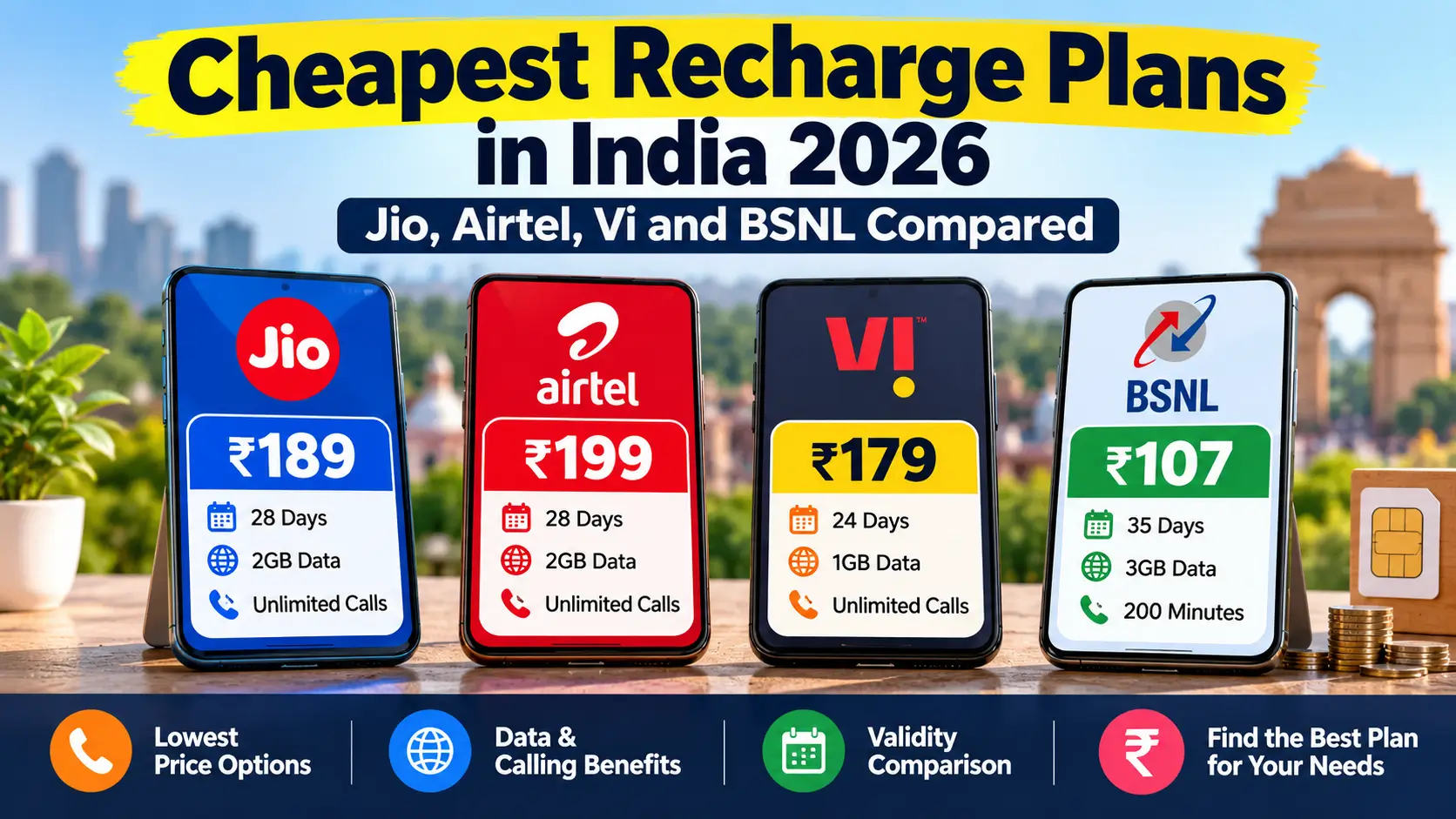
If your only goal is to spend the least possible amount on a mobile recharge, the answer is not simply “choose the ₹99 or ₹155 plan.”
The cheapest recharge depends on what you actually need.
A user who only wants to keep a secondary SIM active has a very different requirement from someone who needs unlimited calling every day. A Wi-Fi user may need only a small amount of mobile data, while another person may need 1GB or 2GB every day.
And there is another complication: prepaid plans can vary by telecom circle, while some offers are available only through an operator’s app or for selected customers.
As of October 6, 2026, Jio, Airtel, Vi and BSNL all have low-cost options, but they target different users. Current plan information also shows why comparing only the recharge amount can produce a misleading result.
Quick answer: Which is the cheapest recharge plan?
There are several different answers.
| What you need | Low-cost option worth checking | Why |
|---|---|---|
| Lowest basic recharge | Vi ₹99 in eligible circles | 15-day validity with 200MB data and limited-rate calling |
| Cheapest mainstream unlimited-calling plan | Vi ₹179 | Unlimited calls, 1GB data, 24 days |
| Cheapest Jio full-service plan | Jio ₹189 | 28 days, 2GB data and unlimited calls |
| Cheapest Airtel full-service plan | Airtel ₹199 | 28 days, 2GB data and unlimited calls |
| Low-cost BSNL option | BSNL ₹107 in applicable circles | 35 days, limited voice and 3GB data |
| Best low-cost long-validity value | BSNL options around ₹197 | Can provide substantially more validity/value depending on circle |
| Best for heavy data | Higher daily-data plan | The cheapest plan isn’t necessarily the cheapest per GB |
Important: These are not interchangeable plans. Eligibility, circle, validity and benefits can differ.
The first thing to understand: “cheapest” has four meanings
Before comparing operators, decide which of these you mean.
1. Cheapest recharge by price
This simply asks:
“What is the smallest amount I can pay?”
This is useful for someone who needs minimal service.
2. Cheapest recharge with unlimited calling
Here, a plan with ₹99 may not qualify if it doesn’t provide unlimited calling.
3. Cheapest recharge for regular mobile use
This usually means:
- unlimited calls
- some data
- SMS
- around 24–30 days of validity
This is probably what most people mean when they search for a cheap mobile recharge.
4. Cheapest recharge per day
This is different again.
A ₹197 plan lasting 35 days can potentially be better value than a ₹189 plan lasting 28 days, even though ₹189 looks cheaper on the first screen.
Jio’s cheapest recharge plans
Jio’s current prepaid catalogue includes a ₹189 Value plan with 28 days of validity and 2GB total data. Current plan databases updated on October 6, 2026 list it as Jio’s affordable value pack.
Jio’s plan structure also includes higher-priced plans aimed at 5G users, including the ₹349 plan with 2GB/day for 28 days.
Jio ₹189
Current basic structure:
- Price: ₹189
- Validity: 28 days
- Data: 2GB total
- Unlimited calling
- SMS/other benefits according to the current pack terms
The ₹189 plan is particularly relevant for people who have Wi-Fi at home or work and don’t need large quantities of mobile data.
Effective daily cost
₹189 ÷ 28 = about ₹6.75 per day
That is more useful than simply saying “₹189 is cheap.”
Who should consider it?
- Wi-Fi users
- Secondary-SIM users
- Light mobile-data users
- People who mainly need calls and occasional internet access
Who shouldn’t?
If you regularly consume 1GB or more every day, the ₹189 plan isn’t the logical choice simply because it has the lowest price.
Jio’s current catalogue includes substantially higher-data options, such as ₹349 for 2GB/day for 28 days.
Airtel’s cheapest recharge plans
Airtel currently lists a ₹199 prepaid plan offering unlimited calling, 2GB total data and 28 days of validity. Its current recharge page also lists plans such as ₹219 with 3GB total data for 28 days and ₹349 with 2GB/day.
Airtel ₹199
Current structure:
- Price: ₹199
- Validity: 28 days
- Data: 2GB
- Unlimited calls
- 100 SMS/day
Airtel also attaches additional digital benefits to selected plans, and the exact bundle can change.
Effective daily cost
₹199 ÷ 28 = about ₹7.11 per day
That is roughly 36 paise more per day than Jio’s ₹189 plan.
Who should consider it?
Airtel’s ₹199 option makes sense if:
- Airtel has better coverage where you live/work
- you mainly need calls
- you use Wi-Fi for most internet consumption
- you don’t want to spend ₹300+ on a daily-data plan
A critical point
The cheapest recharge isn’t useful if the network doesn’t work well where you actually use your phone.
A ₹10 saving over 28 days is not meaningful if you regularly need to switch networks because of poor coverage.
Vi’s cheapest recharge plans
Vi has one of the more complicated entry-level structures because some low-priced plans are circle-dependent.
Vi’s own website says its minimum recharge can be ₹99 in select circles, with 200MB data and 15 days of validity. Its website also lists a ₹179 unlimited-calling option with 1GB data, 300 SMS and 24 days of validity.
Vi ₹99: the lowest-price option
Where available, Vi’s ₹99 plan provides:
- 200MB data
- 15 days validity
- calling charged at the applicable per-second rate
Vi’s dedicated ₹99 page confirms the plan exists, but availability should be checked for the particular number/circle.
This is an important distinction.
₹99 is not equivalent to Jio ₹189 or Airtel ₹199.
It is cheaper because it provides a different level of service.
Vi ₹179: cheap unlimited-calling option
Vi’s ₹179 plan provides:
- Unlimited calls
- 1GB data
- 300 SMS
- 24 days validity
Vi’s own published material identifies ₹155 as an unlimited-calling plan in one plan listing, while its current general recharge information lists ₹179 as an unlimited-call plan. This illustrates why readers should verify the current plan displayed for their own number before recharging.
For the current ₹179 structure:
Effective daily cost
₹179 ÷ 24 = about ₹7.46 per day
That makes it slightly more expensive per day than Jio ₹189 or Airtel ₹199 despite having a lower upfront price than Airtel.
BSNL: the wildcard in cheap recharges
BSNL is especially interesting for budget-conscious users because its plans can have different validity structures from the private operators.
However, BSNL tariffs can vary by circle, so a BSNL plan should never be treated as universally available nationwide without checking the applicable circle.
BSNL tariff documents show low-cost vouchers including ₹107 and ₹197, with benefits and validity depending on the applicable tariff.
Recent October 2026 reporting also highlights a ₹197 BSNL plan with 35 days of validity, making it particularly interesting in the low-cost segment.
BSNL ₹107
A BSNL tariff document lists a ₹107 plan providing:
- 35 days
- 200 minutes
- 3GB data
The exact tariff should be checked for the user’s circle before recharge.
Effective daily cost
₹107 ÷ 35 = about ₹3.06 per day
That is dramatically lower than a ₹199/28-day plan—but the benefits are also much more limited.
This is why comparing price alone can be misleading.
BSNL ₹197: why validity matters
The ₹197 category deserves attention because the latest October 2026 reports describe a 35-day option.
At ₹197 for 35 days:
₹197 ÷ 35 ≈ ₹5.63 per day
Compare that with:
- Jio ₹189 / 28 days ≈ ₹6.75/day
- Airtel ₹199 / 28 days ≈ ₹7.11/day
- Vi ₹179 / 24 days ≈ ₹7.46/day
On a pure validity-cost basis, the BSNL option can therefore be considerably cheaper.
But there is an important warning:
Cheapest per day does not automatically mean best overall.
Network quality, data allowance, calling benefits, 4G/5G availability and local coverage still matter.
Cheapest recharge plans compared
For a practical comparison, consider these commonly relevant entry-level options:
| Operator | Plan | Validity | Data | Calling | Approx. daily cost |
|---|---|---|---|---|---|
| Vi | ₹99* | 15 days | 200MB | Limited-rate calling | ₹6.60 |
| Vi | ₹179 | 24 days | 1GB | Unlimited | ₹7.46 |
| Jio | ₹189 | 28 days | 2GB | Unlimited | ₹6.75 |
| Airtel | ₹199 | 28 days | 2GB | Unlimited | ₹7.11 |
| BSNL | ₹107* | 35 days | 3GB | 200 min | ₹3.06 |
| BSNL | ₹197* | 35 days | Circle-dependent | Circle-dependent | ₹5.63 |
* Circle/availability caveat applies. Always verify the pack shown for your mobile number before payment.
Jio’s ₹189 and Airtel ₹199 figures are corroborated by current October 2026 plan listings and operator information. Vi’s low-end structure is documented by Vi itself. BSNL’s low-priced vouchers are reflected in its circle tariff documents and recent reporting.
So, which operator has the cheapest recharge?
If you mean the lowest possible price
Vi can be the answer, because its ₹99 option exists in selected circles.
But this is not a universal “best cheap recharge.”
If you want unlimited calling for the lowest upfront price
Vi’s ₹179 plan is one of the lowest mainstream options currently listed.
But its 24-day validity means its effective daily cost isn’t necessarily the lowest.
If you want a low-cost 28-day Jio plan
Jio ₹189 is currently a strong entry-level option.
You get 28 days and 2GB total data, making it particularly suitable for light users.
If you are an Airtel customer
Airtel ₹199 is the logical low-cost unlimited-calling option.
It provides 28 days, unlimited calls and 2GB data.
If your priority is maximum value per day
BSNL deserves consideration, particularly where its applicable ₹197/35-day or other low-cost plans are available.
But you should check local network performance first.
The hidden cost of 28-day recharge plans
This is one of the most important things many recharge comparisons fail to explain.
A plan advertised as “28 days” isn’t a full calendar month.
Suppose you repeatedly recharge a ₹199 plan every 28 days.
There are:
365 ÷ 28 ≈ 13.04
28-day cycles in a year.
So you effectively need approximately 13 recharge cycles to maintain uninterrupted service across a year.
At ₹199 each:
₹199 × 13 = ₹2,587
That doesn’t mean you will literally be charged exactly ₹2,587 every calendar year—the recharge timing and validity stacking rules matter—but it illustrates why a ₹199 “monthly” plan shouldn’t automatically be compared with a true 30-day or annual plan as though they were identical.
TRAI has previously received consumer questions specifically about the difference between 28-day recharge cycles and calendar months.
Cheapest isn’t always best: calculate cost per day
This is the simplest way to avoid misleading comparisons.
Example
Plan A: ₹199 / 28 days
₹199 ÷ 28 = ₹7.11/day
Plan B: ₹197 / 35 days
₹197 ÷ 35 = ₹5.63/day
Plan B costs ₹2 more upfront? No—it actually costs ₹2 less.
But the more important difference is that Plan B lasts seven additional days.
That’s why looking only at the ₹197 vs ₹199 price isn’t enough.
What if you only use Wi-Fi?
This is where cheap recharge plans become particularly useful.
If you spend most of your time connected to:
- home broadband
- office Wi-Fi
- college Wi-Fi
- public Wi-Fi
you don’t necessarily need a 1.5GB/day or 2GB/day mobile plan.
A low-data plan with unlimited calls may save you hundreds of rupees over the year.
For such users, the decision should focus on:
validity + calling + minimum required data
rather than maximum mobile data.
What if you use mobile data heavily?
Then don’t choose the cheapest recharge.
This sounds contradictory, but it is important.
Suppose:
Plan A: ₹189 for 2GB total
and
Plan B: ₹349 for 2GB/day.
The second plan costs much more, but comparing their prices without considering total data is meaningless.
If you actually consume several hundred megabytes every day, repeatedly purchasing cheap plans plus data add-ons can become more expensive and inconvenient than taking a proper daily-data plan.
Jio’s current plan catalogue, for example, lists ₹349 with 2GB/day for 28 days, while Airtel also lists ₹349 with 2GB/day.
Cheapest recharge for a secondary SIM
If you have a second SIM that you rarely use, your priorities change.
You may want:
- Minimum possible cost
- Sufficient validity
- Incoming service
- Occasional calls
- Small amount of data
In that situation, a low-cost service-validity plan can make more sense than a full daily-data package.
Vi ₹99 in eligible circles is an example of why checking the operator’s current catalogue matters.
Cheapest recharge for senior citizens or light callers
For someone who primarily uses a mobile phone for calls, WhatsApp messages and occasional browsing, a large daily-data plan can be unnecessary.
A good low-cost plan should provide:
- unlimited or sufficient voice
- adequate validity
- enough data for messaging
- SMS where required
The cheapest plan should therefore be judged against actual consumption, not the amount of data printed on the largest plans.
Jio vs Airtel vs Vi vs BSNL: the practical choice
Choose Jio if:
- You want a relatively low-cost 28-day plan.
- 2GB total data is enough.
- Jio coverage is good in your area.
- You use Wi-Fi heavily.
- You want access to Jio’s digital ecosystem.
Choose Airtel if:
- Airtel provides better coverage for you.
- You mainly need calls.
- You want 28-day validity.
- You don’t consume much mobile data.
- Airtel’s bundled benefits are useful to you.
Choose Vi if:
- You want one of the lowest upfront recharge amounts.
- Your circle offers the low-cost plan you need.
- Vi coverage is good in your location.
- You can make use of Vi’s selected entertainment/data benefits.
Choose BSNL if:
- BSNL coverage is reliable where you live.
- Low daily cost is more important than premium network features.
- A circle-specific BSNL plan offers better validity.
- You don’t depend heavily on 5G.
One more important point: network quality is part of the price
Imagine two plans:
Operator A: ₹179
Operator B: ₹199
At first glance, Operator A wins by ₹20.
But if Operator B works reliably inside your house and Operator A does not, the ₹20 saving may have almost no practical value.
You could end up using:
- Wi-Fi calling
- another SIM
- additional data
- another recharge
- broadband
to compensate.
So the real calculation is:
Recharge price + network reliability + data usage + validity + additional packs
not just the recharge amount.
TRAI’s latest move makes plan comparison more important
On October 1, 2026, TRAI published a direction concerning the publication of tariff offers. The regulator has also been pushing operators to make mandatory tariff packs and special tariff vouchers easier to locate.
This is relevant because consumers shouldn’t have to hunt through multiple screens to discover basic tariff information.
For anyone comparing cheap plans, the safest approach is to check:
operator website/app → enter your number/circle → check the current pack → read validity and benefits → then recharge.
Don’t rely on an old screenshot circulating on social media.
What about future recharge price hikes?
There is another reason not to assume today’s cheapest plan will remain cheapest.
Recent reporting has cited expectations of another telecom tariff increase, with estimates of potentially 12–15% from major private operators in coming months. This is a forecast/report, not an announced price increase, so it should not be presented as a confirmed future tariff change.
For consumers, the practical lesson is simple:
Don’t prepay for a long-term plan solely because you read that prices may rise.
Do it only if the plan genuinely fits your usage and the operator’s terms make sense.
Our verdict: the cheapest recharge depends on the user
There is no single winner.
🏆 Cheapest low-cost option
Vi ₹99, where available, if you need only limited service and short validity.
🏆 Cheapest practical Jio option
Jio ₹189 for 28 days and 2GB total data.
🏆 Cheapest practical Airtel option
Airtel ₹199 for 28 days, unlimited calling and 2GB data.
🏆 Best low-cost validity proposition to investigate
BSNL’s low-cost 35-day options, where available in the applicable circle.
🏆 Best strategy for heavy data users
Don’t buy the cheapest recharge. Compare cost per GB and total validity instead.
The simplest rule before your next recharge
Ask yourself three questions:
1. How much mobile data do I actually use?
2. Do I need unlimited calling?
3. How much does the plan cost per day after accounting for its validity?
If you answer those three questions first, the “cheapest recharge” becomes much easier to identify.
And remember: the cheapest plan is not necessarily the cheapest way to stay connected.
FAQ
Which is the cheapest mobile recharge in India?
There is no single nationwide answer. Vi lists a ₹99 plan in select circles, while Jio, Airtel and Vi have different low-cost plans with different calling, data and validity benefits. BSNL also has circle-specific low-priced options.
Which is the cheapest recharge with unlimited calling?
Among the mainstream low-cost options discussed here, Vi’s ₹179 plan is one of the lowest upfront-price options, while Jio’s ₹189 and Airtel’s ₹199 plans provide 28-day alternatives.
Is Jio ₹189 better than Airtel ₹199?
Not automatically. Both are low-cost 28-day options, but your local network quality, included benefits and data requirements should determine the choice.
Is BSNL cheaper than Jio and Airtel?
It can be, particularly when comparing certain low-cost or longer-validity BSNL vouchers. However, BSNL tariffs can vary by circle and network availability is an important part of the decision.
Is a 28-day recharge really one month?
No. Twenty-eight days is shorter than a calendar month. Over a full year, repeatedly using 28-day cycles can require roughly 13 recharge cycles. TRAI has received consumer questions specifically about this issue.
Which recharge is best for someone who uses Wi-Fi?
A low-cost plan with sufficient validity, calling and a small data allowance is usually more sensible than paying for 1GB/day or 2GB/day that you don’t use.
Which recharge is best for heavy data users?
Don’t choose based on the lowest upfront price. Compare the total data allocation, cost per GB, validity and 5G eligibility. Jio and Airtel both currently have 2GB/day plans around the ₹349 price point.
Can recharge plans change after publication?
Yes. Telecom operators can change pricing, benefits, availability and circle eligibility. Always check the operator’s current website or app before payment.