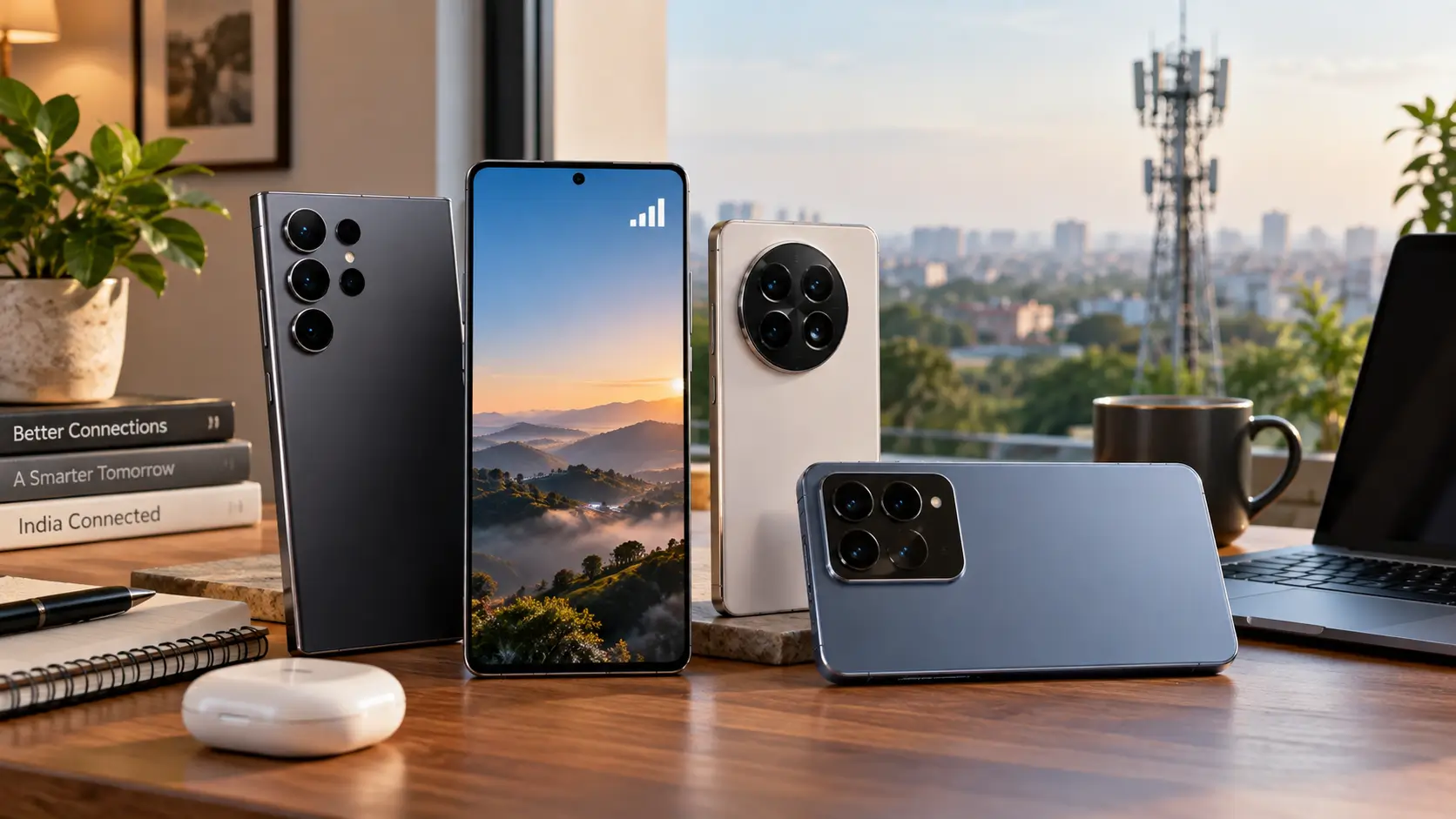
If your phone regularly loses signal inside buildings, struggles in rural areas or drops from 5G to 4G more often than another phone on the same network, the handset itself can be part of the problem. But there is no single specification that guarantees stronger reception.
The best phone for weak signal in India should ideally combine a modern modem, broad LTE and 5G band support, capable RF hardware and a well-designed antenna system. Your mobile operator matters just as much. Jio, Airtel, Vi and BSNL do not have identical network coverage in every location.
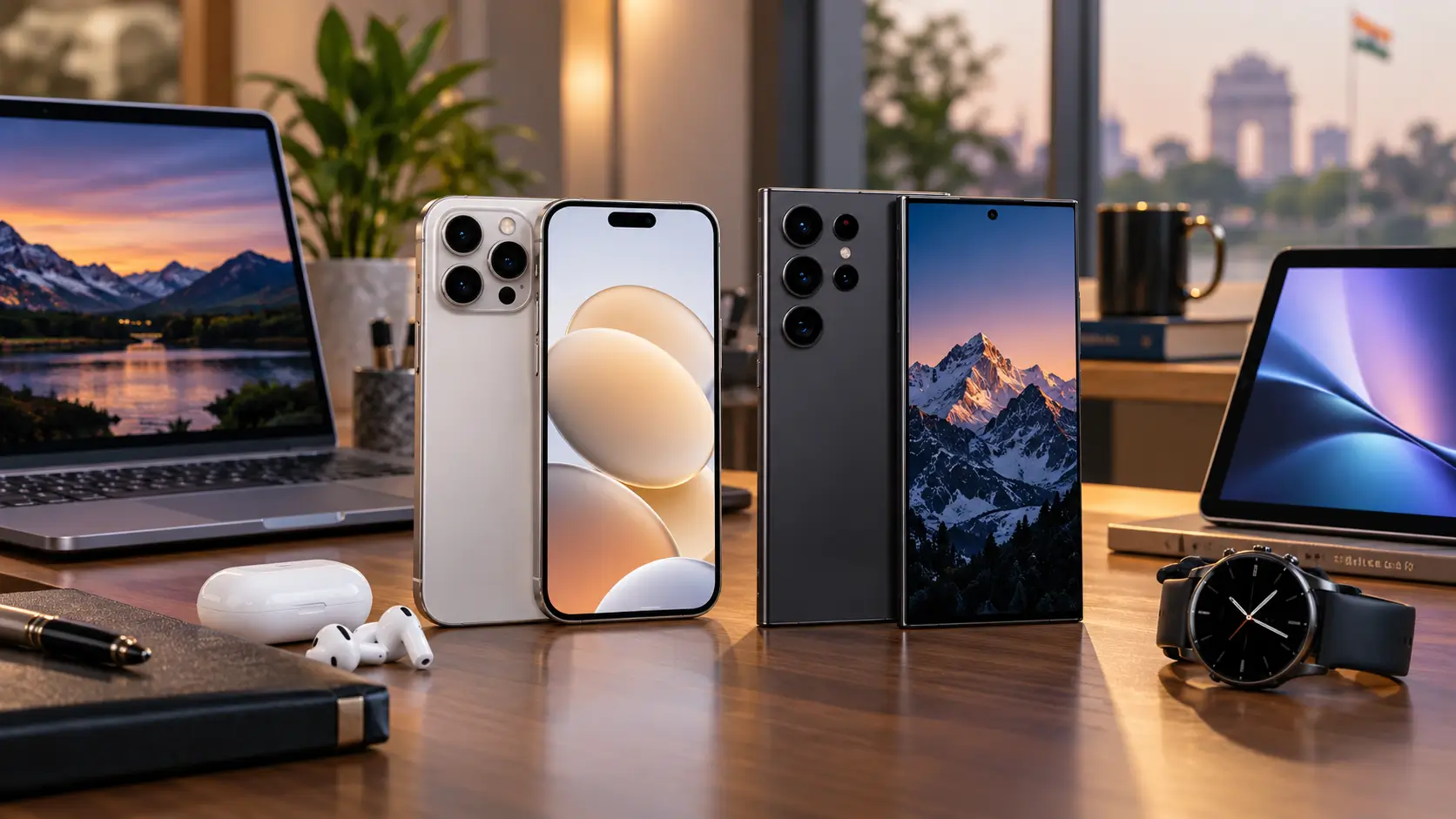
For 2026, the Samsung Galaxy S26 Ultra, OnePlus 15, Google Pixel 11 Pro and iPhone 17 are particularly interesting connectivity-focused choices because their published specifications show broad cellular support. OnePlus also explicitly highlights a 360° omni-directional antenna, while Google says the Pixel 11 Pro uses a new modem designed for improved reliability.
Quick Answer
There is no verified nationwide test that establishes one smartphone as the absolute strongest-reception phone in every part of India.
If weak reception is your main concern, consider:
- Samsung Galaxy S26 Ultra — broad LTE/5G band support and flagship RF hardware
- OnePlus 15 — 360° omni-directional antenna claim and Snapdragon 8 Elite Gen 5
- Google Pixel 11 Pro — new modem and extensive Sub-6 support
- iPhone 17 — broad LTE/5G support with 4×4 MIMO
The right choice also depends on whether your local problem is poor Jio, Airtel, Vi or BSNL coverage.
What Actually Determines Phone Signal Strength?
Signal reception is more complicated than the number of bars shown on the screen.
Four factors matter particularly:
1. Modem and RF system
The modem communicates with the cellular network, while the RF system handles the radio-frequency side of that connection.
Modern flagship platforms can support sophisticated carrier aggregation, multiple antennas, MIMO and a wide range of frequency bands.
Qualcomm’s Snapdragon 8 Elite Gen 5, for example, uses the X85 5G Modem-RF System and supports advanced sub-6GHz carrier aggregation and 5G Advanced features.
2. Antenna design
A phone needs to physically receive radio signals efficiently.
A manufacturer can use several antennas positioned around the chassis to maintain connectivity as the user holds the device in different orientations.
OnePlus specifically describes the OnePlus 15 as having a 360° omni-directional antenna system.
3. Frequency-band support
A phone must support the frequencies actually used by your carrier.
For Jio 5G, Jio currently lists n28, n78 and n258.
Airtel lists n8, n3, n1, n78 and n258 for its 5G network.
This is why a phone with broad band support can be a safer choice for Indian users than a phone designed primarily for another market.
4. The network around you
Even an excellent phone cannot create coverage where there is no usable network.
TRAI’s coverage framework specifically notes that network performance depends on factors including location and cell loading.
If your house is in a genuine coverage dead zone, changing from one flagship to another may make little difference.
Best Phones for Weak Signal in India
1. Samsung Galaxy S26 Ultra
The Galaxy S26 Ultra is a strong candidate for users who want a premium Android phone with extensive cellular compatibility.
Samsung’s India specification sheet lists 5G Sub-6 bands including n1, n3, n5, n7, n8, n28, n40, n41, n77 and n78, along with a broad selection of LTE bands.
That matters because Indian operators use different combinations of low- and mid-band spectrum.
Best for
- Premium Android buyers
- Users who want extensive network-band support
- People who also want a flagship camera, display and performance
- Users who travel between different network environments
Key trade-off
The phone is expensive. Its extensive band support does not guarantee stronger reception in every location.
Samsung’s current Indian listing shows the Galaxy S26 Ultra from ₹130,999 for the 256GB configuration at the time of research.
2. OnePlus 15
The OnePlus 15 is particularly interesting for connectivity-focused buyers because OnePlus explicitly highlights its 360° Omni-directional Antenna.
It also uses Qualcomm’s Snapdragon 8 Elite Gen 5 platform. Qualcomm’s official documentation identifies the platform’s cellular modem-RF system as the X85.
The OnePlus 15 supports a broad collection of Indian-relevant 5G bands, including n1, n3, n5, n8, n28, n40, n41, n77 and n78.
Best for
- Buyers wanting a flagship Android phone without Samsung’s price level
- Heavy 5G users
- Users who value antenna design
- People who also want very long battery life
Key trade-off
A strong antenna specification does not by itself prove superior reception everywhere. Independent testing under your exact carrier and location would be stronger evidence.
3. Google Pixel 11 Pro
Google made connectivity one of the notable hardware changes in the Pixel 11 generation.
Google describes the Pixel 11 Pro’s modem as all-new and says it is designed to be more reliable, faster and more power-efficient.
The India model supports a wide range of LTE and Sub-6 5G bands, including n1, n3, n5, n7, n8, n20, n28, n38, n40, n41, n66, n77, n78 and n79.
Best for
- Pixel users
- People who want Google’s software and AI features
- Users concerned about the previous generation’s modem reputation
- Buyers who travel internationally
Key trade-off
The new modem is promising, but Google’s claim should not be interpreted as proof that Pixel 11 Pro has the strongest reception in every Indian location.
Google lists the Pixel 11 Pro from ₹119,999 in India.
4. iPhone 17
The iPhone 17 is another strong connectivity candidate.
Apple lists 5G sub-6GHz with 4×4 MIMO and a broad set of LTE and 5G bands.
That makes the phone suitable for users who want an iPhone with extensive cellular compatibility rather than relying on a niche regional model.
Best for
- iOS users
- Frequent travellers
- Buyers who want broad cellular compatibility
- Users already invested in Apple’s ecosystem
Key trade-off
Broad band support is not the same thing as superior signal reception. Local carrier coverage still determines much of the real-world experience.
Apple lists the iPhone 17 from ₹82,900 in India.
Which Phone Should You Choose?
If your priority is premium Android connectivity, the Galaxy S26 Ultra and OnePlus 15 are sensible candidates to investigate.
If you specifically want a phone with a new-generation modem, the Pixel 11 Pro deserves attention.
If you prefer iOS, the iPhone 17 combines broad cellular compatibility with 4×4 MIMO.
But there is another important question: which network are you using?
Jio Users: Check n28 and n78
Jio says its 5G network currently uses n28, n78 and n258.
For most Indian buyers, support for the relevant Sub-6 bands is more important than chasing mmWave specifications.
Low-band spectrum such as 700MHz can travel farther and generally offers better coverage characteristics than very high-frequency spectrum.
The phone still needs to support the carrier’s particular configuration.
Airtel Users: Check n1, n3, n8 and n78
Airtel currently identifies n8, n3, n1, n78 and n258 among its 5G bands.
That means a phone with broad support across these bands is preferable when network compatibility is the priority.
Airtel and Jio also use different network architectures and spectrum combinations, so the same phone can behave differently on the two networks.
Why a New Phone May Not Fix Your Signal Problem
Before spending ₹50,000, ₹80,000 or more on a new phone, check whether your current problem is actually caused by the handset.
If every phone in your house struggles with the same operator, the issue is more likely to be related to:
- tower coverage
- indoor penetration
- local terrain
- network congestion
- cell loading
- building materials
- carrier configuration
TRAI’s network-testing methodology measures coverage gap, call performance, throughput, latency, jitter and other parameters precisely because mobile experience involves much more than a phone’s signal bars.
Check Another Network Before Replacing Your Phone
If possible, test another SIM from a different operator at the same location.
For example:
- Test your current phone with Jio.
- Test the same phone with Airtel.
- Compare the results in the same room.
- Test outdoors.
- Repeat at different times of day.
If one network is consistently stronger, changing operator may produce a bigger improvement than changing smartphones.
What Is a Good Signal?
Signal strength is often represented using dBm.
The number is negative, so a value closer to zero generally represents a stronger signal.
For example:
- -80 dBm is stronger than -100 dBm
- -100 dBm is stronger than -115 dBm
However, users should not compare dBm readings across different technologies or situations without context. RSRP, RSRQ, SINR, network technology and cell loading all influence the experience.
Don’t Judge Reception by Signal Bars Alone
Two phones can show three or four bars while experiencing different data performance.
The more useful measurements can include:
- RSRP
- RSRQ
- SINR
- download speed
- upload speed
- latency
- call stability
- network handovers
For a real phone comparison, testing the same SIM, location, time and network conditions is much more meaningful than comparing screenshots.
Bottom Line
There is no scientifically defensible single best signal-strength phone for every Indian location.
For buyers prioritizing connectivity in 2026, the Samsung Galaxy S26 Ultra, OnePlus 15, Google Pixel 11 Pro and iPhone 17 all have credible hardware characteristics worth considering.
But the biggest lesson is simple: buy for your network and location, not just the phone’s 5G badge.
Check your carrier’s coverage, confirm the phone supports the relevant Indian bands, and compare actual signal measurements where possible.
If the entire area has poor coverage, even the most advanced smartphone cannot turn a dead zone into a strong cellular connection.
FAQ
Which mobile phone has the best signal strength in India?
There is no independently verified nationwide ranking proving that one phone has the strongest signal everywhere in India. Phones such as the Galaxy S26 Ultra, OnePlus 15, Pixel 11 Pro and iPhone 17 have strong connectivity specifications worth considering.
Which phone is best for weak network areas?
A phone with a modern modem, broad LTE/5G support and good antenna design is generally the better starting point. The OnePlus 15, Galaxy S26 Ultra, Pixel 11 Pro and iPhone 17 are credible 2026 candidates based on their published connectivity specifications.
Which 5G bands matter most for Jio in India?
Jio currently lists n28, n78 and n258 for its 5G network.
Which 5G bands does Airtel use?
Airtel currently lists n8, n3, n1, n78 and n258 for its 5G network.
Does Snapdragon guarantee better signal reception?
No. Snapdragon modem technology can provide advanced cellular capabilities, but actual reception also depends on the phone’s RF implementation, antennas, software, carrier and location.
Can changing phones improve mobile signal?
Yes, sometimes. A phone with better band support or RF implementation can perform better in a marginal-signal environment. However, if the local carrier has poor coverage, changing phones may not solve the problem.
Is a higher number of 5G bands always better?
No. Band compatibility is important, but the number of bands alone does not prove better reception. The bands must correspond to those actually used by your operator and location.
How can I check my phone’s actual signal strength?
Use the phone’s diagnostic/network information where available and look for measurements such as RSRP rather than relying only on signal bars. Test the same phone and SIM at the same location at different times for a more useful comparison.
DISCLAIMER
Cellular performance varies by operator, location, network technology, device configuration, software and environmental conditions. Manufacturer connectivity specifications do not guarantee stronger reception in every location. Prices and availability can change; verify current details with the manufacturer or authorized retailer before purchasing.