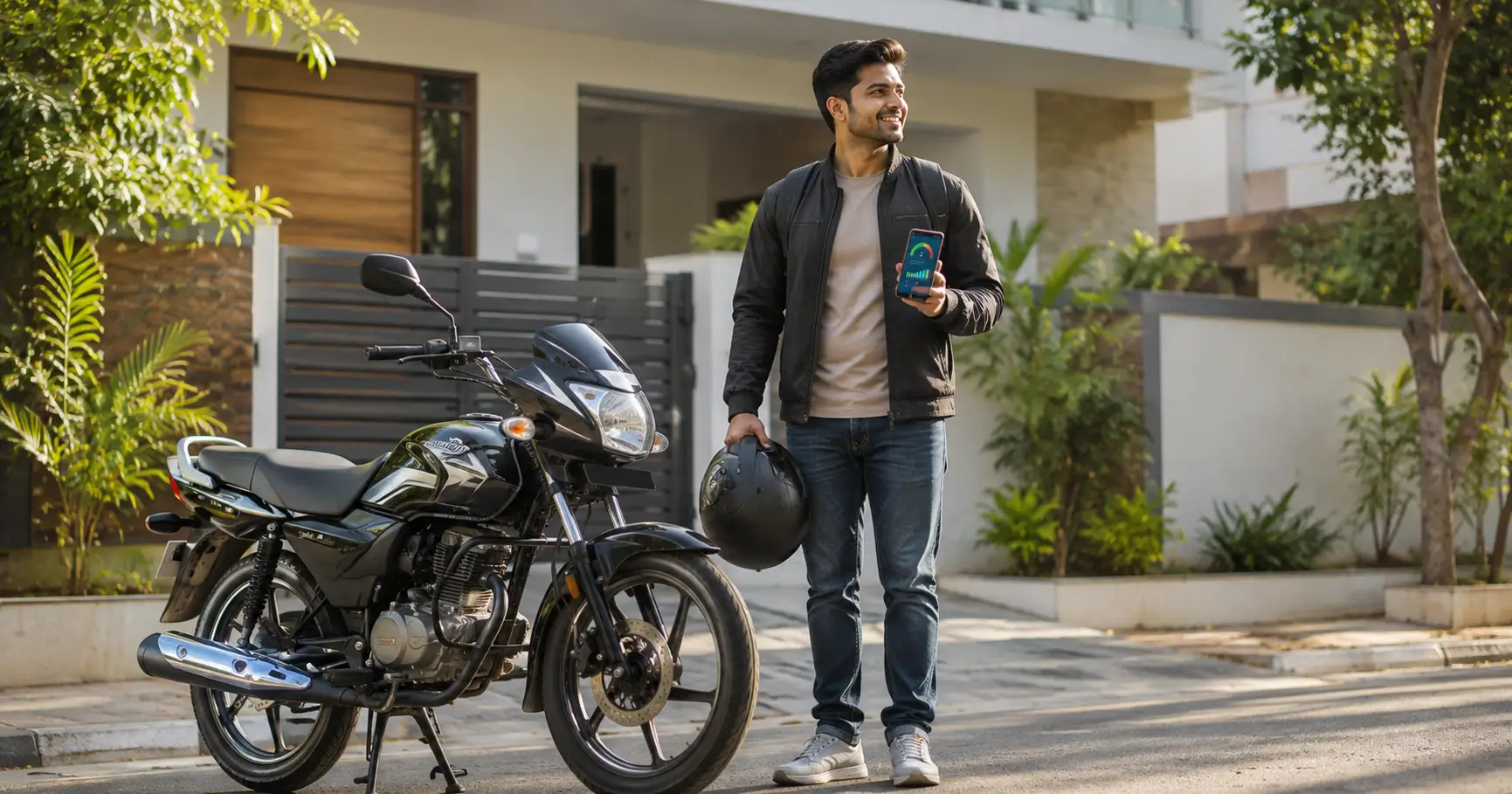
For a daily commuter, a bike that saves fuel every morning can be worth far more than a bike with extra horsepower that rarely gets used.
That is why the search for the best mileage bike remains so important in India. But there is a catch: the motorcycle with the highest claimed mileage is not automatically the best bike for every rider.
A commuter travelling 40 km every day needs something different from someone riding mainly on weekends. And the difference between claimed mileage and real-world fuel economy can change the entire buying decision.
So which bikes deserve attention in 2026? And more importantly, which one makes the most sense for your particular commute?
What makes a bike the “best mileage bike”?
Mileage is the distance a motorcycle can travel using a given amount of fuel, usually expressed as kilometres per litre or kmpl.
However, motorcycle mileage is not a fixed number.
Actual fuel economy can change with:
- Traffic conditions
- Riding speed
- Acceleration habits
- Rider and pillion weight
- Tyre pressure
- Road conditions
- Motorcycle maintenance
- Fuel quality
- Weather and terrain
Manufacturers use controlled testing conditions to establish claimed or certified figures. Real-world mileage can therefore be lower.
For example, Hero’s official HF Deluxe mileage information explains that certified mileage can differ from actual mileage because road conditions and riding habits affect fuel consumption.
That is why the best mileage bike should be judged on efficiency plus everyday usability—not mileage alone.
Best mileage bikes in India 2026
The following motorcycles are among the most relevant choices for buyers who prioritise fuel economy and affordable daily commuting.
| Bike | Engine | Claimed/official mileage* | Best suited for |
|---|---|---|---|
| Hero Splendor+ XTEC 2.0 | 97.2cc | Up to 73 kmpl | Daily urban commuting |
| Hero Splendor+ | 97.2cc | 70 kmpl with E20 fuel | Simple everyday commuting |
| Hero Passion+ | 97.2cc | Up to 71 kmpl | Commuters wanting extra features |
| Hero HF Deluxe | 97.2cc | Around 70–72 kmpl depending on current specification | Budget-focused commuting |
| Bajaj Platina 100 | 99.59cc | Manufacturer-focused fuel efficiency | Comfort-oriented commuting |
| TVS Sport | 109.7cc | Around 70 kmpl class | Value-focused commuters |
| Honda Shine 100 | 98.98cc | Fuel-efficient commuter | Honda buyers seeking simplicity |
*Claimed figures and specifications can vary by variant, testing methodology and model year. Always verify the current variant with the manufacturer before purchasing.
Hero currently lists the Splendor+ at 70 kmpl with E20 fuel and a 97.2cc engine. Its product information also highlights i3S idle stop-start technology designed to improve efficiency during traffic stops.
The newer Splendor+ XTEC 2.0 is particularly interesting for mileage-focused buyers because Hero’s current materials cite up to 73 kmpl and add features such as real-time mileage information.
1. Hero Splendor+ XTEC 2.0: Best overall mileage-focused choice
If the priority is combining strong fuel efficiency with the familiarity of a proven commuter platform, the Hero Splendor+ XTEC 2.0 deserves to be near the top of the shortlist.
Hero’s current product material claims up to 73 kmpl, while the motorcycle uses a 97.2cc fuel-injected engine. It also gets features such as i3S and a real-time mileage indicator.
The biggest advantage is not simply the headline number.
The Splendor formula focuses on low-stress everyday riding, manageable performance and practical ownership.
Who should buy it?
It makes the most sense for someone who:
- Commutes daily
- Wants strong fuel economy
- Prefers a lightweight commuter
- Values established service support
- Does not need high-performance acceleration
Verdict: A strong all-round pick for mileage-first urban riders.
2. Hero Splendor+: The proven commuter
The standard Hero Splendor+ remains one of the most recognisable commuter motorcycles in India.
Hero currently lists 70 kmpl with E20 fuel for the Splendor+, along with a 97.2cc engine, i3S technology and a 4-speed gearbox.
Its appeal is straightforward.
You are not buying it because it is the fastest motorcycle in the segment. You are buying it because everyday commuting demands simplicity, efficiency and predictable running costs.
Who should buy it?
The standard Splendor+ is particularly suitable for:
- Office commuters
- Students
- First-time motorcycle buyers
- Riders covering long daily distances
- Buyers prioritising operating cost
Verdict: One of the safest choices for a no-nonsense daily commuter.
3. Hero Passion+: Mileage with more features
The Hero Passion+ takes the familiar 97.2cc commuter formula and adds a more feature-oriented package.
Hero’s current product page highlights mileage around the 70–71 kmpl class, depending on the listed variant, along with features such as i3S, LED lighting, digital instrumentation and USB charging.
That makes it interesting for buyers who want more than basic transportation.
You get commuter efficiency without stepping too far away from the economical 100cc segment.
Verdict: Consider it if features and styling matter almost as much as fuel economy.
4. Hero HF Deluxe: A budget-friendly mileage specialist
The Hero HF Deluxe is another motorcycle built around the fundamentals of economical commuting.
Hero’s current product information lists the motorcycle with a 97.2cc engine and fuel-efficiency-focused technology, while its mileage pages note that actual mileage can vary with riding conditions.
The bike is particularly attractive to buyers who do not want to spend heavily on a motorcycle but still expect respectable fuel economy.
Its lightweight commuter character also makes it suitable for congested city roads.
Verdict: A sensible choice when purchase price and running cost are both important.
5. Bajaj Platina 100: Mileage plus comfort
The Bajaj Platina 100 approaches the commuter segment from a slightly different direction.
Bajaj lists a 99.59cc engine, 8.2 PS and 8.3 Nm of torque, along with a design focused on comfortable daily transportation.
Its ComforTec-oriented suspension setup is one reason buyers who regularly deal with poor roads may consider it.
The lesson is important: mileage is only one part of ownership.
If an extra few kilometres per litre comes at the expense of comfort on a rough 30 km commute, it may not be the best overall choice for that rider.
Verdict: Strong option for riders who want efficiency with a comfort-focused commuter setup.
6. TVS Sport: A practical alternative
The TVS Sport belongs to the lightweight commuter category where low running costs are a major selling point.
Its appeal is straightforward: economical everyday transportation without requiring buyers to move into a larger, more expensive motorcycle.
For someone who spends most of the day travelling through city traffic, a simple commuter can make more sense than a powerful 125cc motorcycle.
Verdict: Worth comparing if purchase value and fuel economy are your main priorities.
7. Honda Shine 100: Simple Honda commuter
The Honda Shine 100 is another important option for buyers searching for an economical motorcycle.
Honda introduced the updated OBD2B-compliant Shine 100 in March 2025 and positioned it around reliability, fuel efficiency and value.
The motorcycle uses a small-capacity engine and targets the everyday commuter segment rather than performance-focused riders.
Verdict: A sensible alternative for buyers who prefer Honda’s commuter ecosystem.
Claimed mileage vs real-world mileage: the number most buyers miss
This is where many online bike comparisons go wrong.
A manufacturer may advertise a mileage figure obtained under controlled conditions. Your daily commute is anything but controlled.
Imagine two riders using the same motorcycle.
Rider A accelerates gently, maintains correct tyre pressure and spends most of the journey at moderate speeds.
Rider B frequently accelerates hard, carries a passenger and spends the entire commute in stop-and-go traffic.
Their mileage can be noticeably different.
Hero itself notes that factors including harsh acceleration and braking, tyre pressure, servicing and road conditions can affect mileage.
Therefore, treat claimed mileage as a benchmark, not a promise.
How much money can a high-mileage bike actually save?
Consider a simple example.
Suppose you travel 40 km per day for 26 working days. That is:
40 × 26 = 1,040 km per month
Now compare two motorcycles:
- Bike A: 50 kmpl
- Bike B: 70 kmpl
At 50 kmpl, you need approximately 20.8 litres.
At 70 kmpl, you need approximately 14.9 litres.
That is a difference of nearly 5.9 litres every month.
At ₹100 per litre, the theoretical difference is about ₹590 per month, or roughly ₹7,080 per year.
The actual saving depends on fuel prices, riding conditions and real-world mileage.
But this illustrates why a few extra kilometres per litre can become meaningful for a high-mileage commuter.
Is a 100cc bike always better than a 125cc bike for mileage?
Not necessarily.
A smaller engine often has an efficiency advantage when used for moderate urban commuting, but the rider’s needs matter.
A 125cc motorcycle may make more sense if you regularly:
- Carry a pillion
- Travel on highways
- Ride on steep roads
- Need stronger acceleration
- Travel long distances with luggage
The right question is therefore not:
“Which engine gives the highest mileage?”
It is:
“Which motorcycle provides enough performance for my use while keeping fuel consumption reasonable?”
How to get better mileage from your bike
Even the best mileage bike can deliver disappointing fuel economy if it is ridden or maintained poorly.
1. Maintain correct tyre pressure
Under-inflated tyres increase rolling resistance and can reduce efficiency.
Check pressure regularly and follow the manufacturer’s recommended values.
2. Avoid unnecessary hard acceleration
Aggressive throttle inputs can increase fuel consumption.
Smooth acceleration is generally more appropriate for economical commuting.
3. Maintain the motorcycle
Do not ignore scheduled servicing.
Engine oil, air filters, spark plugs, chain condition and other maintenance items can influence running efficiency.
4. Avoid unnecessary idling
If your motorcycle has an idle stop-start feature, use it appropriately.
For example, Hero’s i3S technology is designed to switch the engine off during certain idle conditions, helping reduce unnecessary fuel consumption in traffic.
5. Do not overload the bike
Extra weight requires more energy to move.
If you regularly carry a pillion or luggage, factor that into your expected mileage.
6. Ride at sensible speeds
High speeds increase aerodynamic resistance.
A calm, consistent riding style is generally better for fuel economy than repeated high-speed acceleration and braking.
Common mistakes buyers make when choosing a mileage bike
Mistake 1: Buying only on the advertised mileage
A 73 kmpl claim does not mean every rider will achieve 73 kmpl.
Look at the complete motorcycle.
Mistake 2: Ignoring comfort
A motorcycle that saves fuel but leaves you uncomfortable after a long commute may not be the best ownership choice.
Mistake 3: Ignoring service availability
A slightly cheaper motorcycle may not be worthwhile if authorised service or parts are difficult to access in your area.
Mistake 4: Choosing too small an engine
If your daily route includes highways or steep roads, an ultra-economical 100cc commuter may not satisfy your performance needs.
Mistake 5: Ignoring safety and braking
Mileage should never be the only purchasing criterion.
Evaluate tyres, brakes, lighting, stability and the safety equipment available on the specific variant.
Myths vs facts
| Myth | Fact |
|---|---|
| Higher claimed mileage always means lower ownership cost | Purchase price, servicing, insurance and fuel economy all matter |
| 100cc bikes are always the best choice | A 125cc bike can be better for some riders |
| Manufacturer mileage equals daily mileage | Real-world conditions can produce different results |
| Riding slowly always gives the best mileage | Extremely low or inappropriate gearing can also be inefficient |
| Bigger bikes are always fuel inefficient | Modern engines can be surprisingly efficient depending on use |
| Mileage is the only thing that matters | Comfort, safety, reliability and maintenance also affect ownership |
Which best mileage bike should you choose?
Your answer depends on your riding pattern.
| Your priority | Better type of choice |
|---|---|
| Maximum fuel economy | 100cc commuter |
| Daily office commute | Splendor-class commuter |
| Mileage + features | Passion+/XTEC-type motorcycle |
| Budget ownership | HF Deluxe/Sport-class commuter |
| Rough roads + comfort | Platina-class commuter |
| More highway performance | 125cc commuter |
If your daily travel is mostly urban and your priority is reducing fuel expenditure, a lightweight 100cc commuter remains difficult to beat.
If you regularly travel with a passenger or use highways, spending slightly more on a 125cc motorcycle may be the smarter long-term decision.
Final buying checklist
Before purchasing a mileage-focused motorcycle, check these seven things:
- Claimed mileage
- Expected real-world mileage
- On-road price in your city
- Service and maintenance cost
- Comfort for your daily route
- Braking and safety equipment
- Engine performance for your typical load
Then take a test ride.
A specification sheet can tell you the engine displacement and claimed mileage. Only a real ride can tell you whether the motorcycle suits your body, roads and commute.
The bottom line
The search for the best mileage bike in India 2026 should not end with the motorcycle carrying the biggest kmpl number.
For many daily commuters, motorcycles such as the Hero Splendor+ family, HF Deluxe, Passion+, Bajaj Platina 100 and Honda Shine 100 deserve consideration because they combine fuel efficiency with the practical qualities commuters need.
The Splendor+ XTEC 2.0 is particularly interesting for buyers who put efficiency at the top of their list, with Hero currently citing up to 73 kmpl for the model.
But your best choice depends on your commute.
Choose the bike that delivers the right balance of mileage, comfort, reliability, safety, performance and total ownership cost—not simply the biggest number printed in a brochure.
Before buying, verify the latest variant, price, specifications and mileage directly with the manufacturer or authorised dealer, because motorcycle specifications and pricing can change.
FAQ
Which is the best mileage bike in India in 2026?
The best choice depends on the rider, but the Hero Splendor+ family, including the XTEC 2.0, is among the strongest mileage-focused commuter options. Hero currently cites up to 73 kmpl for the XTEC 2.0.
Which bike gives the highest mileage?
Mileage claims vary by model, variant and testing conditions. Hero currently lists up to 73 kmpl for the Splendor+ XTEC 2.0, making it a notable high-mileage commuter.
Which is the best mileage bike for daily office use?
A lightweight 100cc commuter is usually a strong choice for regular city commuting because it prioritises fuel economy, manageable performance and relatively simple ownership.
Is 70 kmpl possible in real-world riding?
It can be possible under favourable conditions, but claimed or certified mileage should not be treated as a guaranteed real-world figure. Traffic, riding style, load, tyre pressure and maintenance can significantly affect actual mileage.
Is a 100cc bike better than a 125cc bike for mileage?
Not always. A 100cc motorcycle may be more economical for light urban commuting, while a 125cc motorcycle can be a better choice when the rider frequently carries a passenger, uses highways or wants stronger acceleration.
How can I increase my bike mileage?
Maintain correct tyre pressure, follow the manufacturer’s service schedule, avoid aggressive acceleration, reduce unnecessary idling and ride smoothly. These factors can help improve fuel efficiency.
Conclusion
The best mileage bike is not necessarily the motorcycle with the largest mileage number.
For most Indian commuters, the better decision is a motorcycle that combines strong fuel efficiency with comfort, reliability, manageable performance, safety and reasonable ownership costs.
The Hero Splendor+ family remains a major contender, with the current Splendor+ listed at 70 kmpl with E20 fuel and the XTEC 2.0 positioned as an even more efficiency-focused option. Bajaj Platina 100, Hero HF Deluxe, Hero Passion+ and Honda Shine 100 are also worth comparing depending on your priorities.
Before you buy, calculate your monthly kilometres, compare realistic fuel consumption, take a test ride and check the complete on-road ownership cost.
The right motorcycle is the one that saves fuel without compromising the way you actually ride every day.
Disclaimer
Disclaimer: This article is intended for general informational purposes and should not be treated as professional automotive, financial or purchasing advice. Motorcycle prices, mileage claims, specifications, features, variants and availability can change by model year, location and manufacturer updates. Claimed mileage figures are obtained under specified testing conditions and may differ from actual mileage in everyday riding. Always verify the latest specifications, ex-showroom and on-road prices, safety equipment, warranty and availability with the official manufacturer or an authorised dealer before making a purchase.